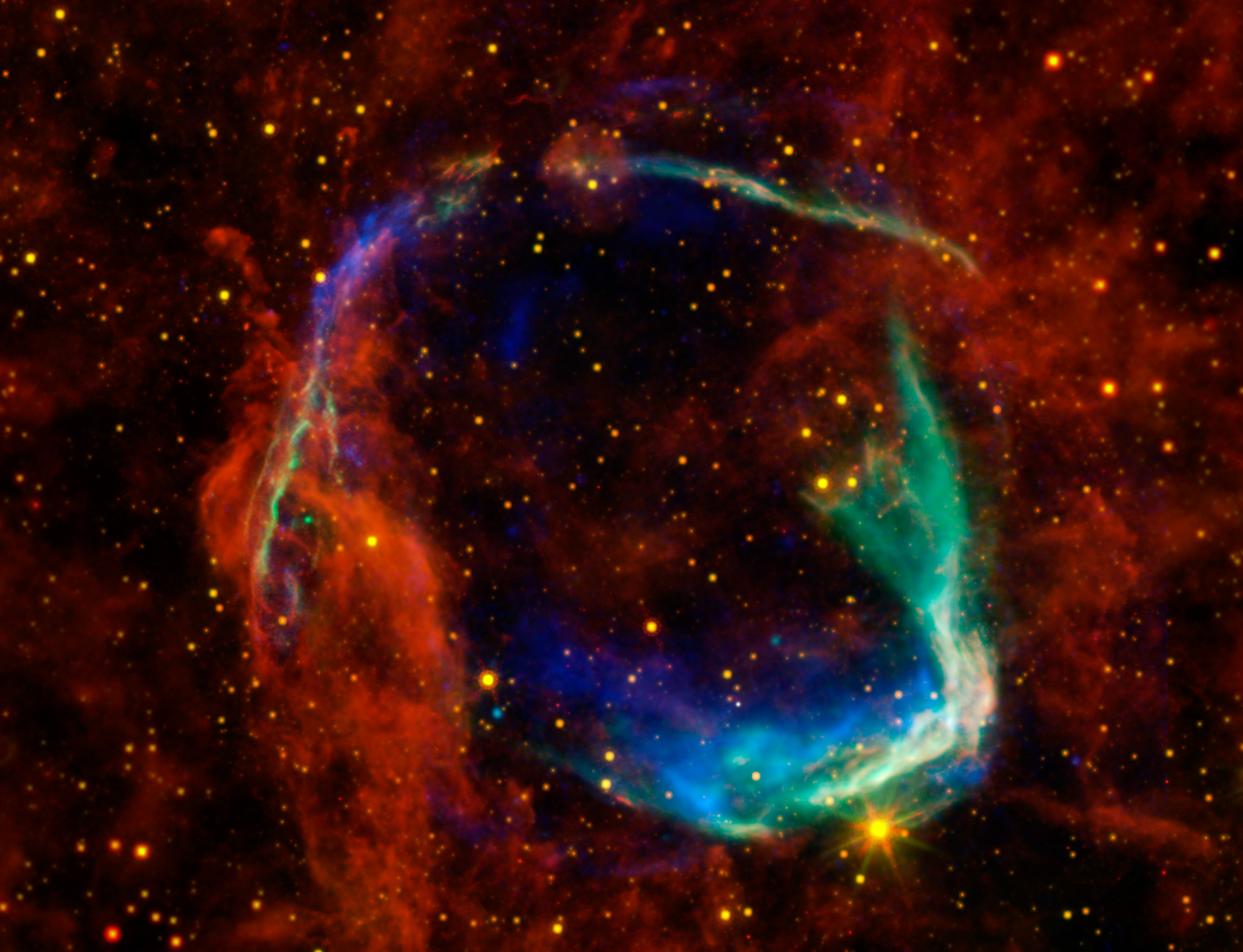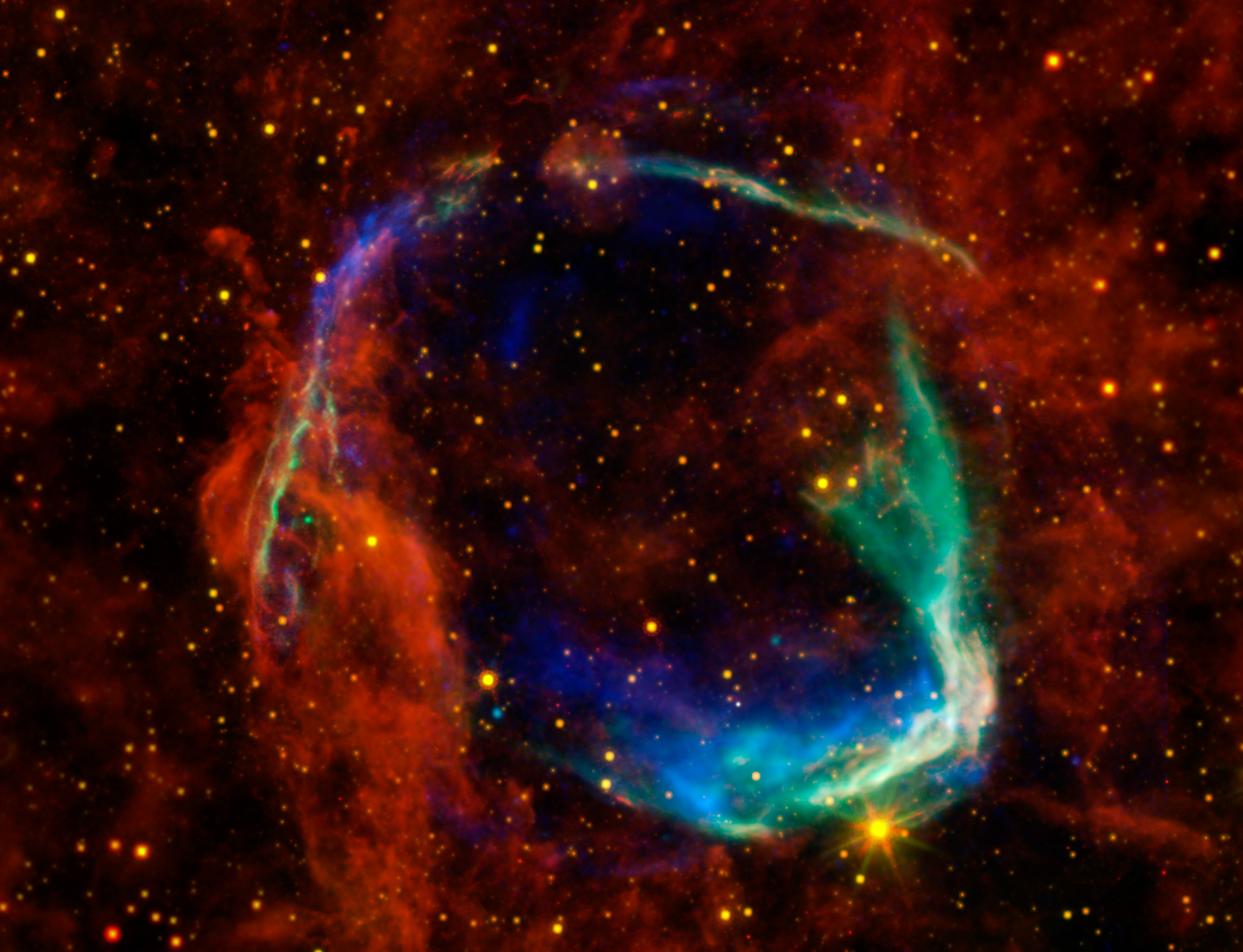
In 185 AD, Chinese astronomers recorded the appearance of a new star in the Nanmen asterism - a part of the sky identified with Alpha and Beta Centauri on modern star charts. The new star was visible for months and is thought to be the earliest recorded supernova. This multiwavelength composite image from orbiting telescopes of the 21st century, XMM-Newton and Chandra in X-rays, and Spitzer and WISE in infrared, shows RCW 86, understood to be the remnant of that stellar explosion. The false-color view traces interstellar gas heated by the expanding supernova shock wave at X-ray energies (blue and green) and interstellar dust radiating at cooler temperatures in infrared light (yellow and red). An abundance of the element iron and lack of a neutron star or pulsar in the remnant suggest that the original supernova was Type Ia. Type Ia supernovae are thermonuclear explosions that destroy a white dwarf star as it accretes material from a companion in a binary star system. Shock velocities measured in the X-ray emitting shell and infrared dust temperatures indicate that the remnant is expanding extremely rapidly into a remarkable low density bubble created before the explosion by the white dwarf system. Near the plane of our Milky Way Galaxy, RCW 86 is about 8,200 light-years away and has an estimated radius of 50 light-years.
En el año 185 d.C., astrónomos chinos registraron la aparición de una nueva estrella en el asterismo Nanmen, una región del cielo identificada con Alfa y Beta Centauri en las cartas estelares modernas. La nueva estrella fue visible durante meses y se considera la supernova registrada más antigua de la historia. Esta imagen compuesta multiespectral, obtenida por telescopios en órbita del siglo XXI —XMM-Newton y Chandra en rayos X, y Spitzer y WISE en infrarrojo— muestra RCW 86, considerado el remanente de esa explosión estelar. La vista en falso color traza el gas interestelar calentado por la onda de choque expansiva de la supernova en energías de rayos X (azul y verde), y el polvo interestelar que irradia a temperaturas más bajas en luz infrarroja (amarillo y rojo). La abundancia del elemento hierro y la ausencia de una estrella de neutrones o púlsar en el remanente sugieren que la supernova original fue de Tipo Ia. Las supernovas de Tipo Ia son explosiones termonucleares que destruyen una estrella enana blanca cuando esta acreta material de una compañera en un sistema estelar binario. Las velocidades de choque medidas en la envoltura emisora de rayos X y las temperaturas del polvo en infrarrojo indican que el remanente se expande a una velocidad extraordinaria en el interior de una notable burbuja de baja densidad, creada antes de la explosión por el sistema de la enana blanca. Ubicado cerca del plano de nuestra galaxia, la Vía Láctea, RCW 86 se encuentra a unos 8.200 años luz de distancia y tiene un radio estimado de 50 años luz.