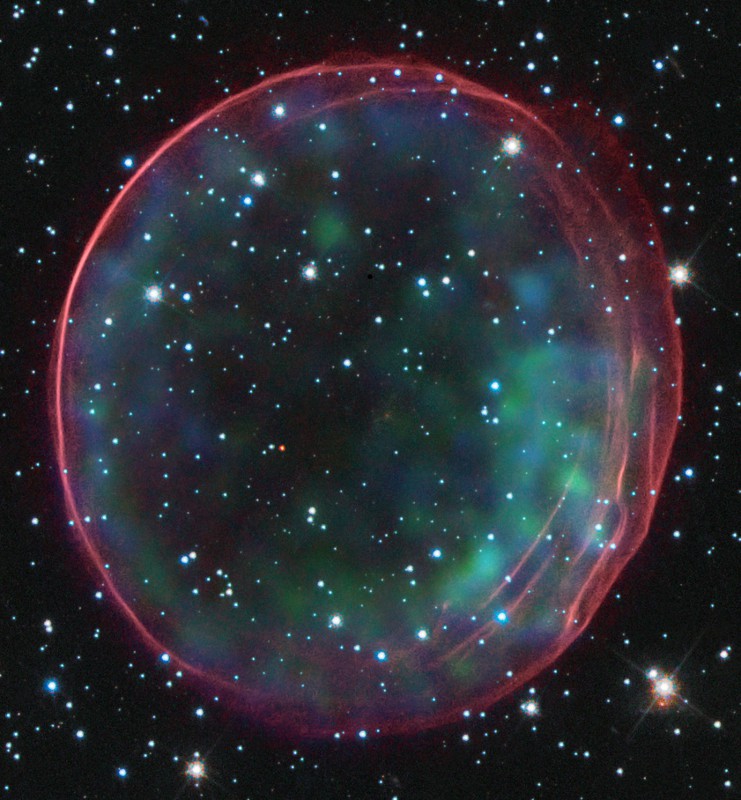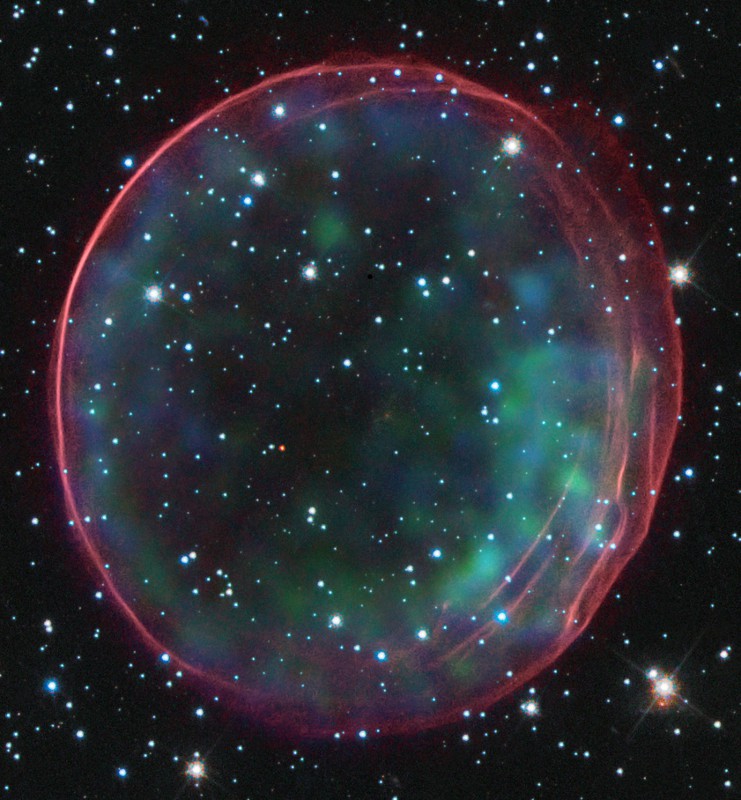
Where's the other star? At the center of this supernova remnant should be the companion star to the star that blew up. Identifying this star is important for understanding just how Type Ia supernova detonate, which in turn could lead to a better understanding of why the brightness of such explosions are so predictable, which in turn is key to calibrating the entire nature of our universe. The trouble is that even a careful inspection of the center of SNR 0509-67.5 has not found any star at all. This indicates that the companion is intrinsically very faint -- much more faint that many types of bright giant stars that had been previous candidates. In fact, the implication is that the companion star might have to be a faint white dwarf, similar to -- but less massive than -- the star that detonated. SNR 0509-67.5 is shown above in both visible light, shining in red as imaged by the Hubble Space Telescope, and X-ray light, shown in false-color green as imaged by the Chandra X-ray Observatory. Putting your cursor over the picture will highlight the central required location for the missing companion star. Discovery + Outreach: Graduate student research position open for APOD
¿Dónde está la otra estrella? En el centro de este remanente de supernova debería encontrarse la estrella compañera de la estrella que explotó. Identificar esta estrella es fundamental para comprender cómo detonan las supernovas de tipo Ia, lo que a su vez podría conducir a un mejor entendimiento de por qué el brillo de tales explosiones es tan predecible, y esto, a su vez, es clave para calibrar la naturaleza de nuestro universo. El problema es que incluso una inspección minuciosa del centro de SNR 0509-67.5 no ha revelado ninguna estrella en absoluto. Esto indica que la compañera es intrínsecamente muy tenue —mucho más tenue que muchos tipos de estrellas gigantes brillantes que habían sido candidatas previas—. De hecho, la implicación es que la estrella compañera podría ser una tenue enana blanca, similar a —pero menos masiva que— la estrella que detonó. SNR 0509-67.5 se muestra en la imagen tanto en luz visible, brillando en rojo según la imagen captada por el Telescopio Espacial Hubble, como en luz de rayos X, representada en falso color verde según las observaciones del Observatorio de Rayos X Chandra. Al colocar el cursor sobre la imagen se resalta la ubicación central requerida para la estrella compañera desaparecida.