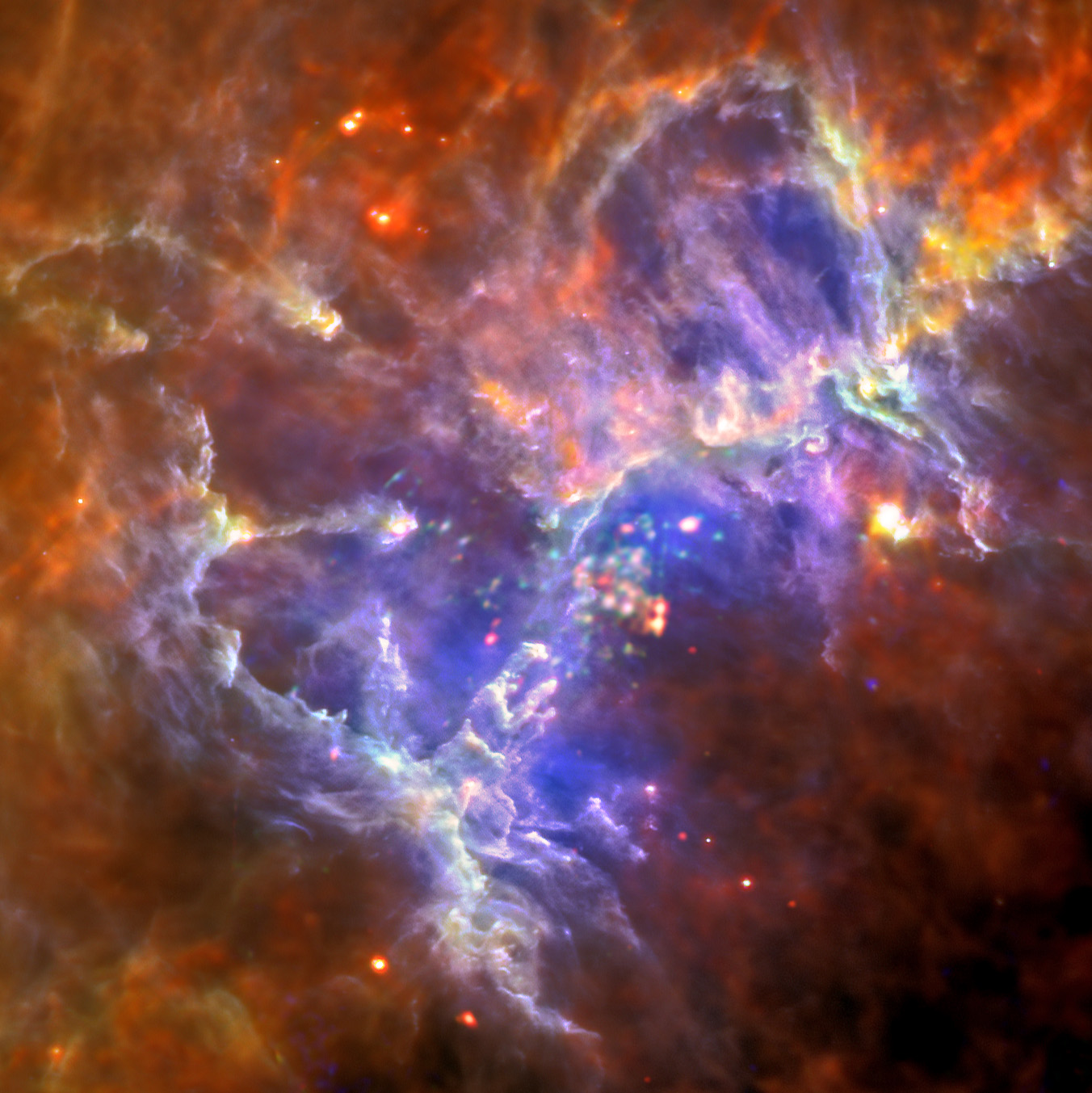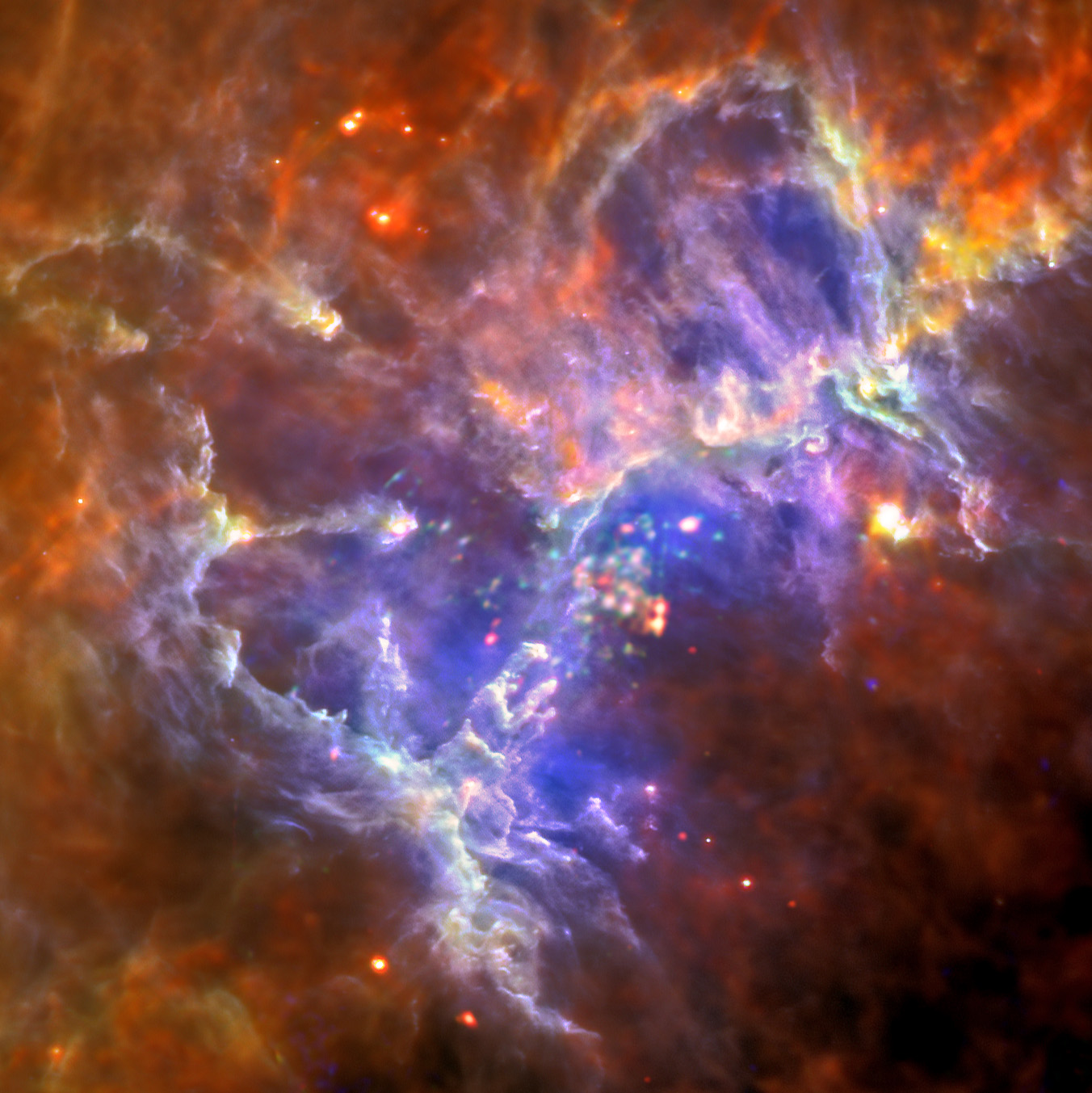
In 1995, a now famous picture from the Hubble Space Telescope featured Pillars of Creation, star forming columns of cold gas and dust light-years long inside M16, the Eagle Nebula. This remarkable false-color composite image revisits the nearby stellar nursery with image data from the orbiting Herschel Space Observatory and XMM-Newton telescopes. Herschel's far infrared detectors record the emission from the region's cold dust directly, including the famous pillars and other structures near the center of the scene. Toward the other extreme of the electromagnetic spectrum, XMM-Newton's X-ray vision reveals the massive, hot stars of the nebula's embedded star cluster. Hidden from Hubble's view at optical wavelengths, the massive stars have a profound effect, sculpting and transforming the natal gas and dust structures with their energetic winds and radiation. In fact, the massive stars are short lived and astronomers have found evidence in the image data pointing to the remnant of a supernova explosion with an apparent age of 6,000 years. If true, the expanding shock waves would have destroyed the visible structures, including the famous pillars. But because the Eagle Nebula is some 6,500 light-years distant, their destruction won't be witnessed for hundreds of years.
En 1995, una célebre imagen del Telescopio Espacial Hubble mostró los Pilares de la Creación, columnas de gas frío y polvo de años luz de longitud situadas en M16, la Nebulosa del Águila. Esta notable imagen compuesta en falso color regresa a la cercana nursería estelar con datos obtenidos por el Observatorio Espacial Herschel y el telescopio XMM-Newton, ambos en órbita. Los detectores de infrarrojo lejano de Herschel registran directamente la emisión procedente del polvo frío de la región, incluidos los famosos pilares y otras estructuras próximas al centro de la escena. En el extremo opuesto del espectro electromagnético, la visión en rayos X de XMM-Newton revela las estrellas masivas y calientes del cúmulo estelar embebido en la nebulosa. Ocultas a la vista del Hubble en longitudes de onda ópticas, estas estrellas masivas ejercen un profundo efecto, esculpiendo y transformando las estructuras primordiales de gas y polvo mediante sus energéticos vientos estelares y su radiación. De hecho, las estrellas masivas tienen una vida corta, y los astrónomos han encontrado en los datos de la imagen indicios del remanente de una explosión de supernova con una antigüedad aparente de 6.000 años. De ser cierto, las ondas de choque en expansión habrían destruido las estructuras visibles, incluidos los famosos pilares. Sin embargo, dado que la Nebulosa del Águila se encuentra a unos 6.500 años luz de distancia, su destrucción no podrá ser presenciada durante cientos de años.