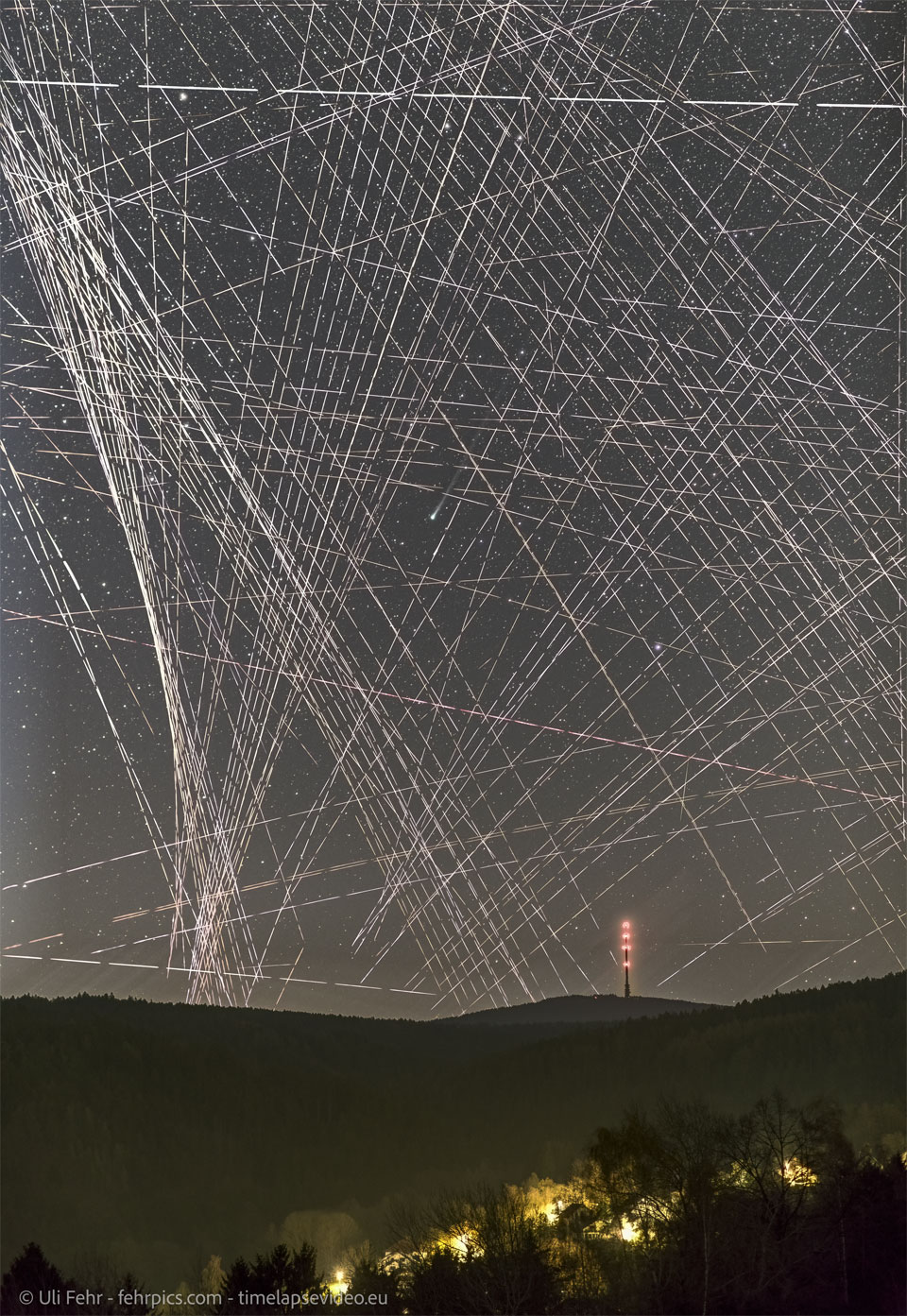
Why don't those stars move? Stars in the sky will typically appear to rise and set as the Earth turns. Those far to the north or south will appear to circle the pole. If you look closely at the above time-lapse movie, however, there are points of light that appear stationary. These objects are not stars but human-launched robotic spacecraft that remain fixed high above the Earth's equator. Called geostationary satellites, they don't fall down because they do orbit the Earth -- they just orbit at exactly the same speed that the Earth rotates. The orbital distance where this is possible is much farther than the International Space Station but much closer than the Moon. The video was taken from one of the highest revolving restaurants in the world located on the Mittelallalin in the Swiss Alps. In the foreground is a mountain known as the Allalinhorn. An even closer inspection will show that the geostationary satellites flash with glints of reflected sunlight. The satellites also all appear on a single line -- actually the projection of the Earth's equator onto the sky.
¿Por qué esos puntos de luz no se mueven? Las estrellas en el cielo típicamente parecen salir y ponerse a medida que la Tierra gira. Aquellas muy al norte o al sur parecen describir círculos alrededor del polo. Si observas con atención la película de tiempo acelerado de arriba, sin embargo, hay puntos de luz que parecen fijos. Estos objetos no son estrellas, sino naves espaciales robóticas lanzadas por el hombre que permanecen fijas muy por encima del ecuador terrestre. Llamadas satélites geoestacionarios, no caen porque sí orbitan la Tierra — simplemente lo hacen a la misma velocidad exacta con la que la Tierra rota. La distancia orbital en la que esto es posible es mucho mayor que la de la Estación Espacial Internacional, pero mucho menor que la de la Luna. El video fue tomado desde uno de los restaurantes giratorios más altos del mundo, ubicado en la Mittelallalin de los Alpes Suizos. En primer plano se encuentra una montaña conocida como el Allalinhorn. Una inspección aún más cercana mostrará que los satélites geoestacionarios reflejan destellos de luz solar. Todos los satélites también aparecen en una sola línea — en realidad, la proyección del ecuador terrestre sobre el cielo.