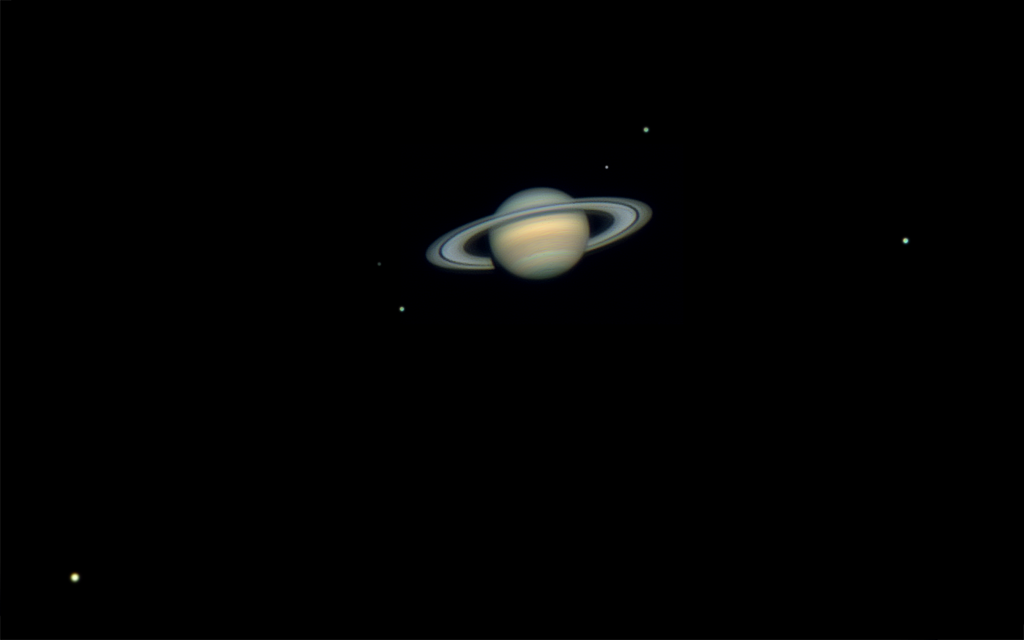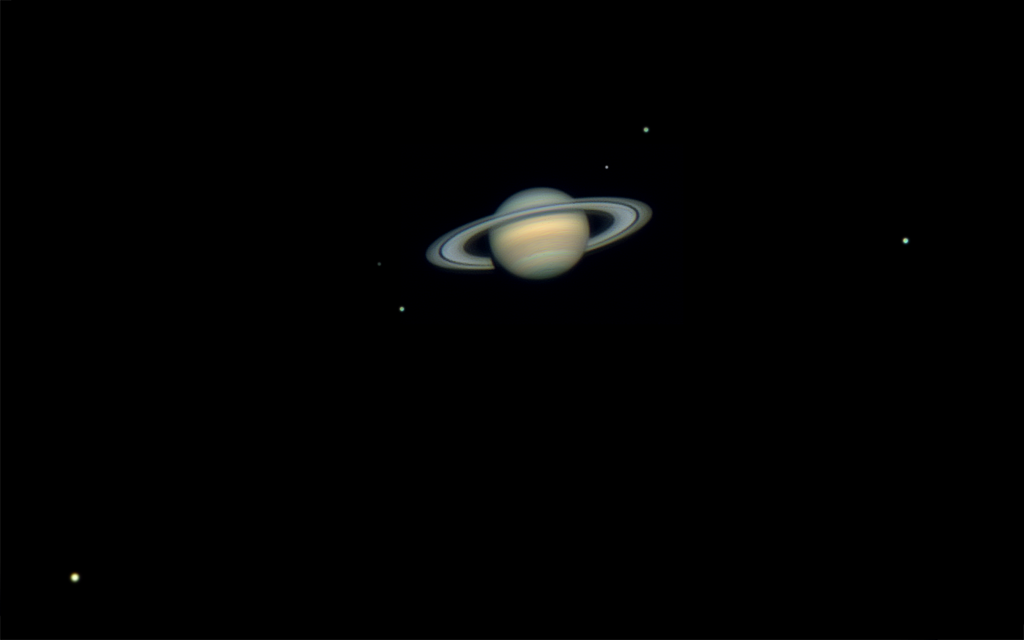
How many moons does Saturn have? So far 62 have been discovered, the smallest only a fraction of a kilometer across. Six of its largest satellites can be seen here, though, in a sharp Saturnian family portrait taken on March 9. Larger than Earth's Moon and even slightly larger than Mercury, Titan has a diameter of 5,150 kilometers and starts the line-up at the lower left. Continuing to the right across the frame are Mimas, Tethys, [Saturn], Enceladus, Dione, and Rhea at far right. Saturn's first known natural satellite, Titan was discovered in 1655 by Dutch astronomer Christiaan Huygens, while most recently the satellite provisionally designated S/2009 S1 was found by the Cassini Imaging Science Team in 2009. Tonight, Saturn reaches opposition in planet Earth's sky, offering the best telescopic views of the ringed planet and moons.
¿Cuántas lunas tiene Saturno? Hasta ahora se han descubierto 62, siendo la más pequeña de solo una fracción de kilómetro de diámetro. En esta nítida imagen familiar de Saturno tomada el 9 de marzo, se pueden ver seis de sus satélites más grandes. Titan, con un diámetro de 5.150 kilómetros y más grande que la Luna de la Tierra e incluso ligeramente más grande que Mercurio, inicia la fila en la esquina inferior izquierda. A continuación, de izquierda a derecha, aparecen Mimas, Tethys, [Saturno], Enceladus, Dione y Rhea en el extremo derecho. Titan, la primera luna natural conocida de Saturno, fue descubierta en 1655 por el astrónomo holandés Christiaan Huygens, mientras que la luna provisionalmente designada como S/2009 S1 fue descubierta recientemente por el Equipo Científico de Imágenes de Cassini en 2009. Esta noche, Saturno alcanza la oposición en el cielo terrestre, ofreciendo las mejores vistas telescópicas del planeta anillado y sus lunas.