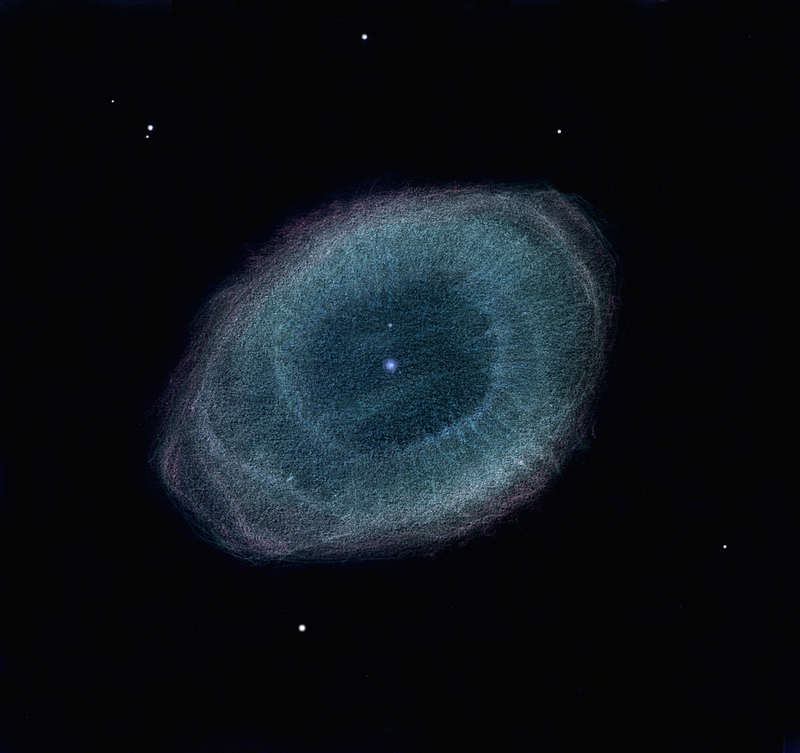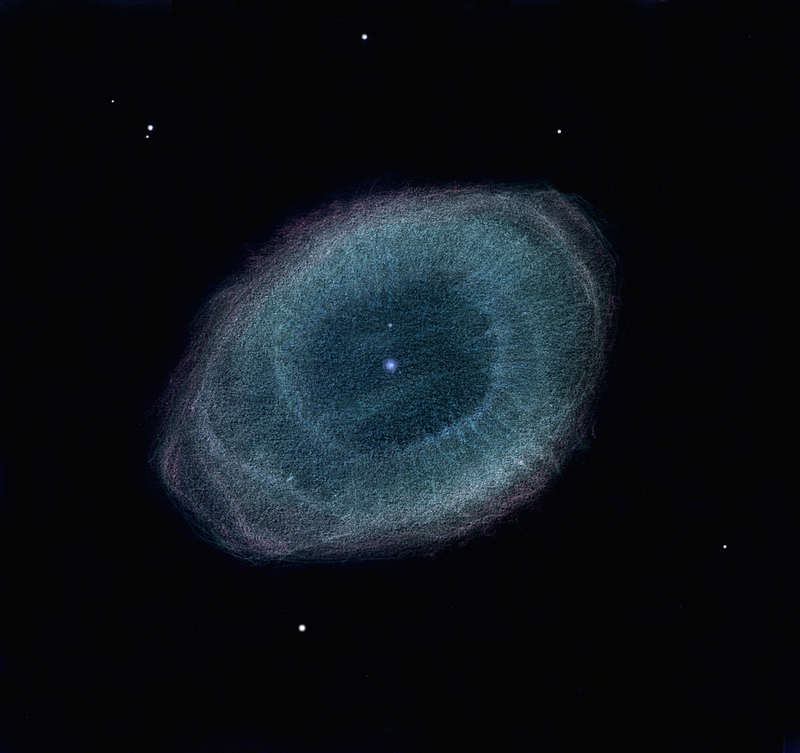
A planetary nebula with a simple symmetry familiar to telescopic sky gazers, the Ring Nebula (M57) is some 2,000 light-years away in the musical constellation Lyra. Hints of changing colors and subtle details are brought out in this remarkable sketch of the cosmic ring. The sketch was made with 800x magnification and excellent seeing conditions directly at the eyepiece of a 40 inch reflecting telescope. Colored pencils on white paper were used to create the original drawing, shown here digitally scanned with an inverted palette applied. About one light-year across, the nebula is composed of outer layers expelled from a dying, once sun-like star. Intense ultraviolet light from the hot central star ionizes atoms in the gas and powers the nebular glow. Ionized hydrogen adds a reddish tint. Ionized oxygen produces a characteristic blue-green color. Difficult to see under average conditions with small telescopes, the Ring Nebula's central star was visible at all times during the artist's study.
Crédito: NASA, CGRO SSC Una nebulosa planetaria con una simetría simple familiar para los observadores del cielo con telescopio, la Nebulosa Anillo (M57) se encuentra a unos 2000 años luz de distancia en la constelación musical de Lyra. Indicios de cambios de color y detalles sutiles se destacan en este notable boceto del anillo cósmico. El boceto fue hecho con una magnificación de 800x y condiciones excelentes de visión directamente en el ocular de un telescopio reflector de 40 pulgadas. Se usaron lápices de colores sobre papel blanco para crear el dibujo original, mostrado aquí digitalmente escaneado con una paleta invertida aplicada. Con un diámetro de aproximadamente un año luz, la nebulosa está compuesta por capas externas expulsadas de una estrella moribunda, una vez similar al Sol. La luz ultravioleta intensa de la estrella caliente central ioniza los átomos en el gas y alimenta el brillo de la nebulosa. El hidrógeno ionizado añade un tono rojizo. El oxígeno ionizado produce un color característico azul-verdoso. Difícil de ver bajo condiciones promedio con telescopios pequeños, la estrella central de la Nebulosa Anillo fue visible en todo momento durante el estudio del artista.