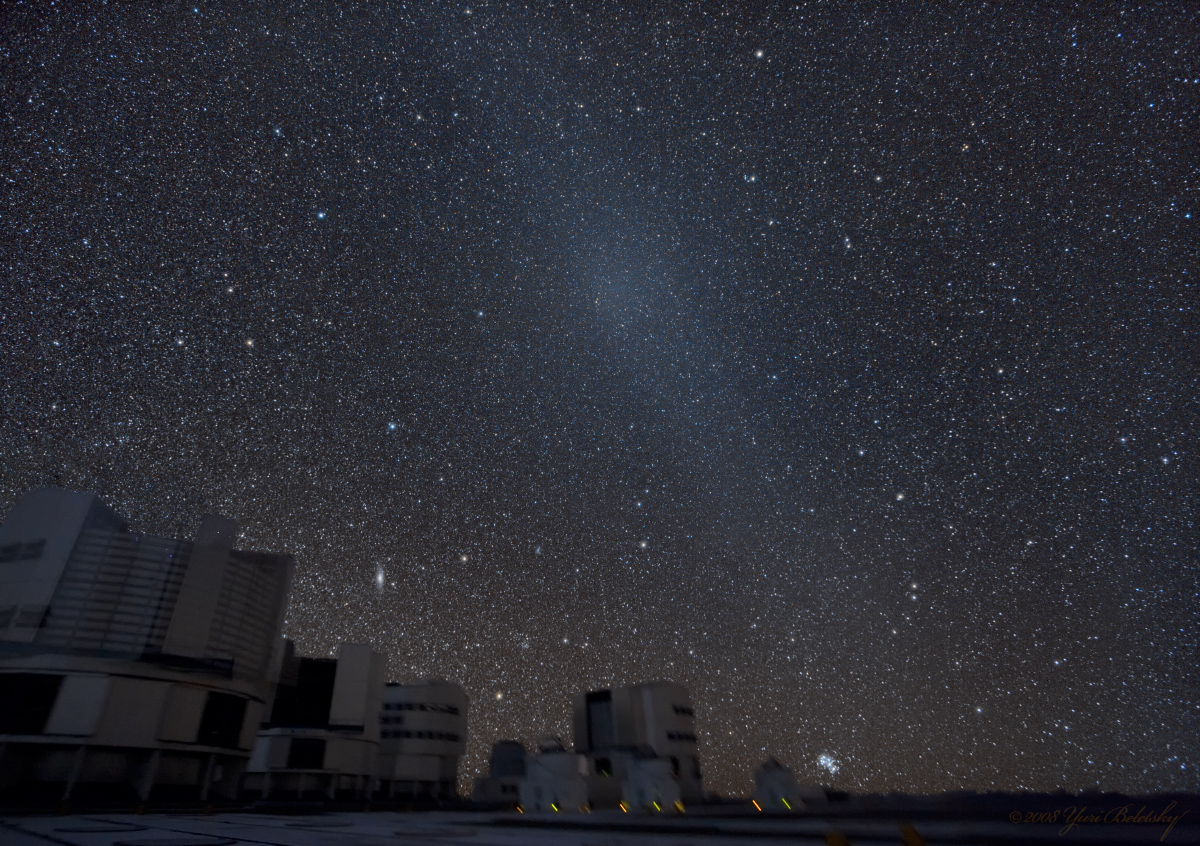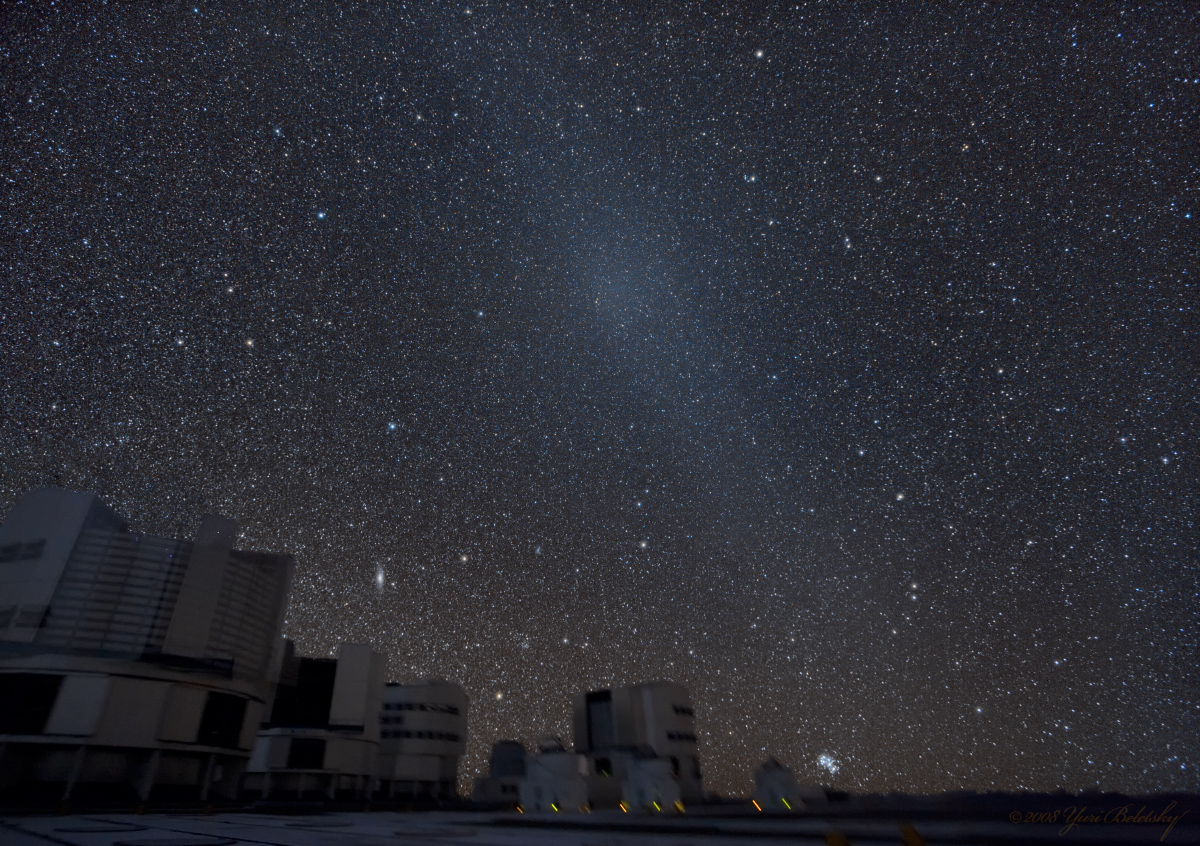
Is the night sky darkest in the direction opposite the Sun? No. In fact, a rarely discernable faint glow known as the gegenschein (German for "counter glow") can be seen 180 degrees around from the Sun in an extremely dark sky. The gegenschein is sunlight back-scattered off small interplanetary dust particles. These dust particles are millimeter sized splinters from asteroids and orbit in the ecliptic plane of the planets. Pictured above from 2008 October is one of the more spectacular pictures of the gegenschein yet taken. Here a deep exposure of an extremely dark sky over Paranal Observatory in Chile shows the gegenschein so clearly that even a surrounding glow is visible. In the foreground are several of the European Southern Observatory's Very Large Telescopes, while notable background objects include the Andromeda galaxy toward the lower left and the Pleiades star cluster just above the horizon. The gegenschein is distinguished from zodiacal light near the Sun by the high angle of reflection. During the day, a phenomenon similar to the gegenschein called the glory can be seen in reflecting air or clouds opposite the Sun from an airplane.
¿Es el cielo nocturno más oscuro en la dirección opuesta al Sol? No. De hecho, un brillo tenue y raramente perceptible conocido como gegenschein (en alemán, 'brillo contraste') puede verse a 180 grados del Sol en un cielo extremadamente oscuro. El gegenschein es la luz solar retrodispersada por pequeños granos de polvo interplanetario. Estas partículas de polvo son fragmentos milimétricos de asteroides y orbitan en el plano de la eclíptica de los planetas. La imagen de arriba, tomada en octubre de 2008, es una de las más espectaculares de gegenschein jamás captadas. Aquí, una exposición profunda de un cielo extremadamente oscuro sobre el Observatorio Paranal en Chile muestra el gegenschein con tanta claridad que incluso se puede ver un brillo circundante. En primer plano aparecen varios de los telescopios del Observatorio Europeo Austral de Gran Telescopio, mientras que objetos notables en el fondo incluyen la galaxia Andrómeda hacia la izquierda inferior y el cúmulo estelar de las Pléyades justo por encima del horizonte. El gegenschein se distingue de la luz zodiacal cerca del Sol por el ángulo elevado de reflexión. Durante el día, un fenómeno similar al gegenschein llamado gloria puede verse en el aire o nubes reflejantes opuestos al Sol desde un avión.