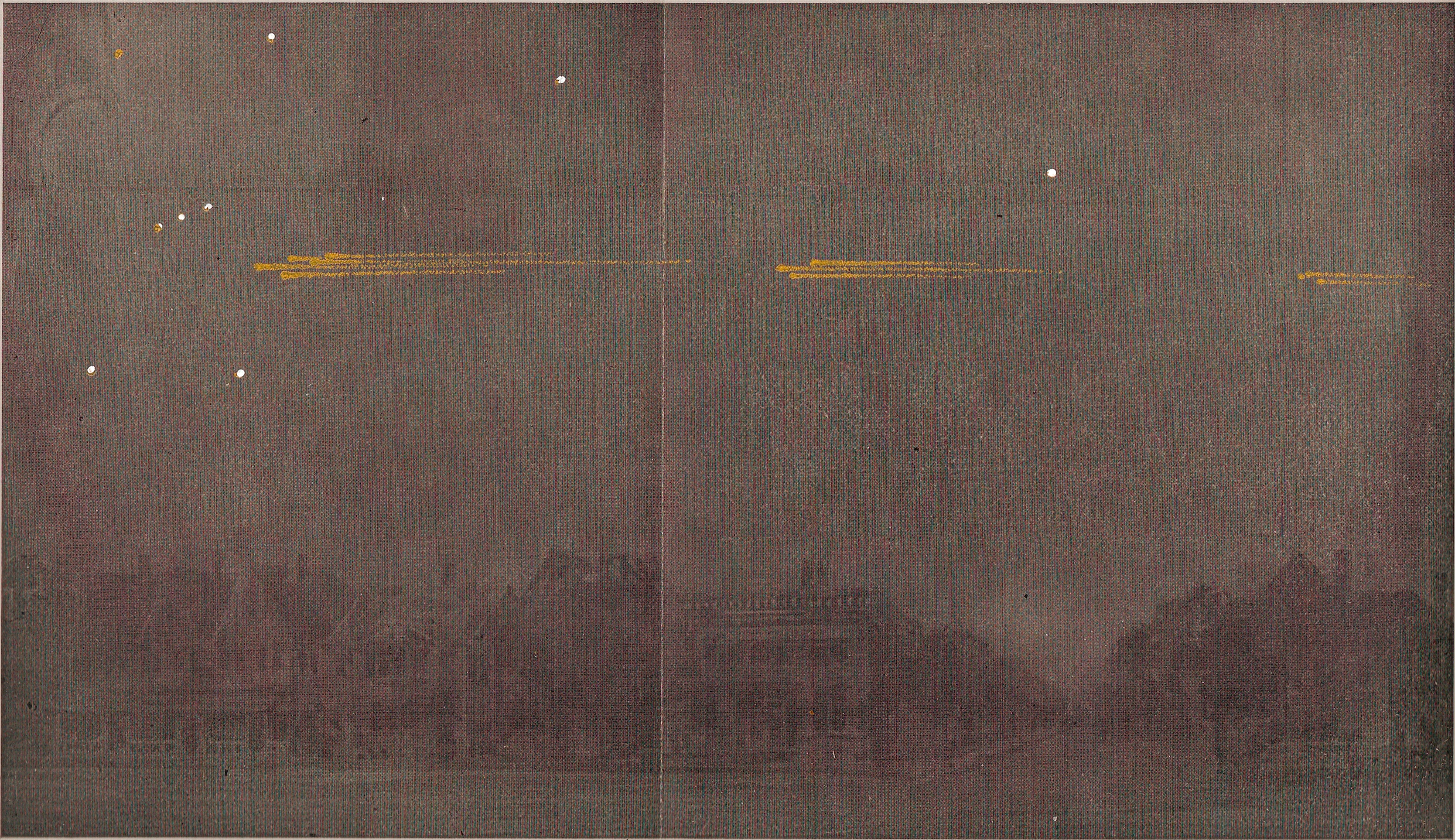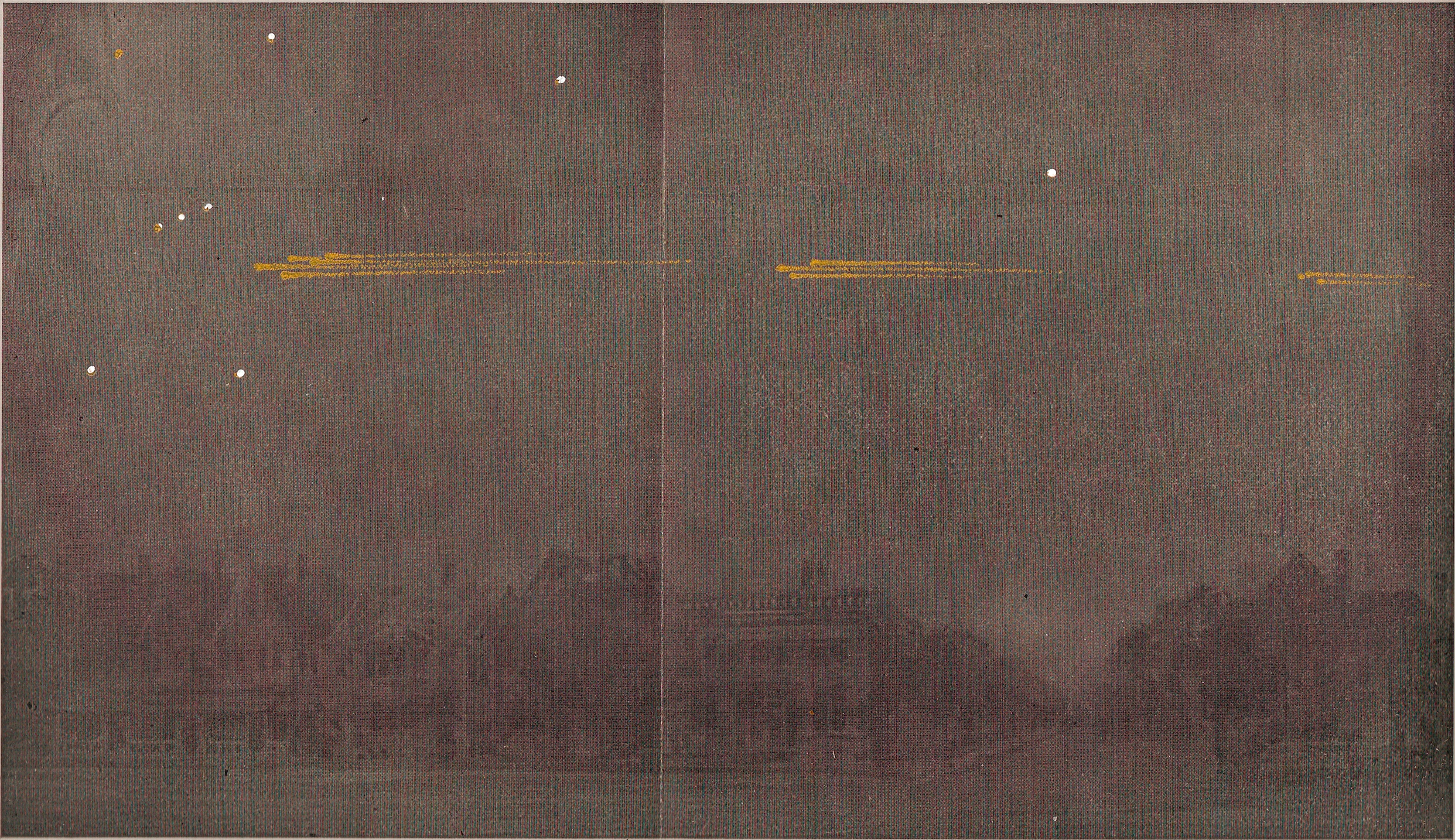
One hundred years ago today the Great Meteor Procession of 1913 occurred, a sky event described by some as "magnificent" and "entrancing" and which left people feeling "spellbound" and "privileged". Because one had to be in a right location, outside, and under clear skies, only about 1,000 people noted seeing the procession. Lucky sky gazers -- particularly those near Toronto, Canada -- had their eyes drawn to an amazing train of bright meteors streaming across the sky, in groups, over the course of a few minutes. A current leading progenitor hypothesis is that a single large meteor once grazed the Earth's atmosphere and broke up. When the resulting pieces next encountered the Earth, they came in over south-central Canada, traveled thousands of kilometers as they crossed over the northeastern USA, and eventually fell into the central Atlantic ocean. Pictured above is a digital scan of a halftone hand-tinted image by the artist Gustav Hahn who was fortunate enough to witness the event first hand. Although nothing quite like the Great Meteor Procession of 1913 has been reported since, numerous bright fireballs -- themselves pretty spectacular -- have since been recorded, some even on video. Did a relative see this?: Please tell us in APOD's discussion forum
Hace cien años, hoy ocurrió la Gran Procesión de Meteoros de 1913, un evento celeste descrito por algunos como 'magnífico' y 'encantador', y que dejó a las personas sintiéndose 'hipnotizadas' y 'privilegiadas'. Debido a que uno tenía que estar en el lugar correcto, al aire libre y bajo cielos despejados, solo aproximadamente 1,000 personas notaron haber visto la procesión. Los afortunados observadores del cielo — especialmente aquellos cerca de Toronto, Canadá — tuvieron sus ojos atraídos por una impresionante fila de meteoros brillantes que se deslizaban por el cielo, en grupos, durante unos minutos. Una hipótesis actual sobre el origen de este fenómeno sugiere que un solo meteorito grande rozó la atmósfera terrestre y se descompuso. Cuando los fragmentos resultantes volvieron a encontrarse con la Tierra, entraron sobre el centro de Canadá, recorrieron miles de kilómetros al cruzar el sureste de Estados Unidos y finalmente cayeron en el océano Atlántico central. La imagen mostrada es una escaneada digital de una imagen en relieve a color realizada por el artista Gustav Hahn, quien tuvo la suerte de presenciar el evento en persona. Aunque nada semejante a la Gran Procesión de Meteoros de 1913 ha sido reportado desde entonces, se han registrado numerosos bólidos brillantes — por sí mismos bastante espectaculares — algunos incluso en video.