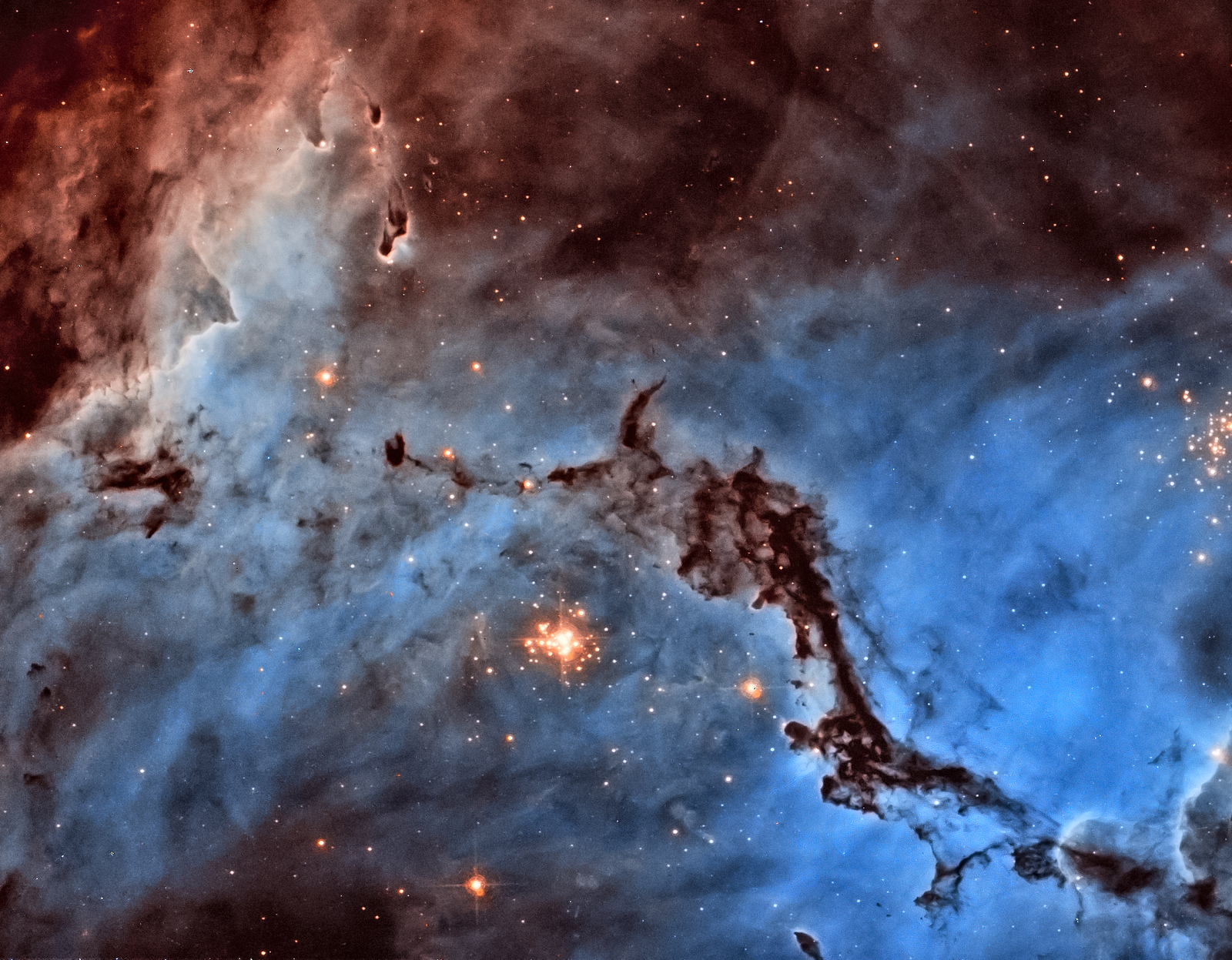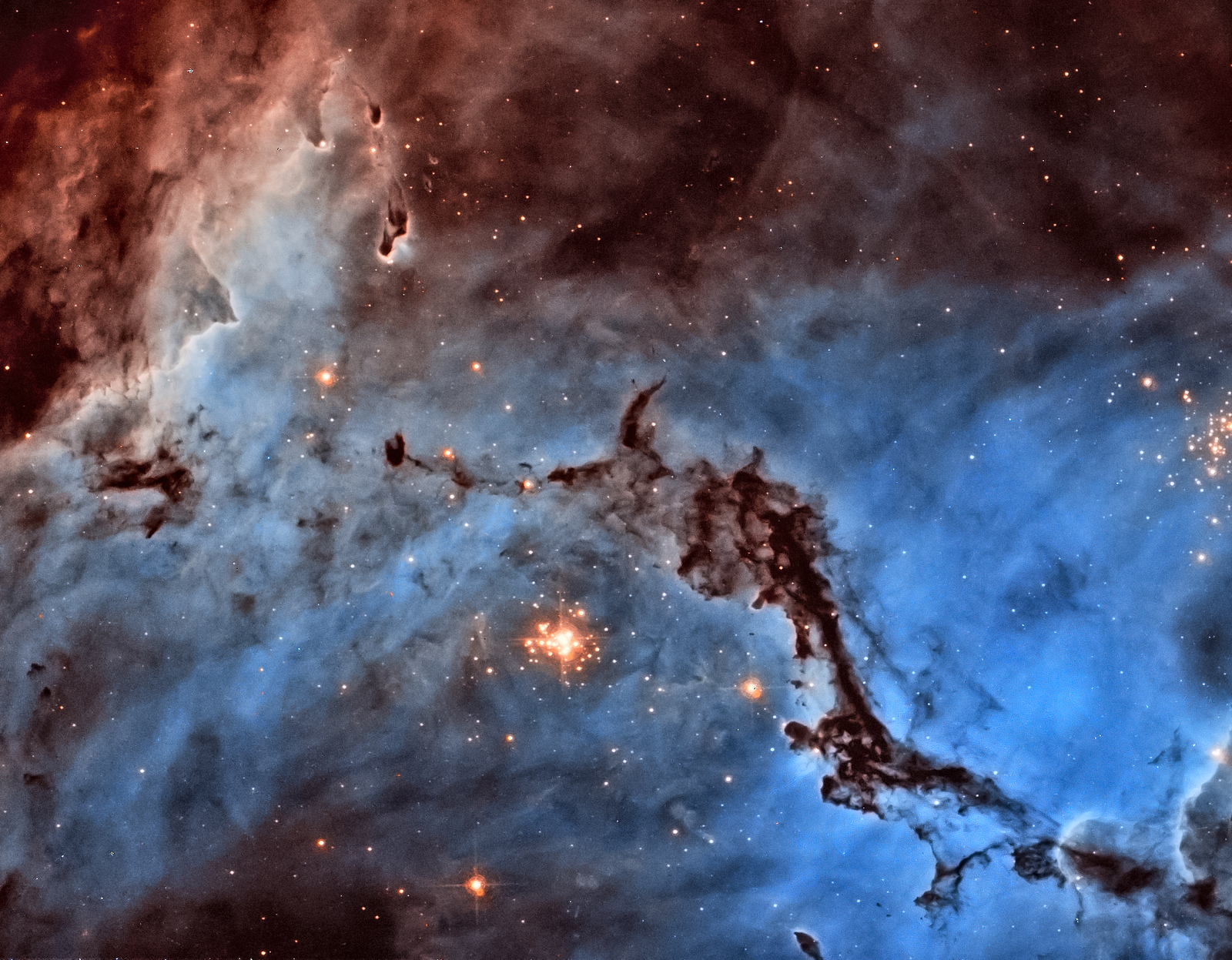
Massive stars, abrasive winds, mountains of dust, and energetic light sculpt one of the largest and most picturesque regions of star formation in the Local Group of Galaxies. Known as N11, the region is visible on the upper right of many images of its home galaxy, the Milky Way neighbor known as the Large Magellanic Clouds (LMC). The above image was taken for scientific purposes by the Hubble Space Telescope and reprocessed for artistry by an amateur to win the Hubble's Hidden Treasures competition. Although the section imaged above is known as NGC 1763, the entire N11 emission nebula is second in LMC size only to 30 Doradus. Studying the stars in N11 has shown that it actually houses three successive generations of star formation. Compact globules of dark dust housing emerging young stars are also visible around the image.
Estrellas masivas, vientos abrasivos, montañas de polvo y luz energética moldean una de las regiones más grandes y más pintorescas de formación estelar en el Grupo Local de Galaxias. Conocida como N11, la región es visible en la parte superior derecha de muchas imágenes de su galaxia natal, la vecina de la Vía Láctea conocida como la Nube Magallánica Grande (LMC). La imagen anterior fue tomada con fines científicos por el Telescopio Espacial Hubble y reprocesada con fines artísticos por un aficionado para ganar el concurso Hubble's Hidden Treasures. Aunque la sección mostrada en la imagen se conoce como NGC 1763, toda la nebulosa de emisión N11 es la segunda más grande en la LMC, solo superada por 30 Doradus. El estudio de las estrellas en N11 ha mostrado que en realidad alberga tres generaciones sucesivas de formación estelar. También se pueden ver compactos globulos de polvo oscuro que albergan estrellas jóvenes emergentes alrededor de la imagen.