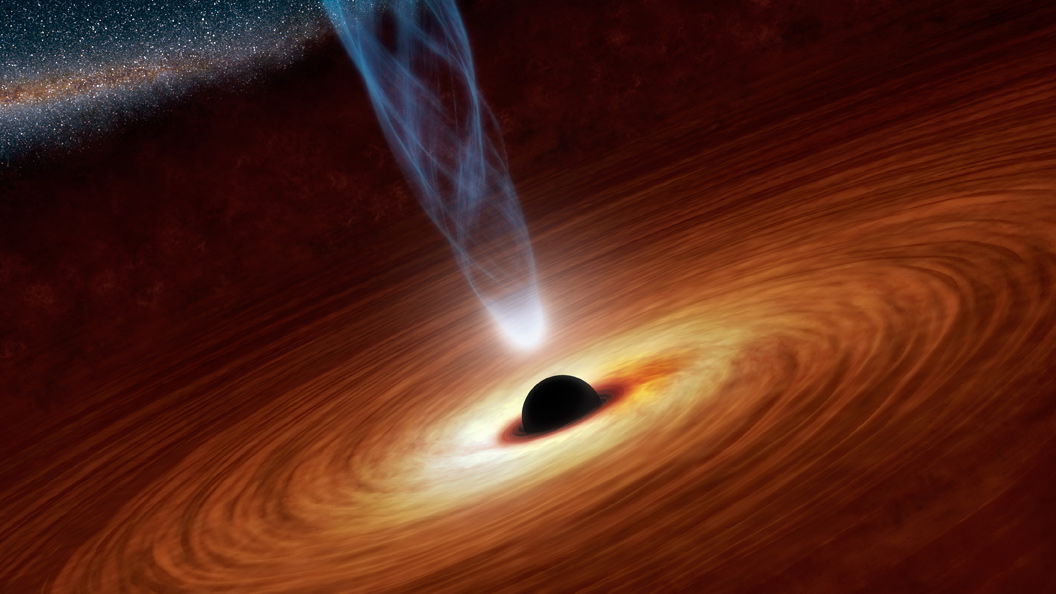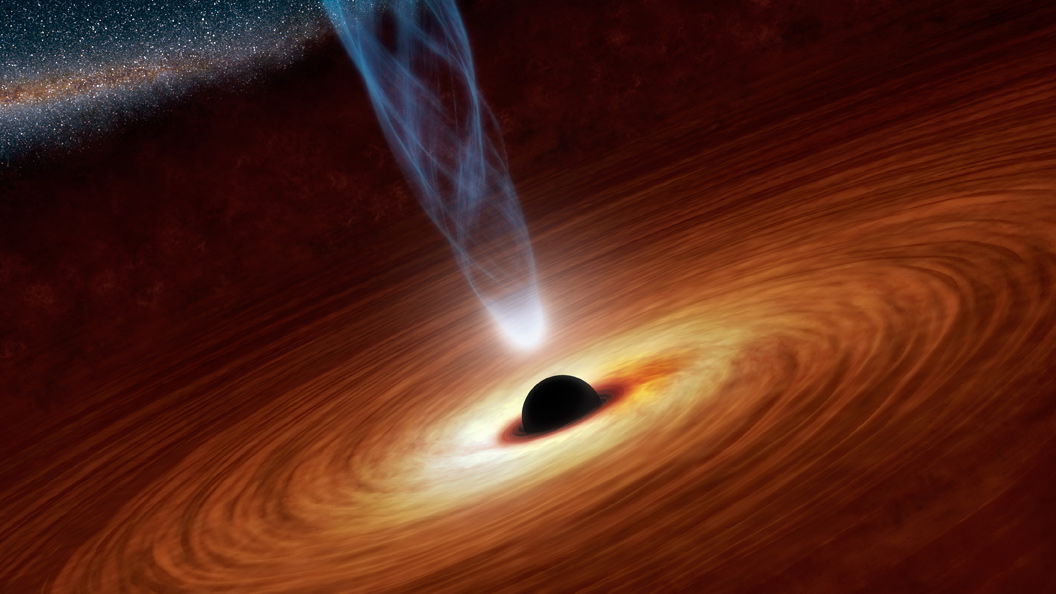
How fast can a black hole spin? If any object made of regular matter spins too fast -- it breaks apart. But a black hole might not be able to break apart -- and its maximum spin rate is really unknown. Theorists usually model rapidly rotating black holes with the Kerr solution to Einstein's General Theory of Relativity, which predicts several amazing and unusual things. Perhaps its most easily testable prediction, though, is that matter entering a maximally rotating black hole should be last seen orbiting at near the speed of light, as seen from far away. This prediction was tested recently by NASA's NuSTAR and ESA's XMM satellites by observing the supermassive black hole at the center of spiral galaxy NGC 1365. The near light-speed limit was confirmed by measuring the heating and spectral line broadening of nuclear emissions at the inner edge of the surrounding accretion disk. Pictured above is an artist's illustration depicting an accretion disk of normal matter swirling around a black hole, with a jet emanating from the top. Since matter randomly falling into the black hole should not spin up a black hole this much, the NuSTAR and XMM measurements also validate the existence of the surrounding accretion disk.
¿A qué velocidad puede girar un agujero negro? Si cualquier objeto compuesto de materia normal gira demasiado rápido, se descompone. Pero un agujero negro podría no poder descomponerse, y su velocidad máxima de rotación es realmente desconocida. Los teóricos suelen modelar agujeros negros que giran rápidamente con la solución de Kerr a la Teoría General de la Relatividad de Einstein, que predice varias cosas asombrosas y poco comunes. Quizás su predicción más fácil de probar es que la materia que entra en un agujero negro que gira al máximo debería verse por última vez orbitando a casi la velocidad de la luz, desde una distancia lejana. Esta predicción fue probada recientemente por los satélites de la NASA NuSTAR y de la ESA XMM al observar el agujero negro supermasivo en el centro de la galaxia espiral NGC 1365. El límite de velocidad cercana a la de la luz fue confirmado midiendo el calentamiento y el ensanchamiento de la línea espectral de las emisiones nucleares en el borde interno del disco de acreción circundante. La imagen mostrada es una ilustración artística que representa un disco de acreción de materia normal que gira alrededor de un agujero negro, con una eyección emanando desde la parte superior. Dado que la materia que cae aleatoriamente en el agujero negro no debería acelerarlo tanto, las mediciones de NuSTAR y XMM también validan la existencia del disco de acreción circundante.