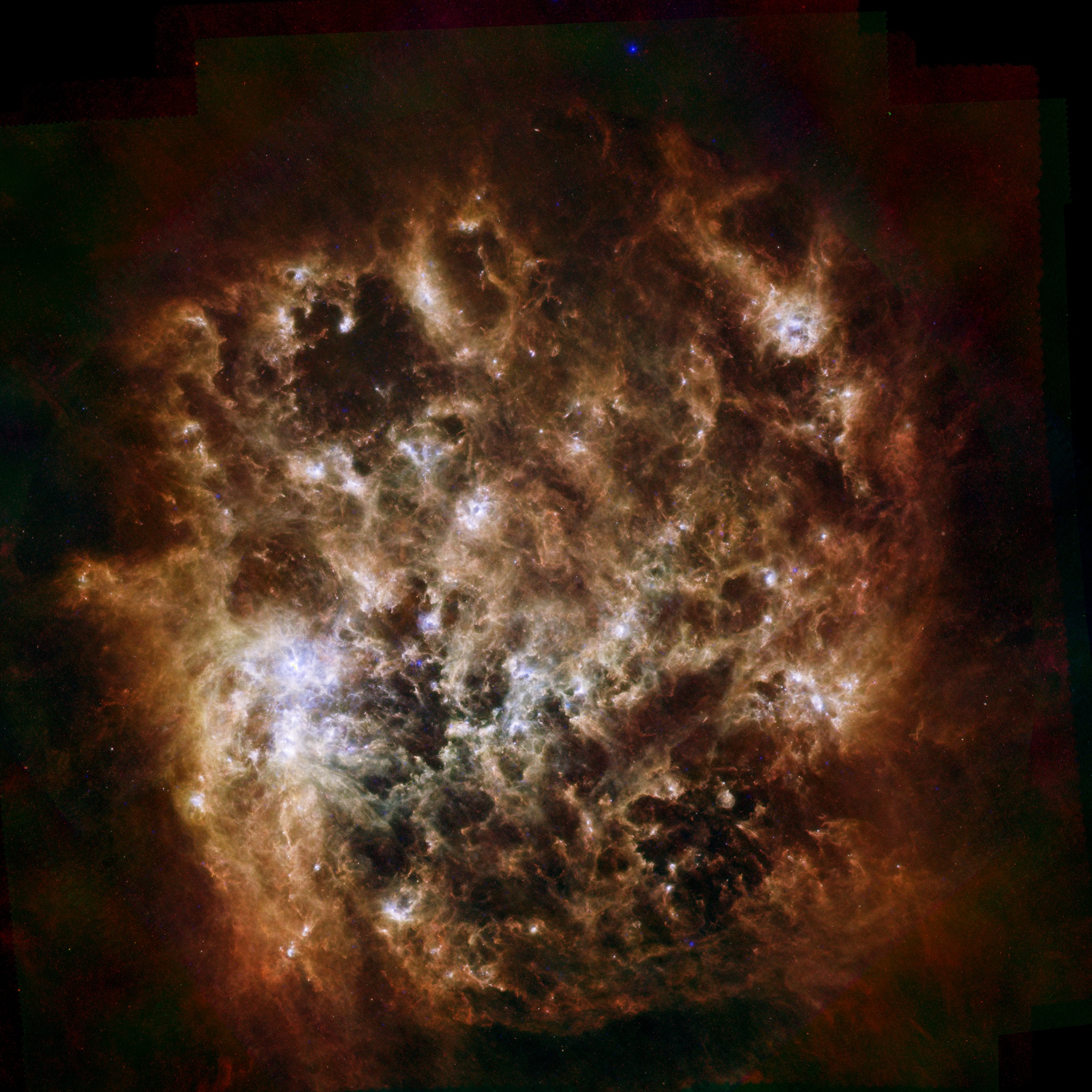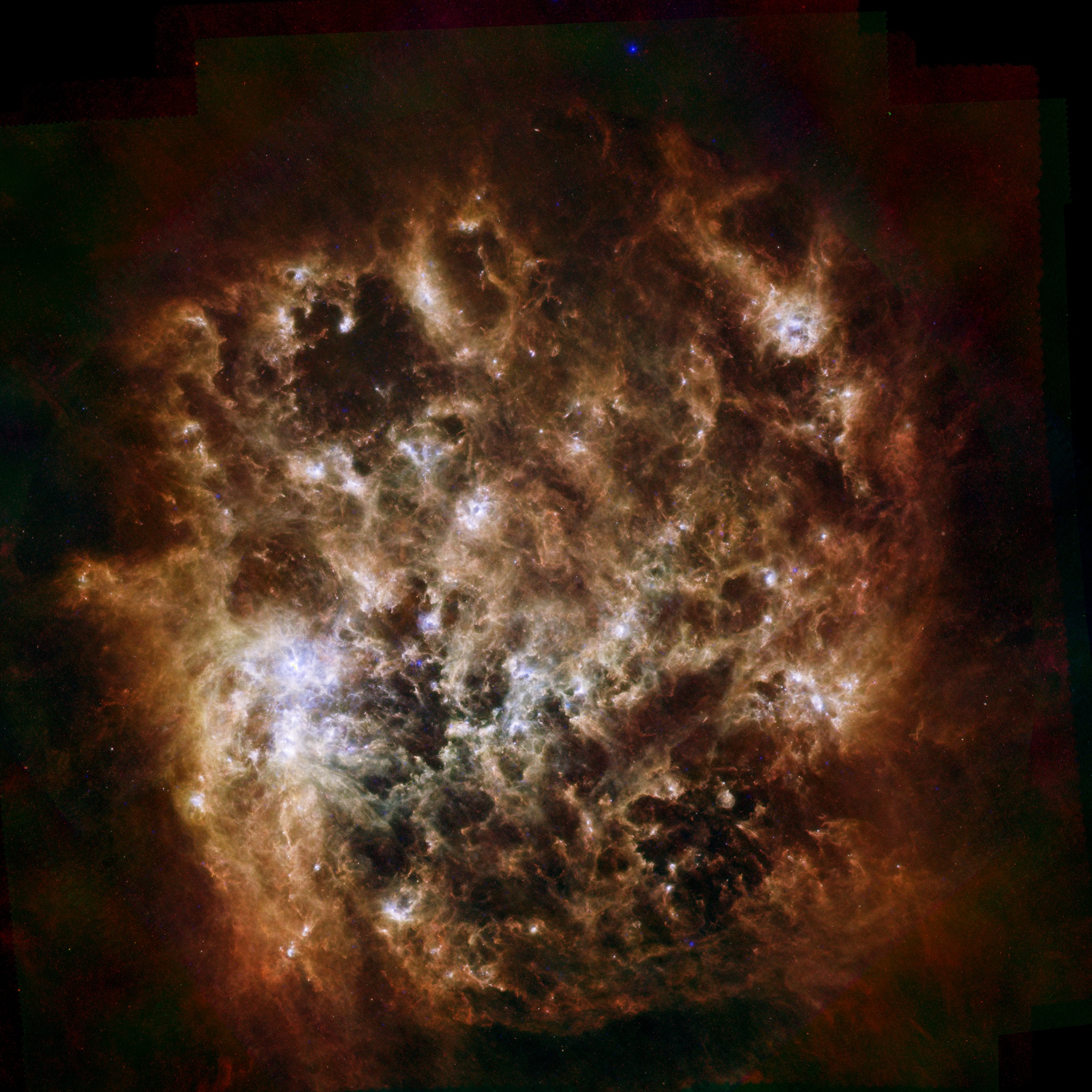
Cosmic dust clouds ripple across this infrared portrait of our Milky Way's satellite galaxy, the Large Magellanic Cloud. In fact, the remarkable composite image from the Herschel Space Observatory and the Spitzer Space Telescope show that dust clouds fill this neighboring dwarf galaxy, much like dust along the plane of the Milky Way itself. The dust temperatures tend to trace star forming activity. Spitzer data in blue hues indicate warm dust heated by young stars. Herschel's instruments contributed the image data shown in red and green, revealing dust emission from cooler and intermediate regions where star formation is just beginning or has stopped. Dominated by dust emission, the Large Magellanic Cloud's infrared appearance is different from views in optical images. But this galaxy's well-known Tarantula Nebula still stands out, easily seen here as the brightest region to the left of center. A mere 160,000 light-years distant, the Large Cloud of Magellan is about 30,000 light-years across.
Nubes de polvo cósmico se extienden a través de este retrato infrarrojo de nuestra galaxia vecina, la Nube Grande de Magallanes. De hecho, la impresionante imagen compuesta del Observatorio Espacial Herschel y del Telescopio Espacial Spitzer muestra que las nubes de polvo llenan esta galaxia enana vecina, de manera similar al polvo a lo largo del plano de la Vía Láctea. Las temperaturas del polvo tienden a seguir la actividad de formación estelar. Los datos del Spitzer en tonos azules indican polvo cálido calentado por estrellas jóvenes. Los instrumentos de Herschel aportaron los datos de imagen mostrados en rojo y verde, revelando emisión de polvo en regiones más frías y de temperatura intermedia donde la formación estelar apenas comienza o ha terminado. Dominada por la emisión de polvo, la apariencia infrarroja de la Nube Grande de Magallanes es diferente de las vistas en imágenes ópticas. Pero la famosa Nebulosa Tarántula de esta galaxia aún destaca, fácilmente visible aquí como la región más brillante a la izquierda del centro. A tan solo 160 000 años luz de distancia, la Nube Grande de Magallanes tiene un diámetro de aproximadamente 30 000 años luz.