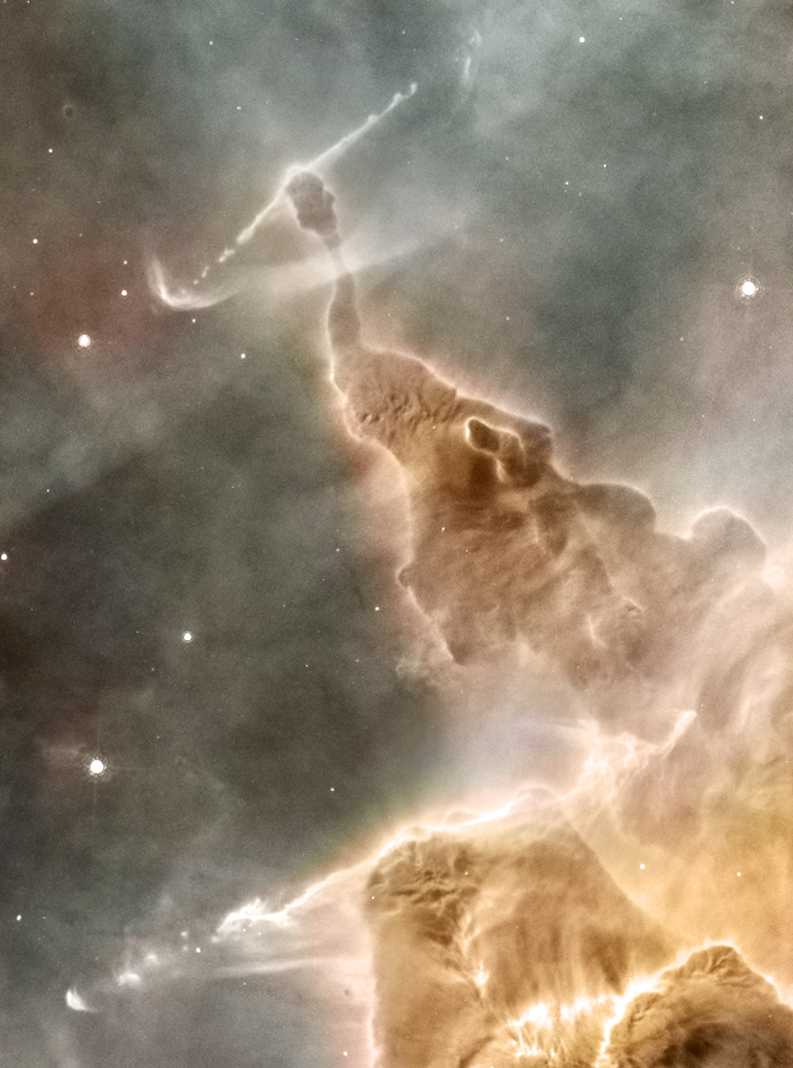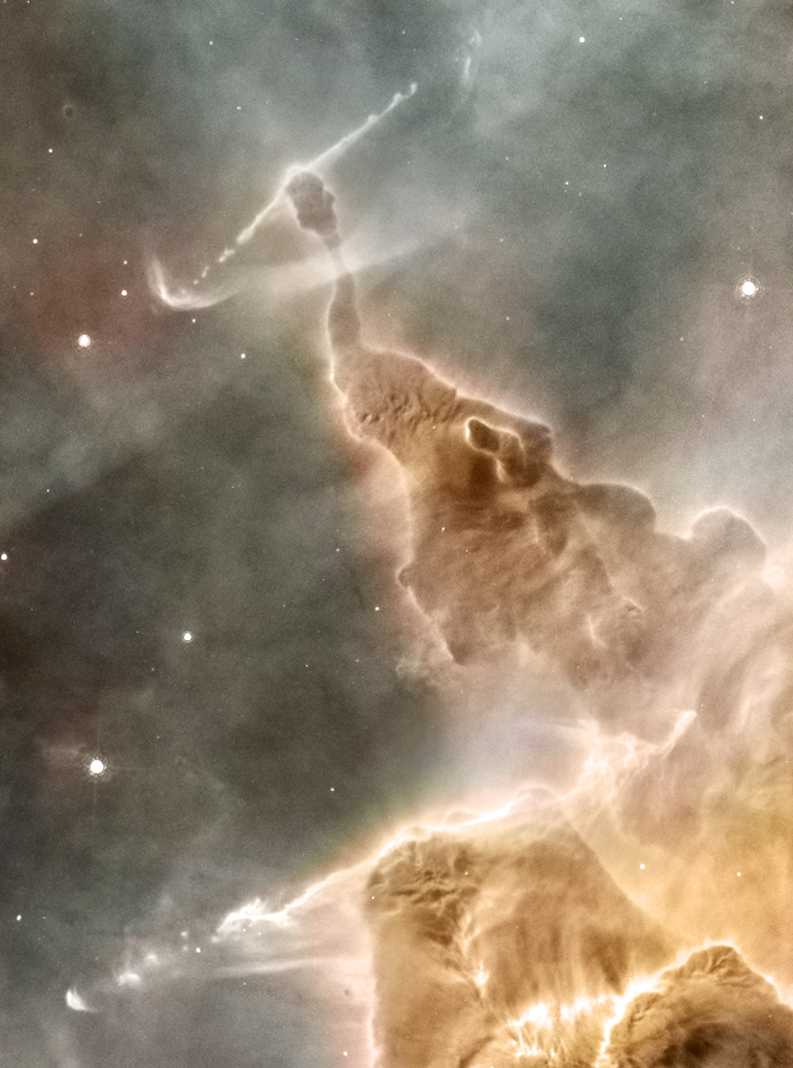
Inside the head of this interstellar monster is a star that is slowly destroying it. The monster, actually an inanimate pillar of gas and dust, measures over a light year in length. The star, not itself visible through the opaque dust, is bursting out partly by ejecting energetic beams of particles. Similar epic battles are being waged all over the star-forming Carina Nebula (NGC 3372). The stars will win in the end, destroying their pillars of creation over the next 100,000 years, and resulting in a new open cluster of stars. The pink dots are newly formed stars that have already been freed from their birth monster. The above image is only a small part of a highly detailed panoramic mosaic of the Carina Nebula taken by the Hubble Space Telescope in 2007. The technical name for the stellar jets are Herbig-Haro objects. How a star creates Herbig-Haro jets is an ongoing topic of research, but it likely involves an accretion disk swirling around a central star. A second impressive Herbig-Haro jet is visible across the bottom of a larger image.
Dentro de la cabeza de este monstruo interestelar hay una estrella que lo está destruyendo lentamente. El monstruo, en realidad un pilar inanimado de gas y polvo, mide más de un año luz de longitud. La estrella, que no es visible a través del polvo opaco, está expulsando parte de su energía mediante chorros energéticos de partículas. Batallas épicas similares se están librando en toda la nebulosa estelar de la Carina (NGC 3372). Las estrellas ganarán al final, destruyendo sus pilares de creación durante los próximos 100.000 años, lo que resultará en un nuevo cúmulo estelar abierto. Los puntos rosados son estrellas recién formadas que ya han sido liberadas de su monstruo natal. La imagen anterior es solo una pequeña parte de un mosaico panorámico altamente detallado de la Nebulosa de la Carina tomado por el Telescopio Espacial Hubble en 2007. El nombre técnico de los chorros estelares es objetos Herbig-Haro. Cómo una estrella crea los chorros Herbig-Haro es un tema de investigación en curso, pero probablemente involucra un disco de acreción que gira alrededor de una estrella central. Un segundo impresionante chorro Herbig-Haro es visible a través de la parte inferior de una imagen más amplia.