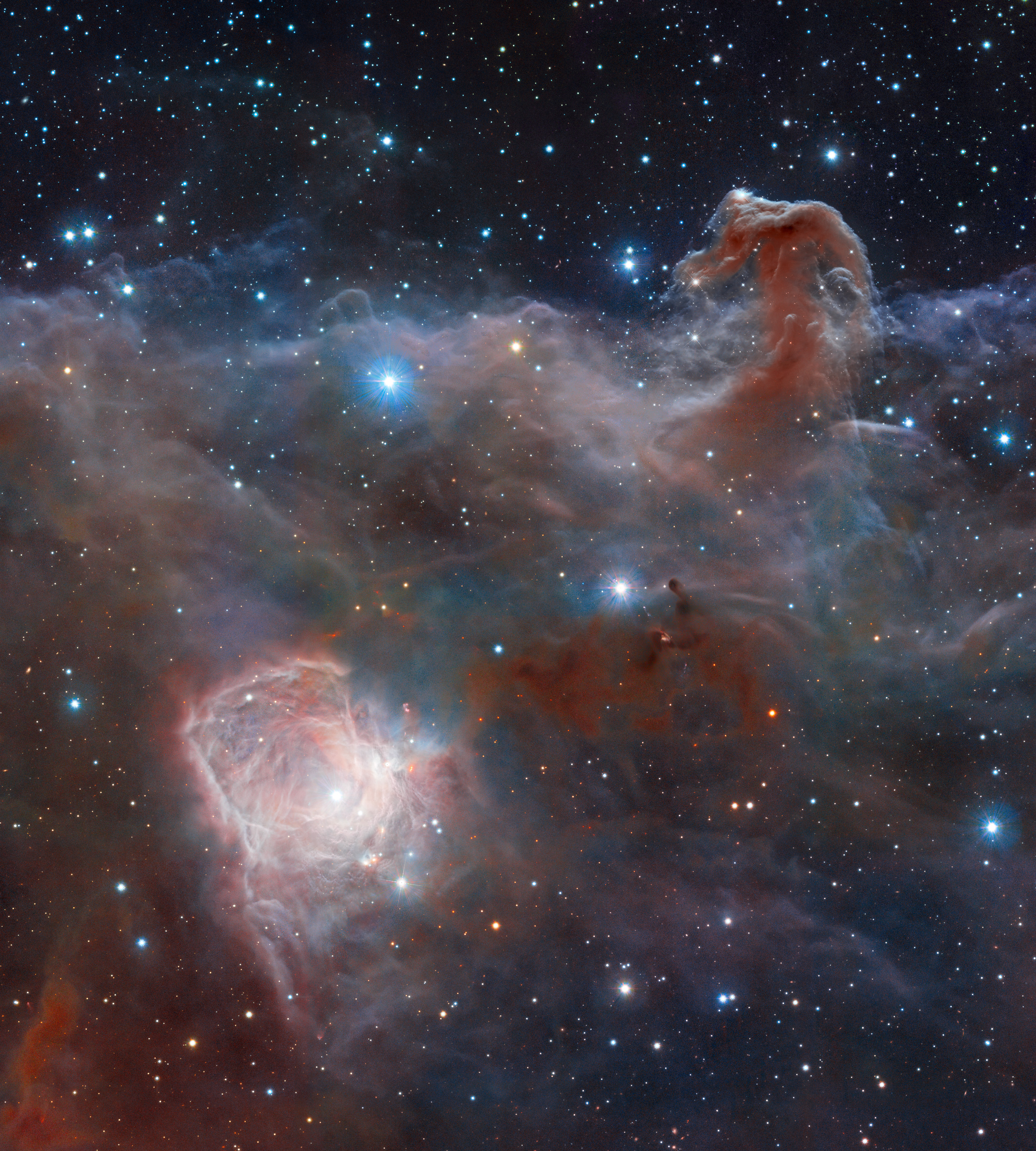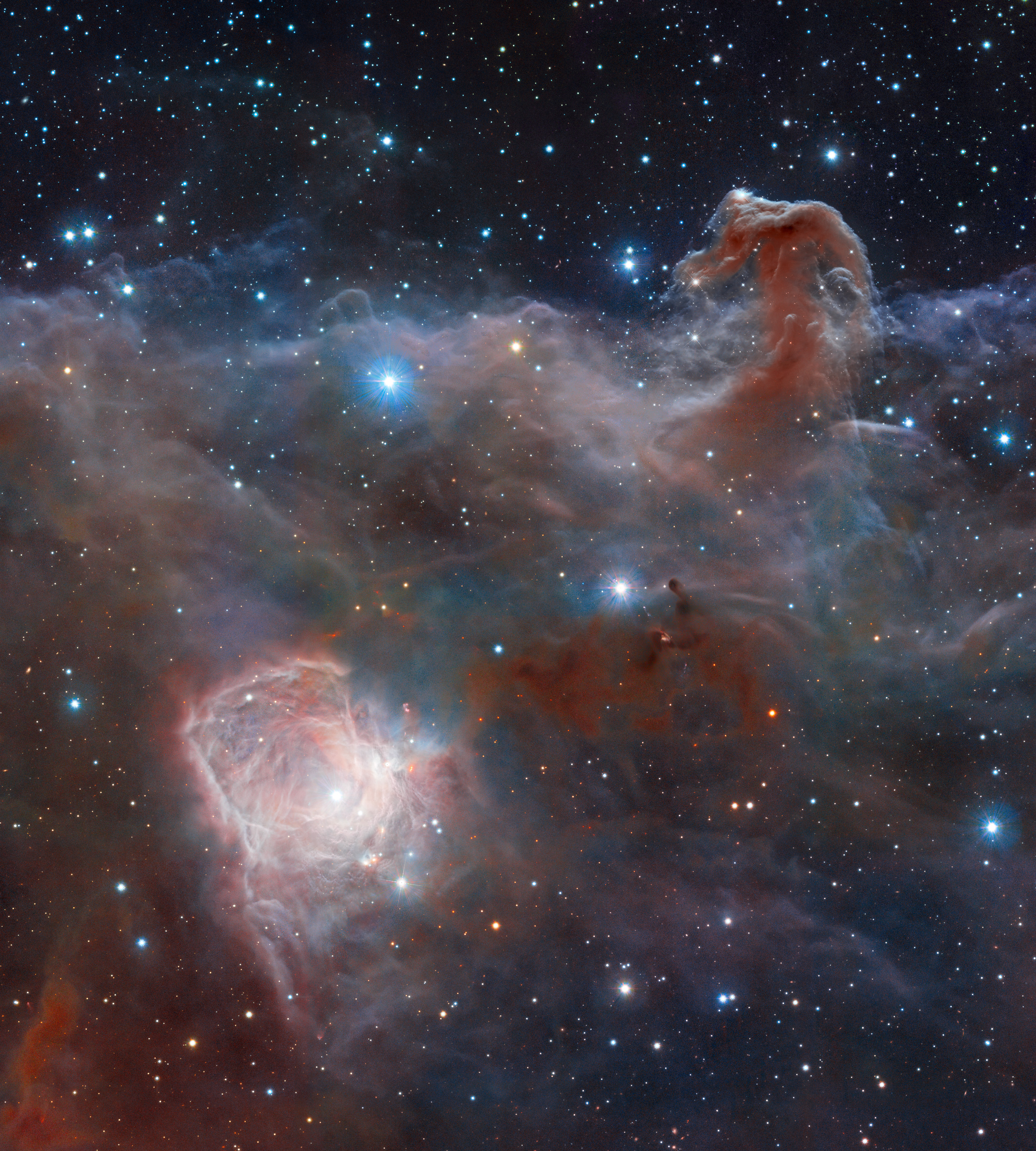
Combined image data from the massive, ground-based VISTA telescope and the Hubble Space Telescope was used to create this wide perspective of the interstellar landscape surrounding the famous Horsehead Nebula. Captured at near-infrared wavelengths, the region's dusty molecular cloud sprawls across the scene that covers an angle about two-thirds the size of the Full Moon on the sky. Left to right the frame spans just over 10 light-years at the Horsehead's estimated distance of 1,600 light-years. Also known as Barnard 33, the still recognizable Horsehead Nebula stands at the upper right, the near-infrared glow of a dusty pillar topped with newborn stars. Below and left, the bright reflection nebula NGC 2023 is itself the illuminated environs of a hot young star. Obscuring clouds below the base of the Horsehead and on the outskirts of NGC 2023 show the tell-tale far red emission of energetic jets, known as Herbig-Haro objects, also associated with newborn stars.
Se utilizó datos de imagen combinados del poderoso telescopio terrestre VISTA y del Telescopio Espacial Hubble para crear esta perspectiva amplia del paisaje interestelar que rodea la famosa Nebulosa del Caballo de Troya. Capturada en longitudes de onda de infrarrojo cercano, la región nubosa molecular polvorienta se extiende a través de la escena que cubre un ángulo aproximadamente dos tercios del tamaño de la Luna Llena en el cielo. De izquierda a derecha, el marco abarca un poco más de 10 años luz a la distancia estimada del Caballo de Troya, que es de 1.600 años luz. También conocida como Barnard 33, la Nebulosa del Caballo de Troya aún es reconocible en la parte superior derecha, donde brilla la luz en infrarrojo cercano de un pilar polvoriento coronado por estrellas recién nacidas. Debajo y a la izquierda, la brillante nebulosa de reflexión NGC 2023 en sí misma es el entorno iluminado de una estrella joven caliente. Las nubes que obstruyen la base del Caballo de Troya y en los bordes exteriores de NGC 2023 muestran la emisión roja lejana característica de chorros energéticos, conocidos como objetos Herbig-Haro, también asociados con estrellas recién nacidas.