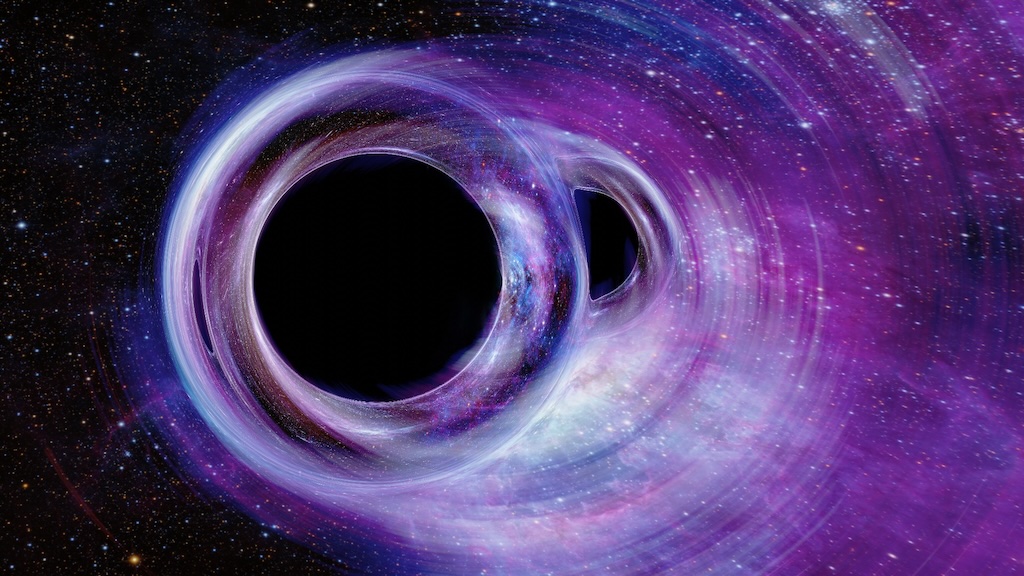
What would it look like to orbit a black hole? Since the strong gravity of the black hole can significantly alter light paths, conditions would indeed look strange. For one thing, the entire sky would be visible, since even stars behind the black hole would have their light bent to the observer's eye. For another, the sky near the black hole would appear significantly distorted, with more and more images of the entire sky visible increasingly near the black hole. Most visually striking, perhaps, is the outermost sky image completely contained inside an easily discernible circle known as the Einstein ring. Orbiting a black hole, as shown in the above scientifically-accurate computer-created illustrative video, will show stars that pass nearly directly behind the black hole as zipping around rapidly near the Einstein ring. Although star images near the Einstein ring may appear to move faster than light, no star is actually moving that quickly. The above video is part of a sequence of videos visually exploring the space near a black hole's event horizon. (Disclosure: Video creator Robert Nemiroff is an editor for APOD.)
¿Qué se vería al orbitar un agujero negro? Debido a la fuerte gravedad del agujero negro, que puede alterar significativamente los caminos de la luz, las condiciones efectivamente se verían extrañas. En primer lugar, todo el cielo sería visible, ya que incluso las estrellas detrás del agujero negro tendrían su luz doblada hacia el ojo del observador. En segundo lugar, el cielo cerca del agujero negro aparecería significativamente distorsionado, con imágenes cada vez más completas del cielo visibles cada vez más cerca del agujero negro. Lo más visualmente llamativo, quizás, es la imagen del cielo exterior completamente contenida dentro de un círculo fácilmente discernible conocido como anillo de Einstein. Al orbitar un agujero negro, como se muestra en el video anteriormente mencionado, que es un video científicamente preciso creado por computadora, se verían estrellas que pasan casi directamente detrás del agujero negro zipping rápidamente cerca del anillo de Einstein. Aunque las imágenes de estrellas cerca del anillo de Einstein pueden parecer moverse más rápido que la luz, ninguna estrella realmente se mueve con tanta rapidez. El video anterior forma parte de una secuencia de videos que exploran visualmente el espacio cerca del horizonte de sucesos de un agujero negro. (Revelación: El creador del video, Robert Nemiroff, es un editor para APOD).