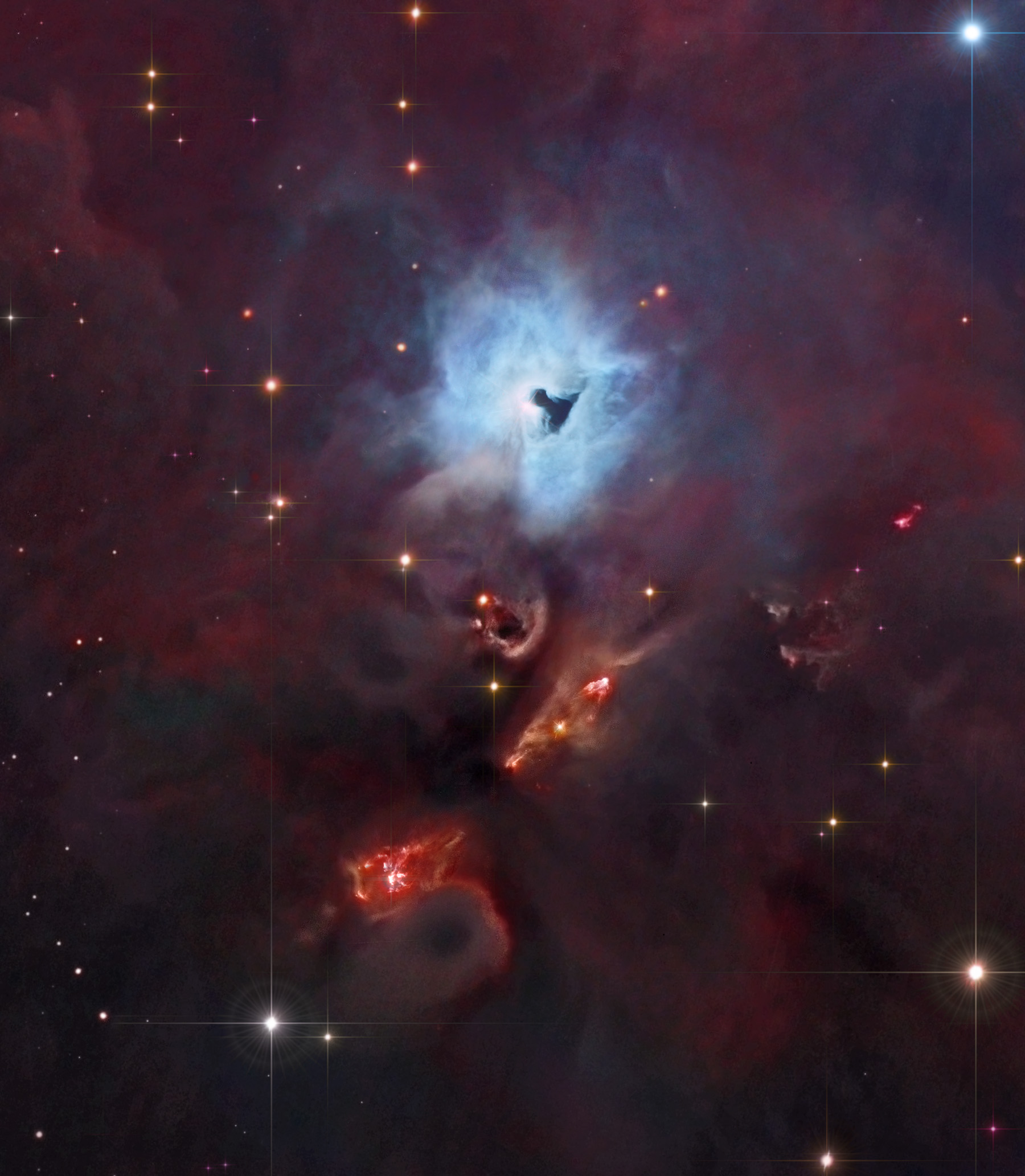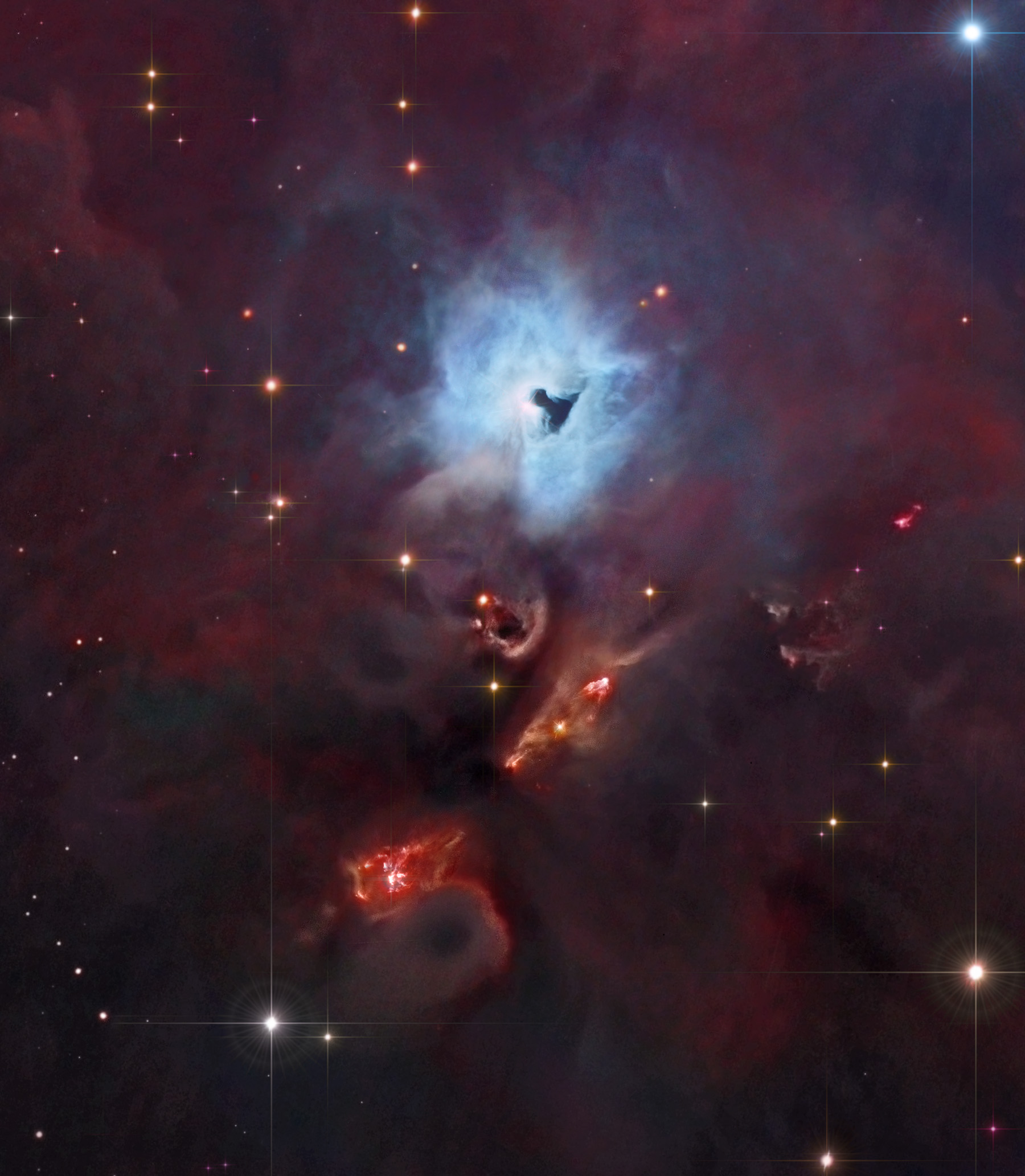
South of the large star-forming region known as the Orion Nebula, lies bright blue reflection nebula NGC 1999. At the edge of the Orion molecular cloud complex some 1,500 light-years distant, NGC 1999's illumination is provided by the embedded variable star V380 Orionis. That nebula is marked with a dark sideways T-shape near center in this cosmic vista that spans about 10 light-years. The dark shape was once assumed to be an obscuring dust cloud seen in silhouette against the bright reflection nebula. But recent infrared images indicate the shape is likely a hole blown through the nebula itself by energetic young stars. In fact, this region abounds with energetic young stars producing jets and outflows with luminous shock waves. Cataloged as Herbig-Haro (HH) objects, named for astronomers George Herbig and Guillermo Haro, the shocks look like red gashes in this scene that includes HH1 and HH2 just below NGC 1999. The stellar jets push through the surrounding material at speeds of hundreds of kilometers per second. Comet ISON: Observing Campaign | SOHO | SDO | STEREO | Hangout
Al sur de la extensa región de formación estelar conocida como la Nebulosa de Orión se encuentra la brillante nebulosa de reflexión NGC 1999. En el borde de la compleja nube molecular de Orión, a unos 1.500 años luz de distancia, la iluminación de NGC 1999 proviene de la estrella variable incrustada V380 Orionis. Esa nebulosa está marcada con una forma oscura en forma de T de lado a lado cerca del centro en este panorama cósmico que abarca aproximadamente 10 años luz. Inicialmente se creía que la forma oscura era una nube de polvo que se veía en silueta contra la brillante nebulosa de reflexión. Sin embargo, imágenes recientes en infrarrojos indican que la forma probablemente es un hueco excavado en la nebulosa misma por estrellas jóvenes energéticas. De hecho, esta región está llena de estrellas jóvenes energéticas que producen chorros y eyecciones con ondas de choque luminosas. Catalogados como objetos Herbig-Haro (HH), nombrados en honor a los astrónomos George Herbig y Guillermo Haro, los choques parecen ser cortes rojos en esta escena que incluye HH1 y HH2 justo debajo de NGC 1999. Los chorros estelares atraviesan el material circundante a velocidades de cientos de kilómetros por segundo.