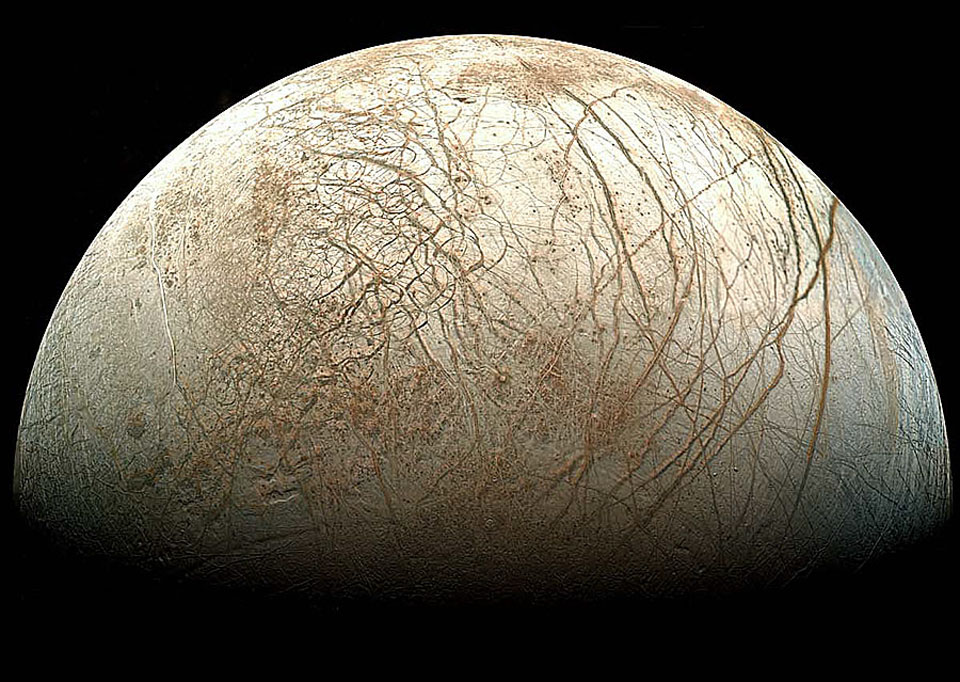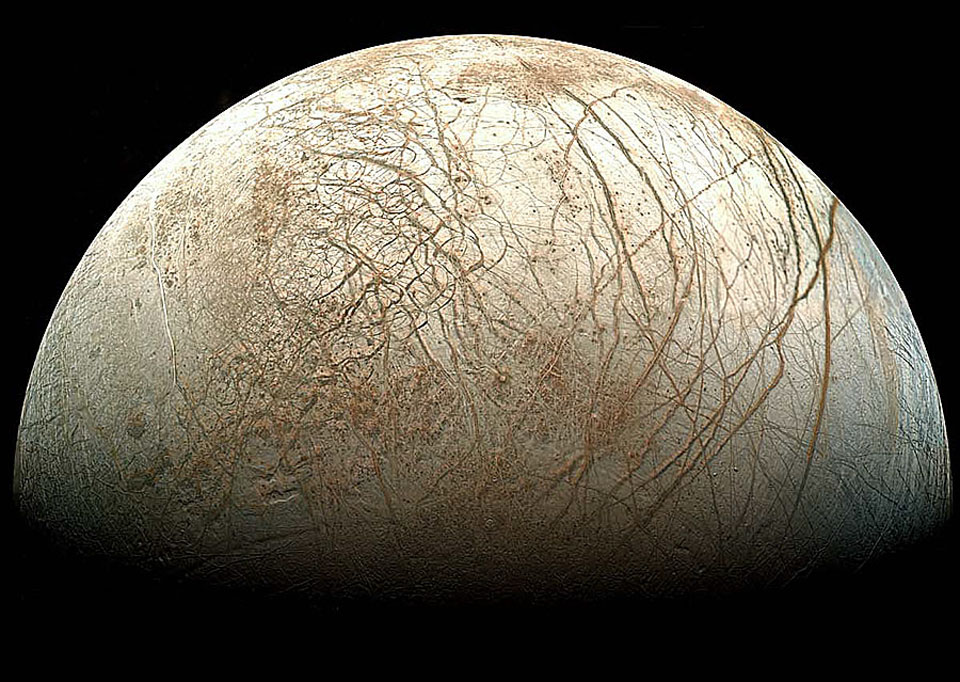
Although the phase of this moon might appear familiar, the moon itself might not. In fact, this gibbous phase shows part of Jupiter's moon Europa. The robot spacecraft Galileo captured this image mosaic during its mission orbiting Jupiter from 1995 - 2003. Visible are plains of bright ice, cracks that run to the horizon, and dark patches that likely contain both ice and dirt. Raised terrain is particularly apparent near the terminator, where it casts shadows. Europa is nearly the same size as Earth's Moon, but much smoother, showing few highlands or large impact craters. Evidence and images from the Galileo spacecraft, indicated that liquid oceans might exist below the icy surface. To test speculation that these seas hold life, ESA has started preliminary development of the Jupiter Icy Moons Explorer (JUICE), a spacecraft proposed for launch around 2022 that would further explore Jupiter and in particular Europa. Recent observations by the Hubble Space Telescope have uncovered new evidence that Europa, like Saturn's moon Enceladus, has ice venting from its surface. Budget Universe: Free APOD 2014 Calendar in PDF format
Aunque la fase de esta luna podría parecer familiar, la luna en sí misma podría no serlo. De hecho, esta fase gibbosa muestra parte de la luna de Júpiter, Europa. La nave espacial robotizada Galileo capturó esta imagen mosaico durante su misión orbitando Júpiter entre 1995 y 2003. Se pueden ver llanuras de hielo brillante, grietas que se extienden hasta el horizonte, y manchas oscuras que probablemente contienen tanto hielo como tierra. El terreno elevado es especialmente visible cerca del terminador, donde proyecta sombras. Europa tiene casi el mismo tamaño que la Luna de la Tierra, pero es mucho más lisa, mostrando pocas alturas o grandes cráteres de impacto. La evidencia e imágenes del vehículo espacial Galileo indicaron que podrían existir océanos líquidos bajo la superficie helada. Para probar la especulación de que estos océanos albergan vida, la ESA ha comenzado el desarrollo preliminar del Explorador de Lunas Heladas de Júpiter (JUICE), una nave espacial propuesta para su lanzamiento alrededor de 2022 que exploraría más a fondo Júpiter y, en particular, Europa. Recientes observaciones del Telescopio Espacial Hubble han revelado nueva evidencia de que Europa, al igual que la luna de Saturno Encelado, tiene eyecta de hielo desde su superficie.