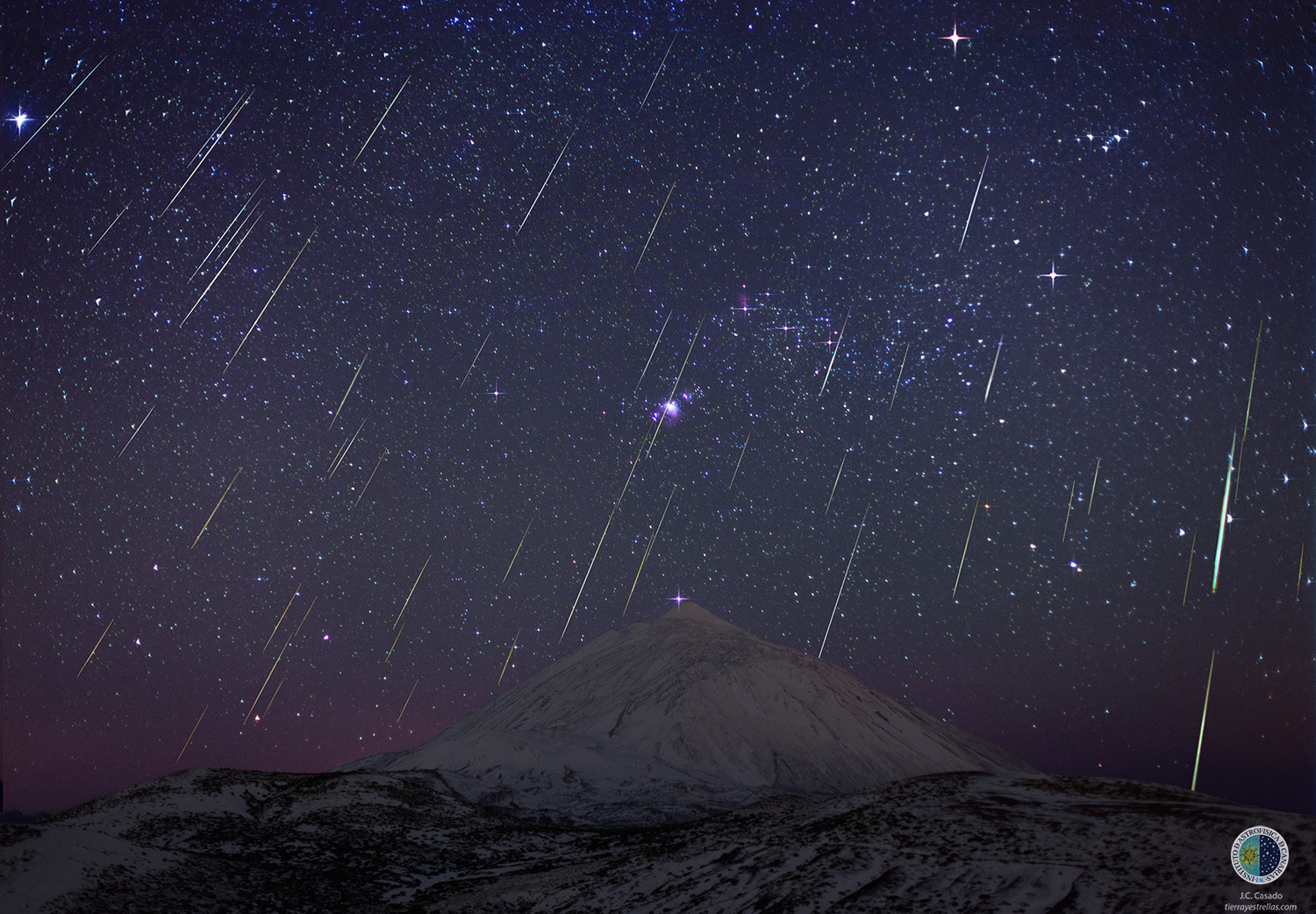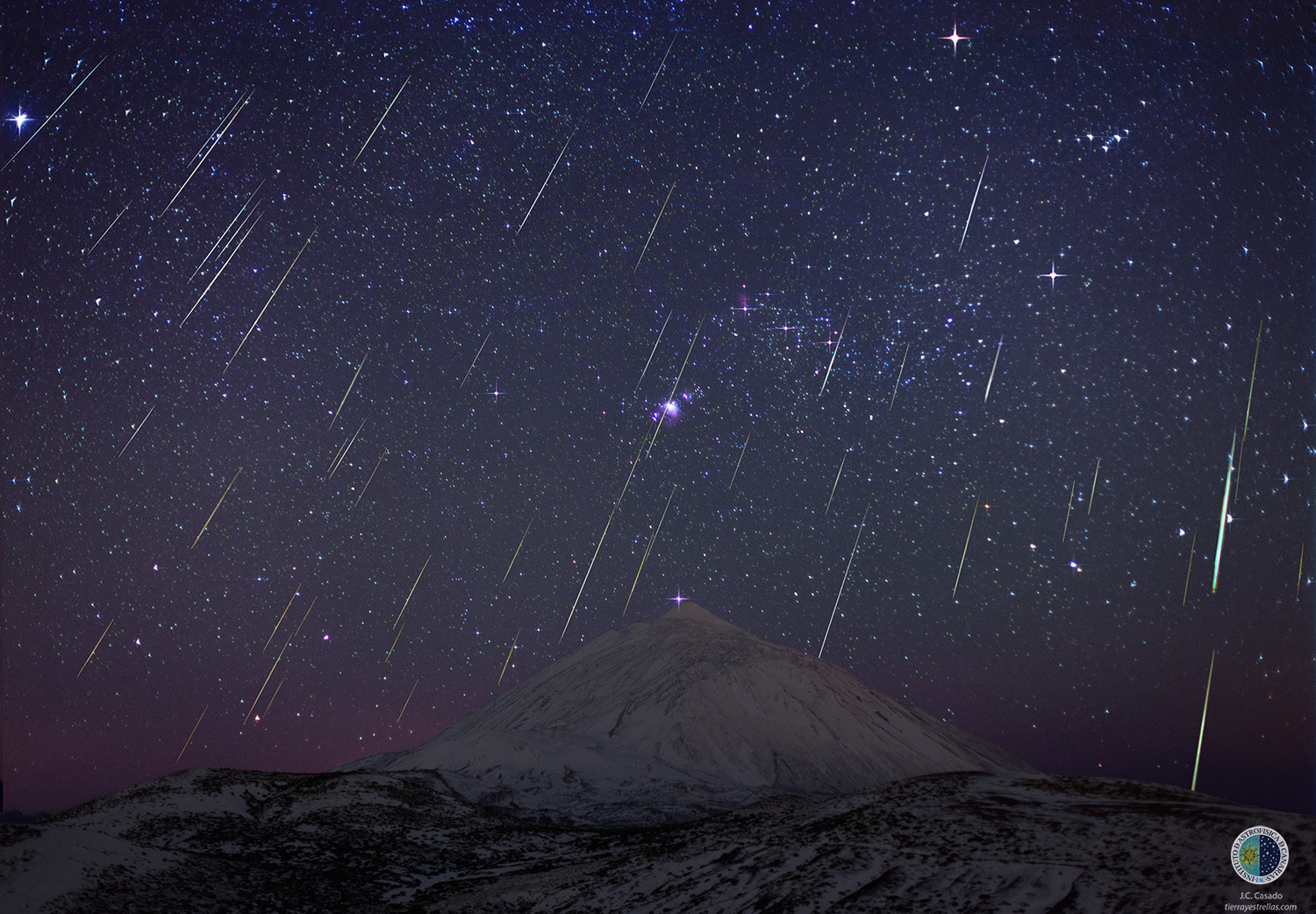
On some nights it rains meteors. Peaking two nights ago, asteroid dust streaked through the dark skies of Earth, showering down during the annual Geminids meteor shower. Astrophotographer Juan Carlos Casado captured the space weather event, as pictured above, in a series of exposures spanning about 2.3 hours using a wide angle lens. The snowcapped Teide volcano of the Canary Islands of Spain towers in the foreground, while the picturesque constellation of Orion highlights the background. The star appearing just near the top of the volcano is Rigel. Although the asteroid dust particles are traveling parallel to each other, the resulting meteor streaks appear to radiate from a single point on the sky, in this case in the constellation of Gemini, off the top of the image. Like train tracks appearing to converge in the distance, the meteor radiant effect is due to perspective. The astrophotographer has estimated that there are about 50 Geminids visible in the above composite image -- how many do you see? Budget Universe: Free APOD 2014 Calendar in PDF format
En algunas noches llueven meteoros. Alcanzando su punto máximo hace dos noches, el polvo de un asteroide cruzó los cielos oscuros de la Tierra, cayendo durante la lluvia de meteoros anual de las Geminidas. El astrónomo fotógrafo Juan Carlos Casado capturó este evento meteorológico espacial, como se muestra en la imagen anterior, en una serie de exposiciones que abarcan aproximadamente 2,3 horas utilizando un objetivo de gran angular. El volcán Teide, cubierto de nieve, de las islas Canarias de España se alza en primer plano, mientras que la constelación de Orión, pintoresca, destaca en el fondo. La estrella que aparece justo cerca de la parte superior del volcán es Rigel. Aunque las partículas de polvo del asteroide se mueven en paralelo entre sí, las trayectorias resultantes de los meteoros parecen emanar de un solo punto en el cielo, en este caso dentro de la constelación de Géminis, al margen superior de la imagen. Al igual que las vías férreas que parecen converger en la distancia, el efecto de radiante de los meteoros se debe a la perspectiva. El fotógrafo astronómico ha estimado que hay aproximadamente 50 Geminidas visibles en la imagen compuesta anterior — ¿cuántas ves tú?