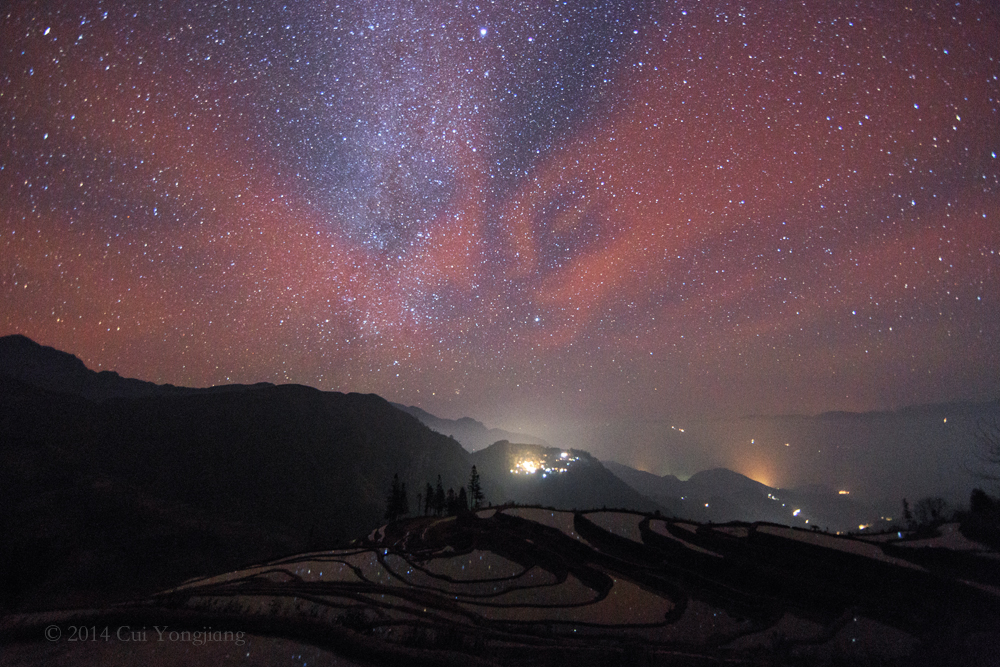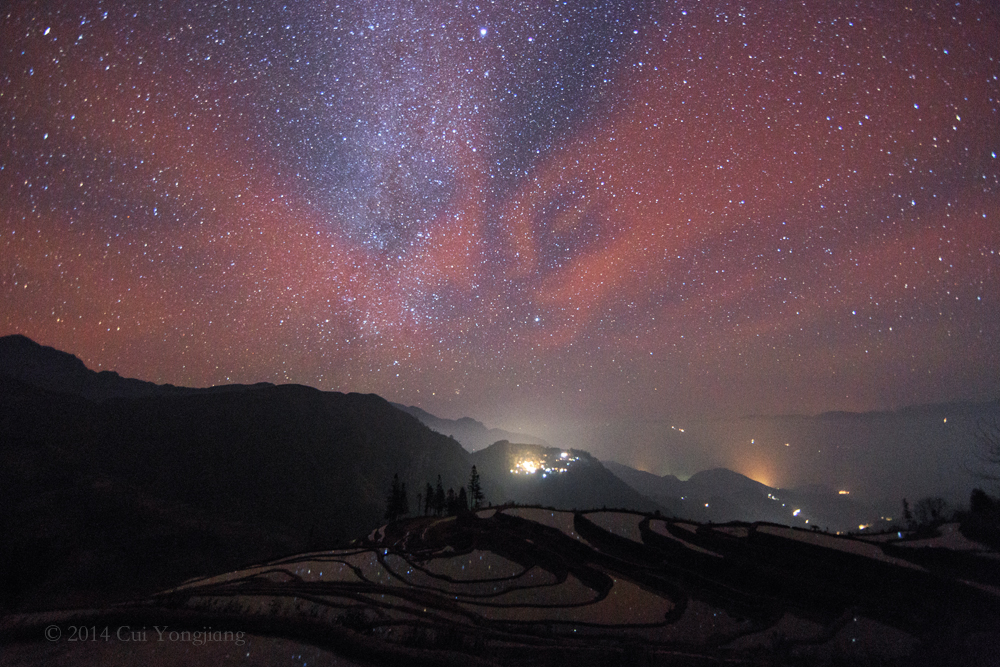
Long after sunset on January 25 an unusually intense red airglow floods this south-looking skyscape. The scene was recorded with a long exposure using a digital camera over Yunnan Province in southwest China. At best faintly visible to the eye, the lingering airglow is due to chemiluminescence, the production of light through chemical excitation. Originating at an altitude similar to aurora, it can found around the globe. The chemical energy is initially provided by the Sun's extreme ultraviolet radiation On this night, despite the luminous atmosphere, the band of the Milky Way clearly stretches above the horizon with bright star Sirius near the top of the frame. Both airglow and starry sky are beautifully reflected in region's watery Yuanyang rice terraces below.
Mucho tiempo después del atardecer del 25 de enero, un resplandor rojo inusualmente intenso de la luminiscencia atmosférica ilumina este paisaje celeste orientado hacia el sur. La escena fue capturada con una exposición prolongada utilizando una cámara digital sobre la provincia de Yunnan en el suroeste de China. A simple vista, la luminiscencia atmosférica es apenas visible, y se debe a la quimiluminiscencia, la producción de luz mediante la excitación química. Originada a una altitud similar a la de las auroras, puede encontrarse en todo el mundo. La energía química se proporciona inicialmente por la radiación ultravioleta extremadamente intensa del Sol. En esta noche, a pesar de la atmósfera luminosa, la banda de la Vía Láctea se extiende claramente por encima del horizonte, con la brillante estrella Sirio cerca de la parte superior del marco. Tanto la luminiscencia atmosférica como el cielo estrellado se reflejan hermosamente en las terrazas de arroz de Yuanyang, que se encuentran en la región inferior.