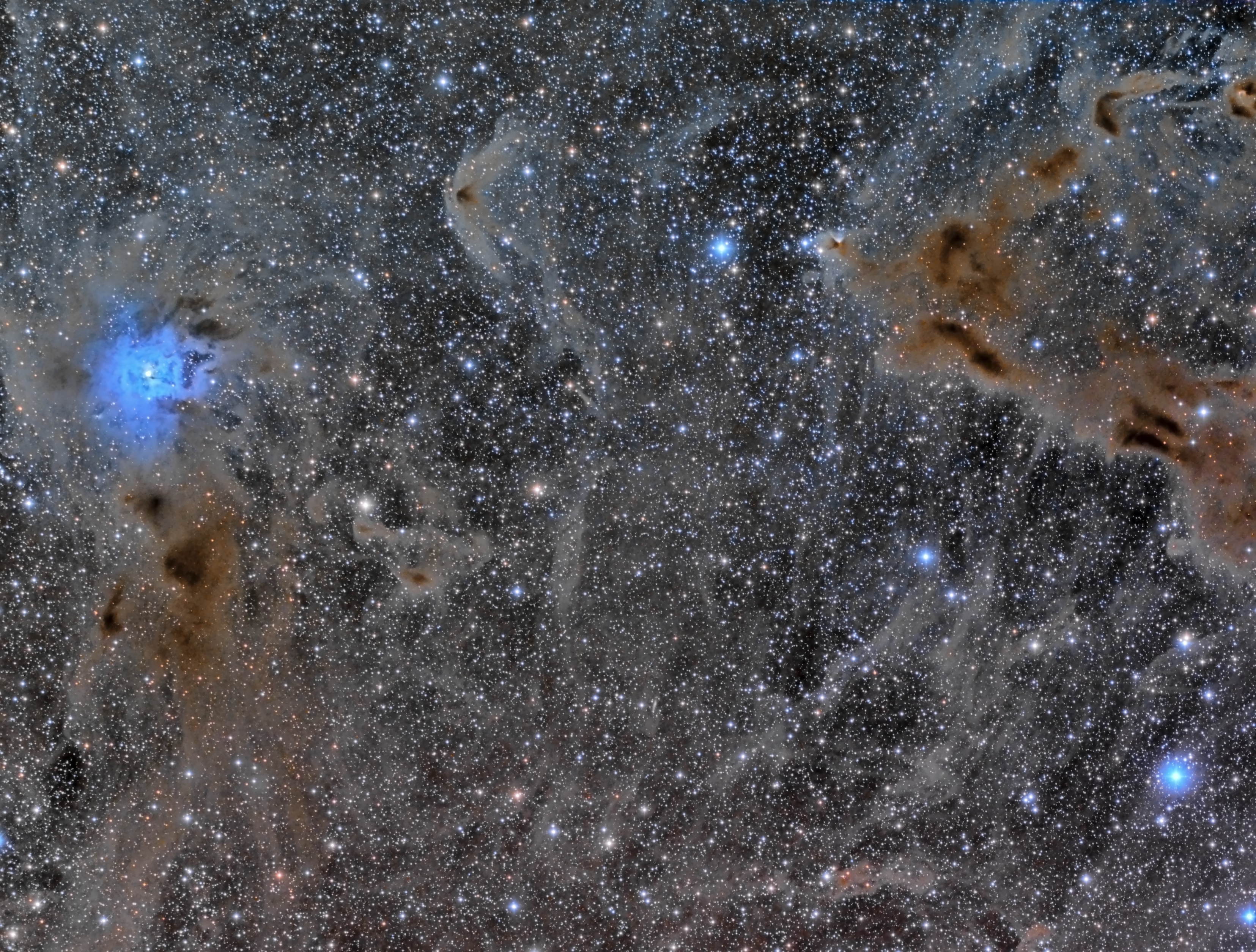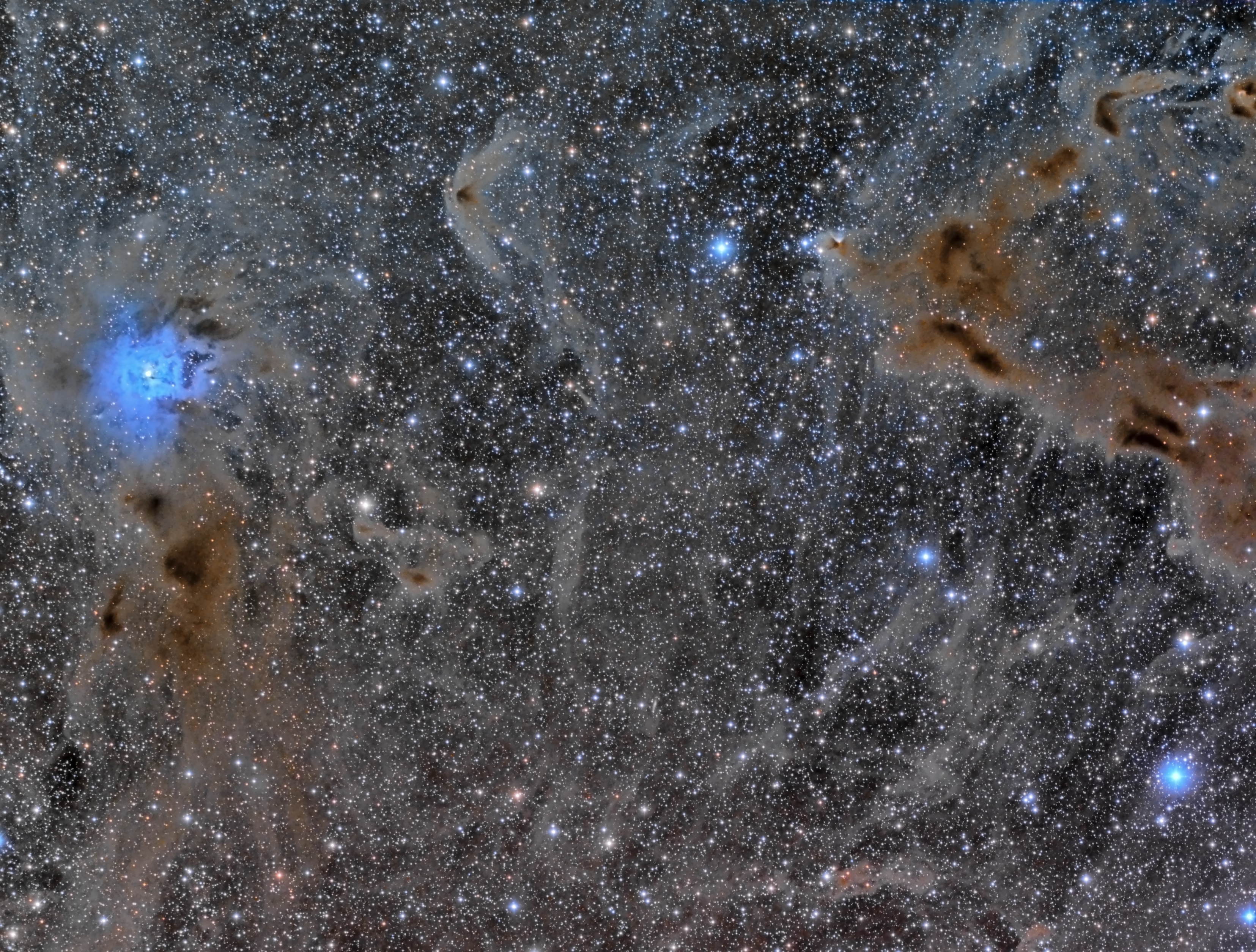
What flowers in this field of dark star dust? The Iris Nebula. The striking blue color of the Iris Nebula is created by light from the bright star SAO 19158 reflecting off of a dense patch of normally dark dust. Not only is the star itself mostly blue, but blue light from the star is preferentially reflected by the dust -- the same affect that makes Earth's sky blue. The brown tint of the pervasive dust comes partly from photoluminescence -- dust converting ultraviolet radiation to red light. Cataloged as NGC 7023, the Iris Nebula is studied frequently because of the unusual prevalence there of Polycyclic Aromatic Hydrocarbons (PAHs), complex molecules that are also released on Earth during the incomplete combustion of wood fires. The bright blue portion of the Iris Nebula spans about six light years. The Iris Nebula, pictured above, lies about 1300 light years distant and can be found with a small telescope toward the constellation of Cepheus.
¿Qué florece en este campo de polvo estelar oscuro? La Nebulosa Iris. El llamativo color azul de la Nebulosa Iris se genera por la luz de la brillante estrella SAO 19158 reflejándose en un denso parche de polvo normalmente oscuro. No solo la estrella en sí misma es principalmente azul, sino que la luz azul de la estrella se refleja preferentemente en el polvo — el mismo efecto que hace que el cielo terrestre sea azul. El tono marrón del polvo omnipresente proviene parcialmente de la fotoluminiscencia — el polvo convierte la radiación ultravioleta en luz roja. Catalogada como NGC 7023, la Nebulosa Iris es estudiada con frecuencia debido a la presencia inusual de Hidrocarburos Aromáticos Policíclicos (HAP), moléculas complejas que también se liberan en la Tierra durante la combustión incompleta de fuegos de leña. La parte brillante azul de la Nebulosa Iris abarca aproximadamente seis años luz. La Nebulosa Iris, mostrada arriba, se encuentra a unos 1300 años luz de distancia y puede ser observada con un telescopio pequeño hacia la constelación de Cefeo.