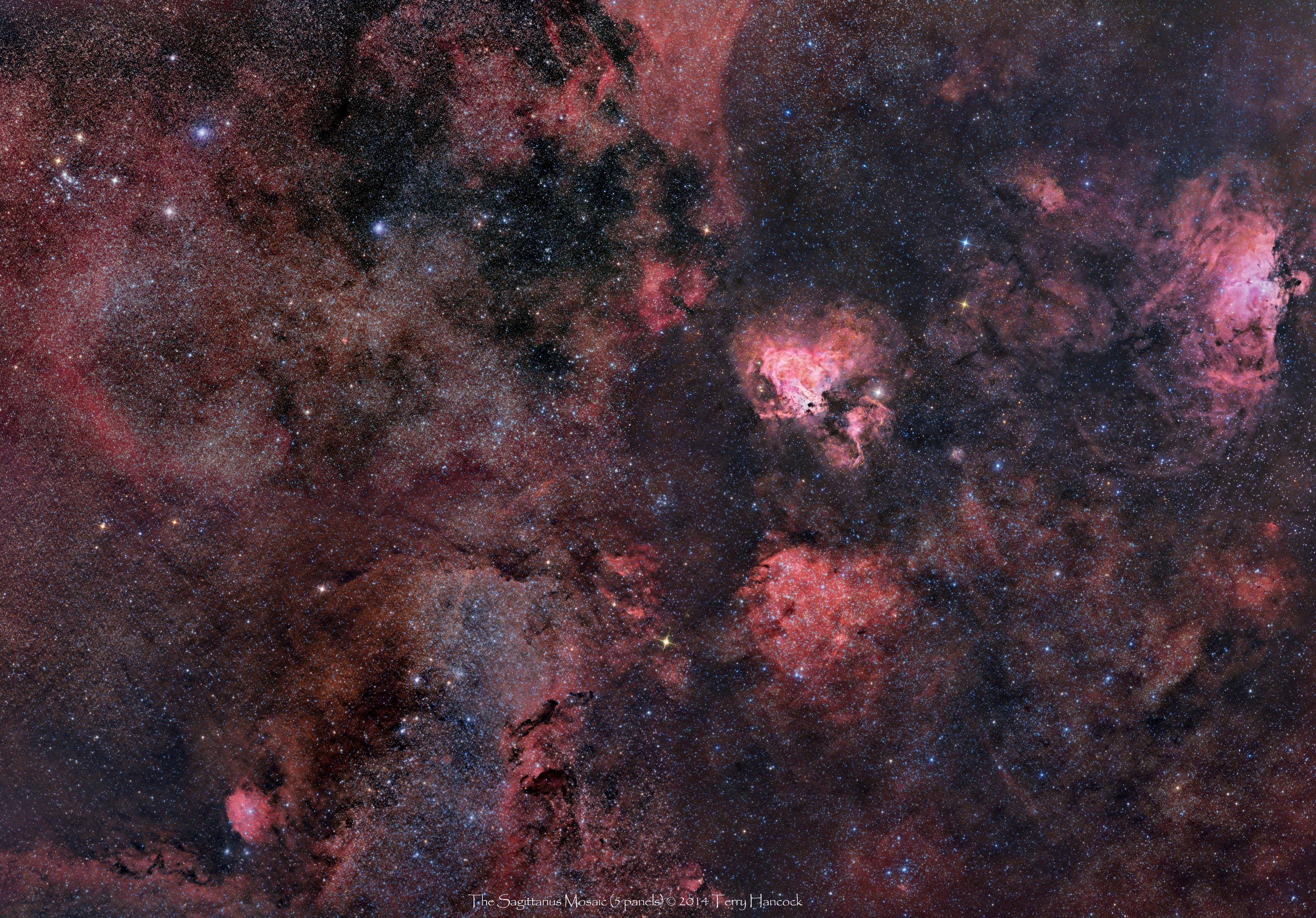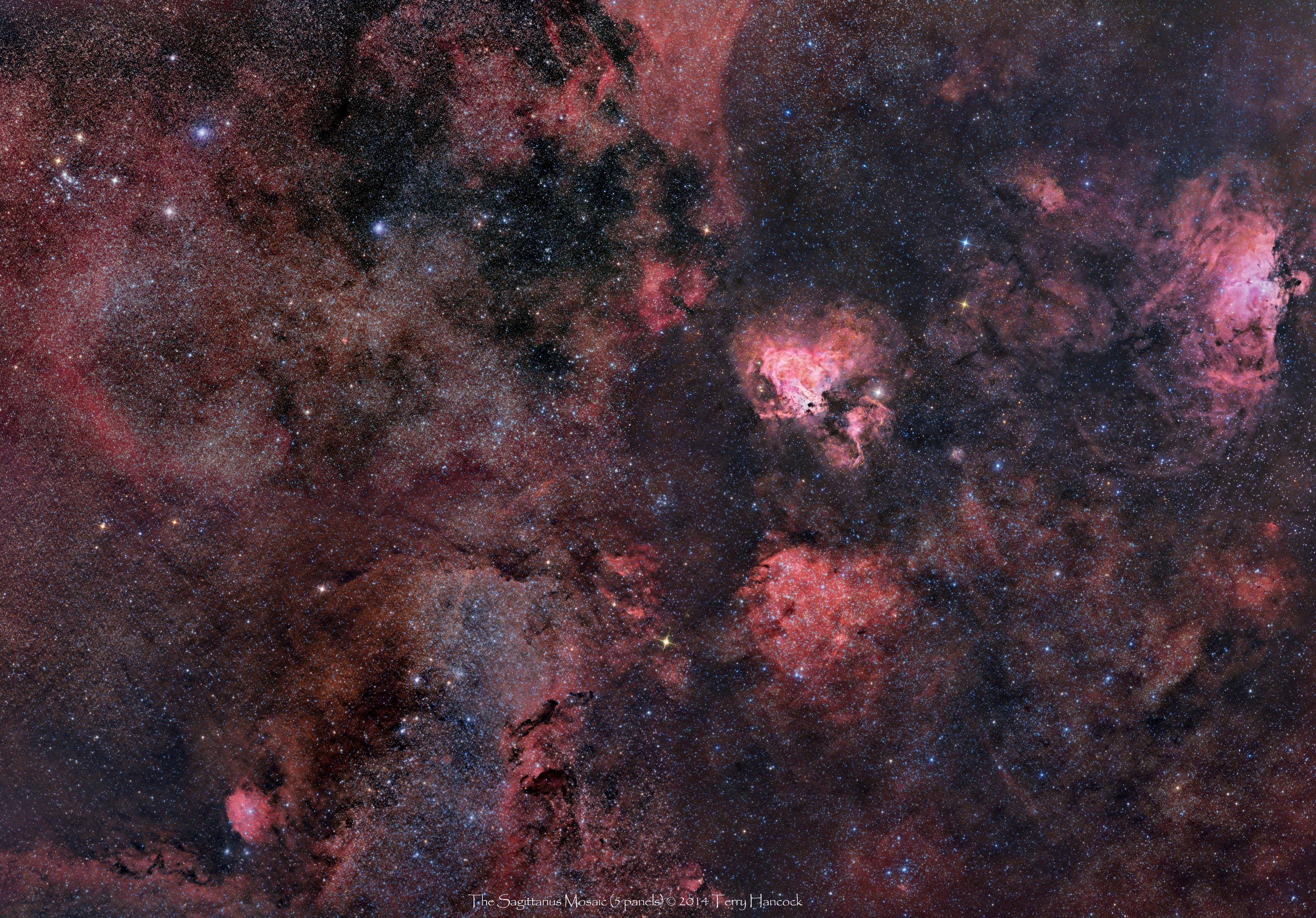
This rich starscape spans nearly 7 degrees on the sky, toward the Sagittarius spiral arm and the center of our Milky Way galaxy. A telescopic mosaic, it features well-known bright nebulae and star clusters cataloged by 18th century cosmic tourist Charles Messier. Still popular stops for skygazers M16, the Eagle (far right), and M17, the Swan (near center) nebulae are the brightest star-forming emission regions. With wingspans of 100 light-years or so, they shine with the telltale reddish glow of hydrogen atoms from over 5,000 light-years away. Colorful open star cluster M25 near the upper left edge of the scene is closer, a mere 2,000 light-years distant and about 20 light-years across. M24, also known as the Sagittarius Star Cloud, crowds in just left of center along the bottom of the frame, fainter and more distant Milky Way stars seen through a narrow window in obscuring fields of interstellar dust.
Este rico paisaje estelar abarca casi 7 grados en el cielo, hacia el brazo espiral de Sagitario y el centro de nuestra galaxia Vía Láctea. Es una mosaica telescópica que incluye nebulosas y cúmulos estelares bien conocidos catalogados por el turista cósmico del siglo XVIII, Charles Messier. Los lugares populares para observadores de cielos, como M16, la Águila (a la derecha lejana), y M17, la Cigüeña (cerca del centro), son las regiones más brillantes de formación estelar. Con extensiones de unos 100 años luz, brillan con el característico tono rojizo del hidrógeno atómico, proveniente de más de 5,000 años luz de distancia. El cúmulo estelar abierto M25, cerca del borde superior izquierdo de la escena, está más cerca, a solo 2,000 años luz de distancia y tiene un diámetro de aproximadamente 20 años luz. M24, también conocido como la Nube Estelar de Sagitario, se encuentra justo a la izquierda del centro, en la parte inferior del marco, mostrando estrellas más tenues y distantes de la Vía Láctea, visibles a través de una pequeña ventana en los campos de polvo interestelar que los ocultan.