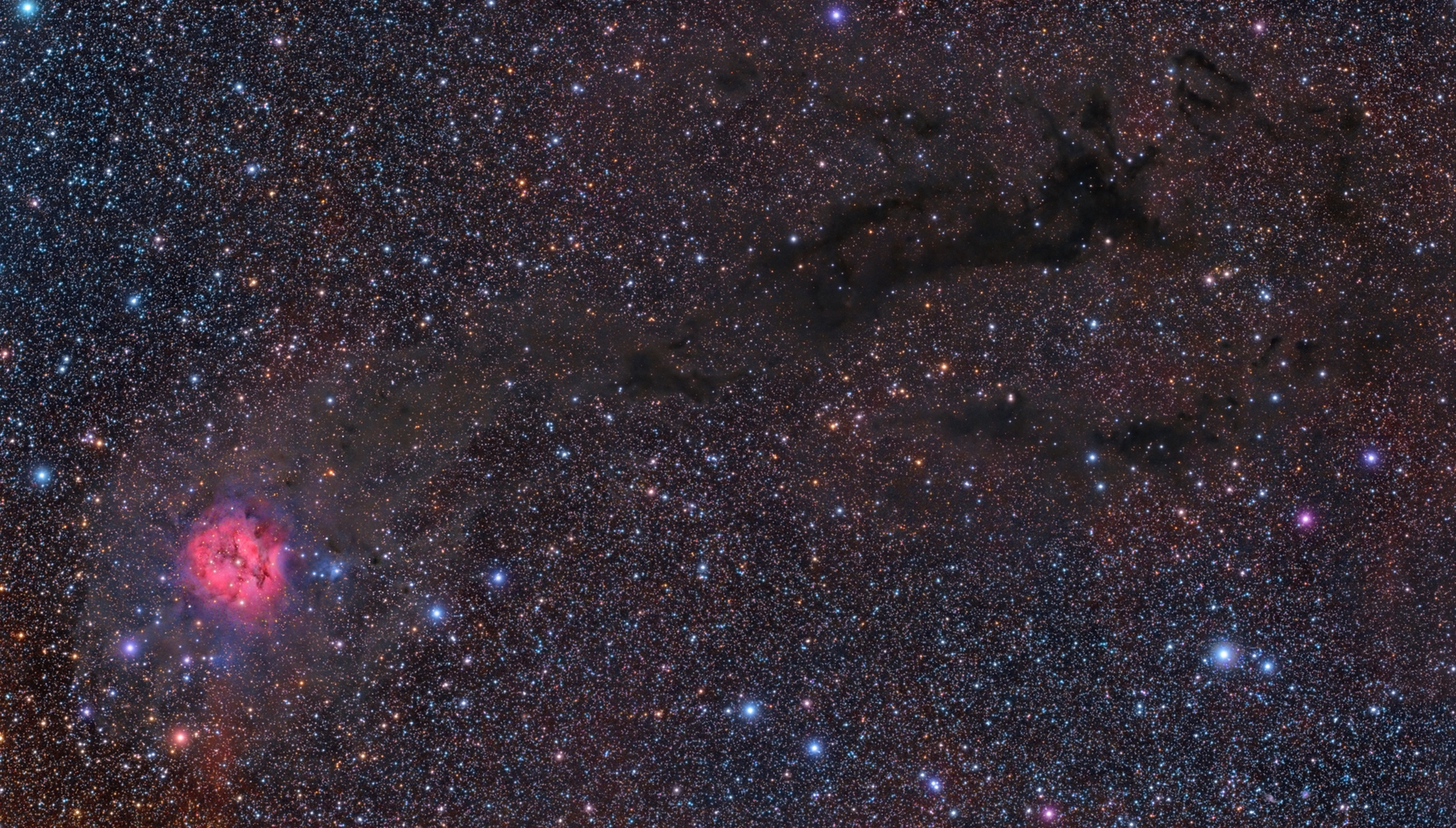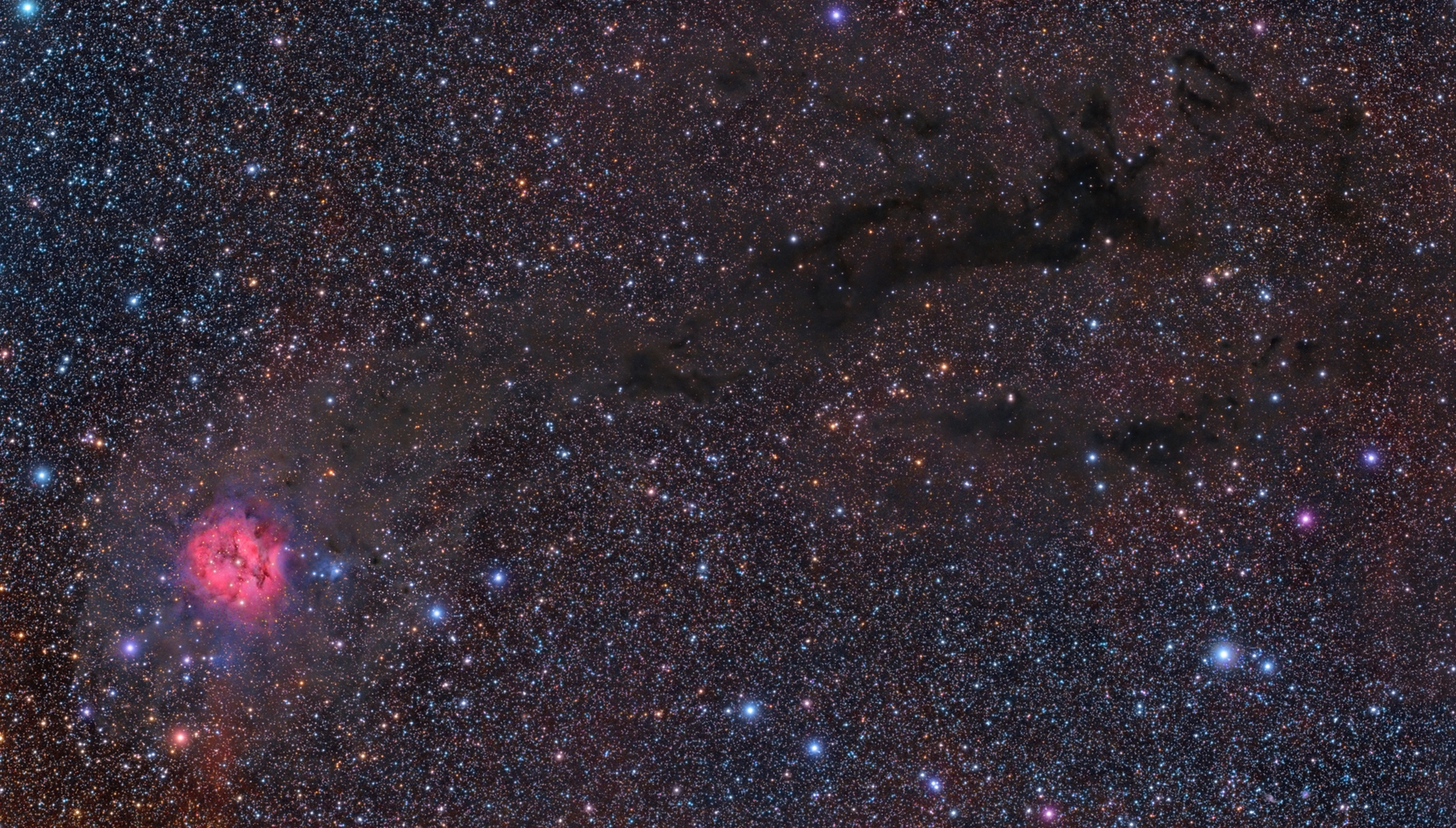
In this crowded starfield covering over 2 degrees within the high flying constellation Cygnus, the eye is drawn to the Cocoon Nebula. A compact star forming region, the cosmic Cocoon punctuates a long trail of obscuring interstellar dust clouds. Cataloged as IC 5146, the nebula is nearly 15 light-years wide, located some 4,000 light years away. Like other star forming regions, it stands out in red, glowing, hydrogen gas excited by the young, hot stars and blue, dust-reflected starlight at the edge of an otherwise invisible molecular cloud. In fact, the bright star near the center of this nebula is likely only a few hundred thousand years old, powering the nebular glow as it clears out a cavity in the molecular cloud's star forming dust and gas. But the long dusty filaments that appear dark in this visible light image are themselves hiding stars in the process of formation that can be seen seen at infrared wavelengths.
En este campo estelar denso que abarca más de 2 grados dentro de la constelación elevada de Cisne, la mirada se dirige hacia la Nebulosa del Capullo. Una región compacta de formación estelar, la nebulosa cósmica del Capullo destaca en una larga trayectoria de nubes de polvo interestelar que ocultan. Catalogada como IC 5146, la nebulosa tiene casi 15 años luz de ancho y se encuentra a unos 4.000 años luz de distancia. Al igual que otras regiones de formación estelar, destaca en gas hidrógeno rojizo excitado por las estrellas jóvenes y calientes, y en luz estelar azul reflejada en el borde de una nube molecular invisible en otro lugar. De hecho, la estrella brillante cerca del centro de esta nebulosa probablemente tiene solo unos pocos cientos de miles de años, alimentando el resplandor nebuloso mientras despega una cavidad en el polvo y el gas de formación estelar de la nube molecular. Sin embargo, las largas filamentos polvorientos que aparecen oscuros en esta imagen de luz visible en sí mismos ocultan estrellas en proceso de formación que pueden verse en longitudes de onda infrarrojas.