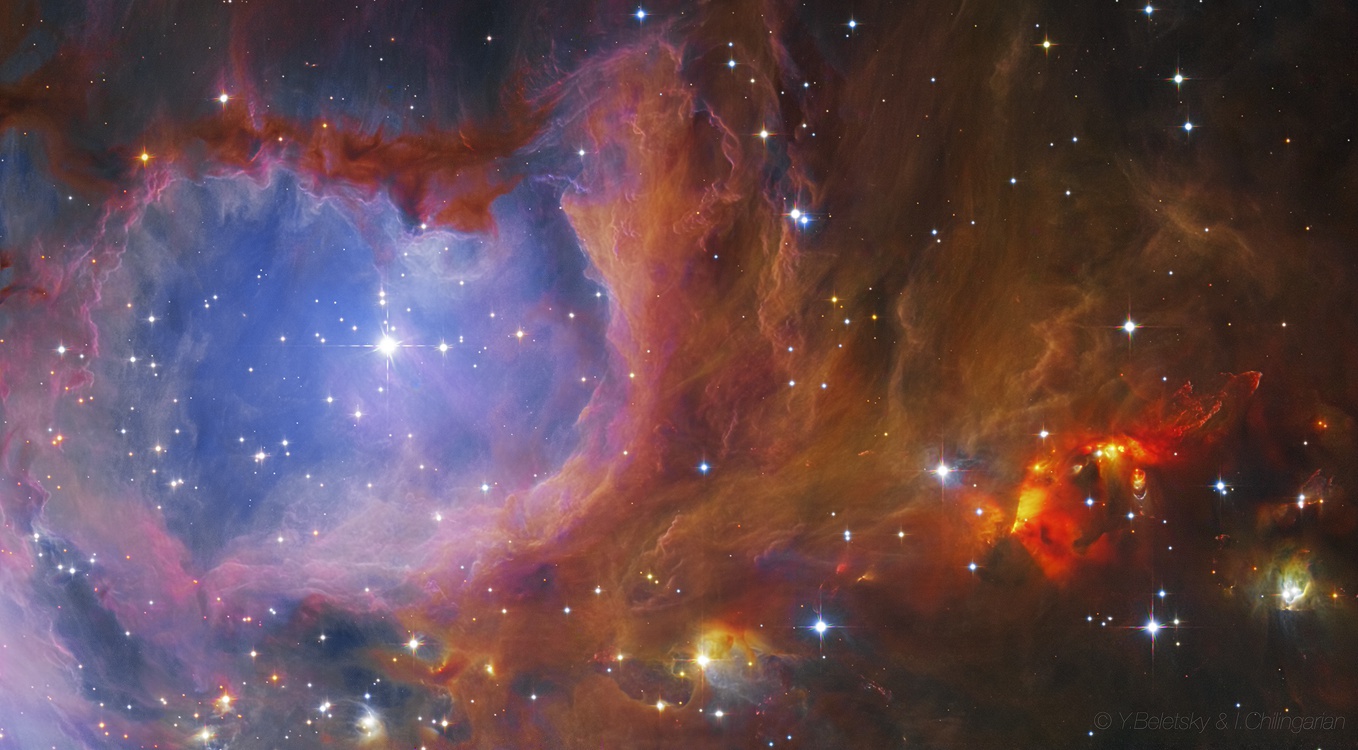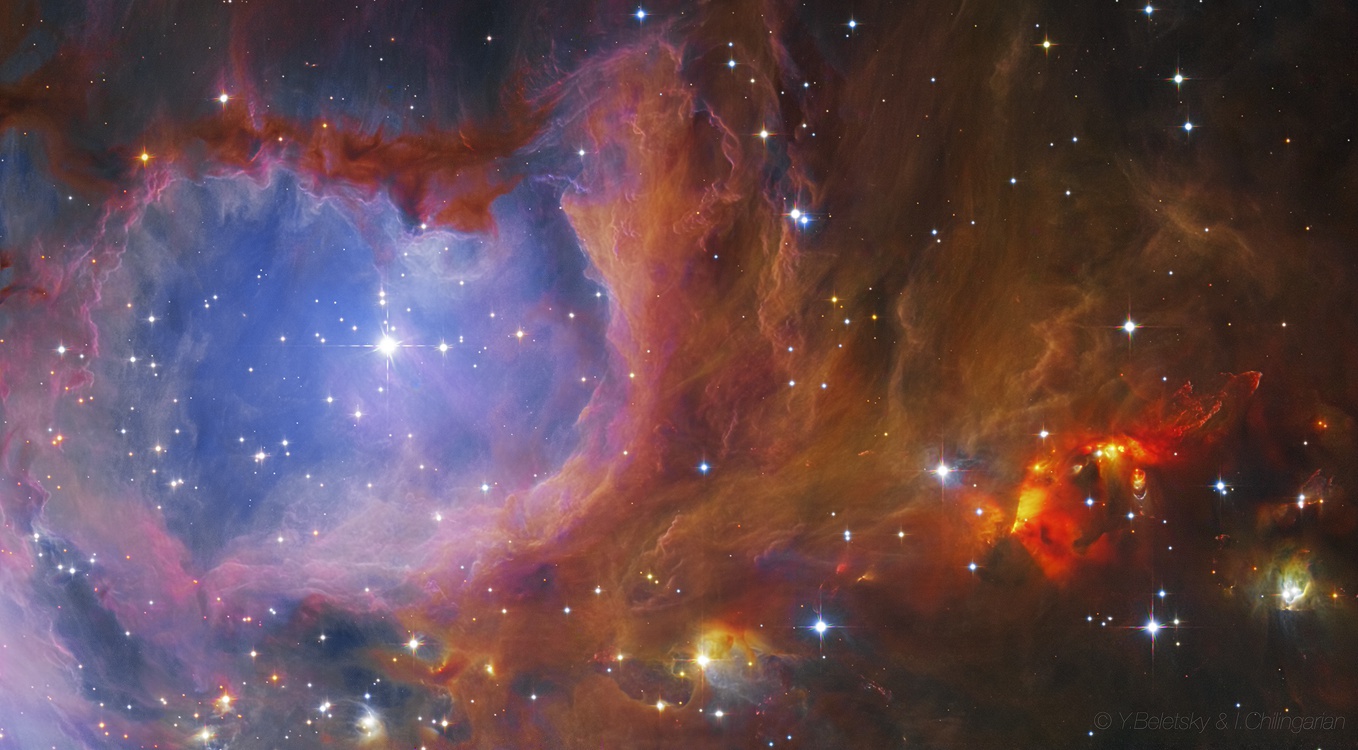
Often imaged but rarely mentioned, Messier 43 is a large star forming region in its own right. It's just part of the star forming complex of gas and dust that includes the larger, more famous neighboring Messier 42, the Great Orion Nebula. In fact, the Great Orion Nebula itself lies off the lower edge of this scene. The close-up of Messier 43 was made while testing the capabilities of a near-infrared instrument with one of the twin 6.5 meter Magellan telescopes at Las Campanas Observatory in the Chilean Andes. The composite image shifts the otherwise invisible infrared wavelengths to blue, green, and red colors. Peering into caverns of interstellar dust hidden from visible light, the near-infrared view can also be used to study cool, brown dwarf stars in the complex region. Along with its celebrity neighbor, Messier 43 lies about 1,500 light-years away, at the edge of Orion's giant molecular cloud. At that distance, this field of view spans about 5 light-years.
A menudo capturada en imágenes pero raramente mencionada, Messier 43 es una región de formación estelar importante en sí misma. Es simplemente una parte de la compleja región de formación estelar de gas y polvo que incluye al más grande y famoso vecino, Messier 42, la Gran Nebulosa de Orión. De hecho, la Gran Nebulosa de Orión se encuentra en el borde inferior de esta escena. El acercamiento a Messier 43 se realizó durante la prueba de las capacidades de un instrumento de infrarrojo cercano con uno de los telescopios gemelos de 6,5 metros del Observatorio Las Campanas en las Andes chilenas. La imagen compuesta desplaza las longitudes de onda infrarrojas, normalmente invisibles, a colores azul, verde y rojo. Al mirar dentro de las cavernas de polvo interestelar ocultas a la luz visible, la vista en infrarrojo cercano también puede utilizarse para estudiar estrellas enanas marrones frías en la región compleja. Junto con su famoso vecino, Messier 43 se encuentra a unos 1.500 años luz de distancia, en el borde de la gran nube molecular de Orión. A esa distancia, este campo de visión abarca aproximadamente 5 años luz.