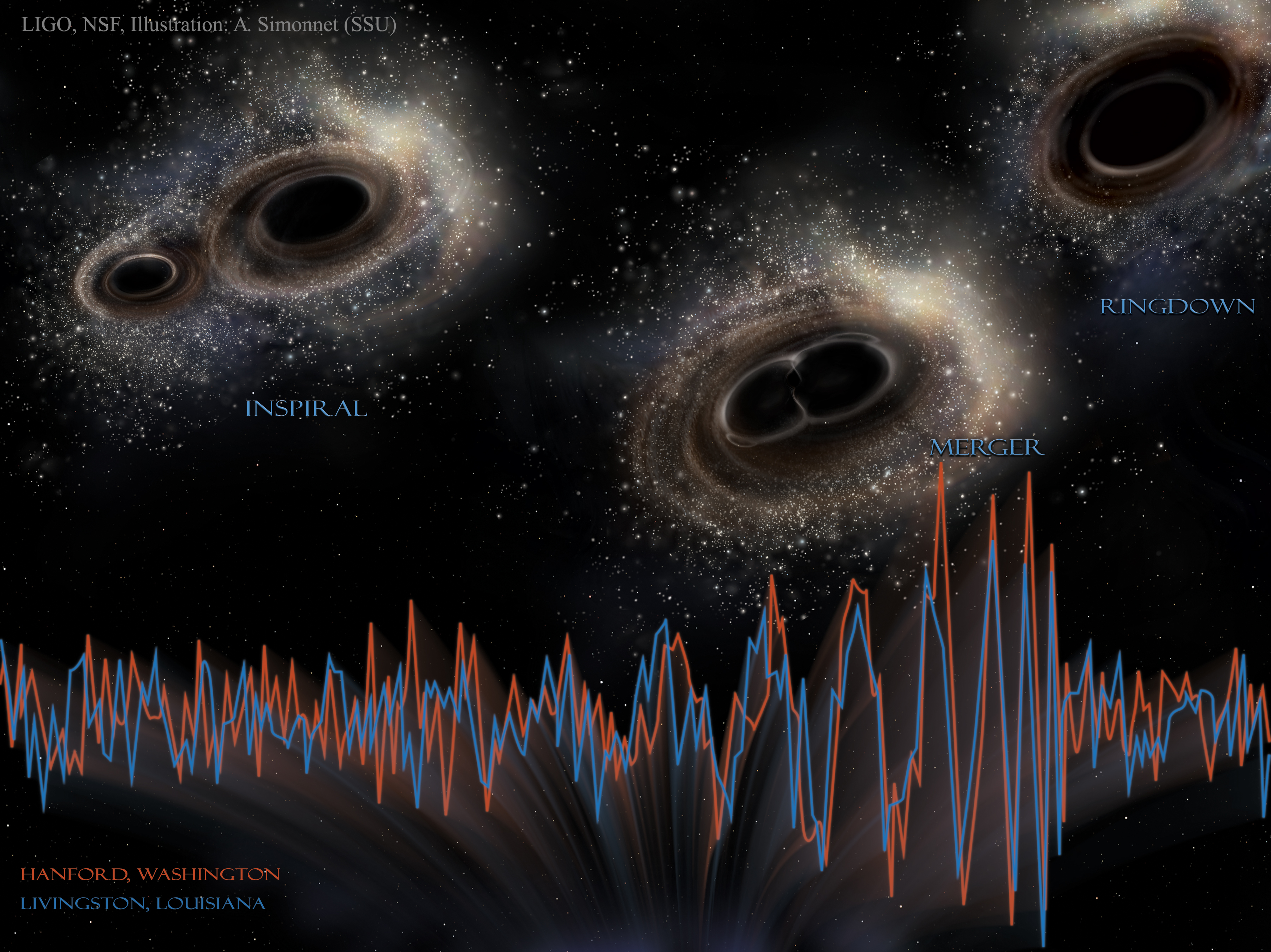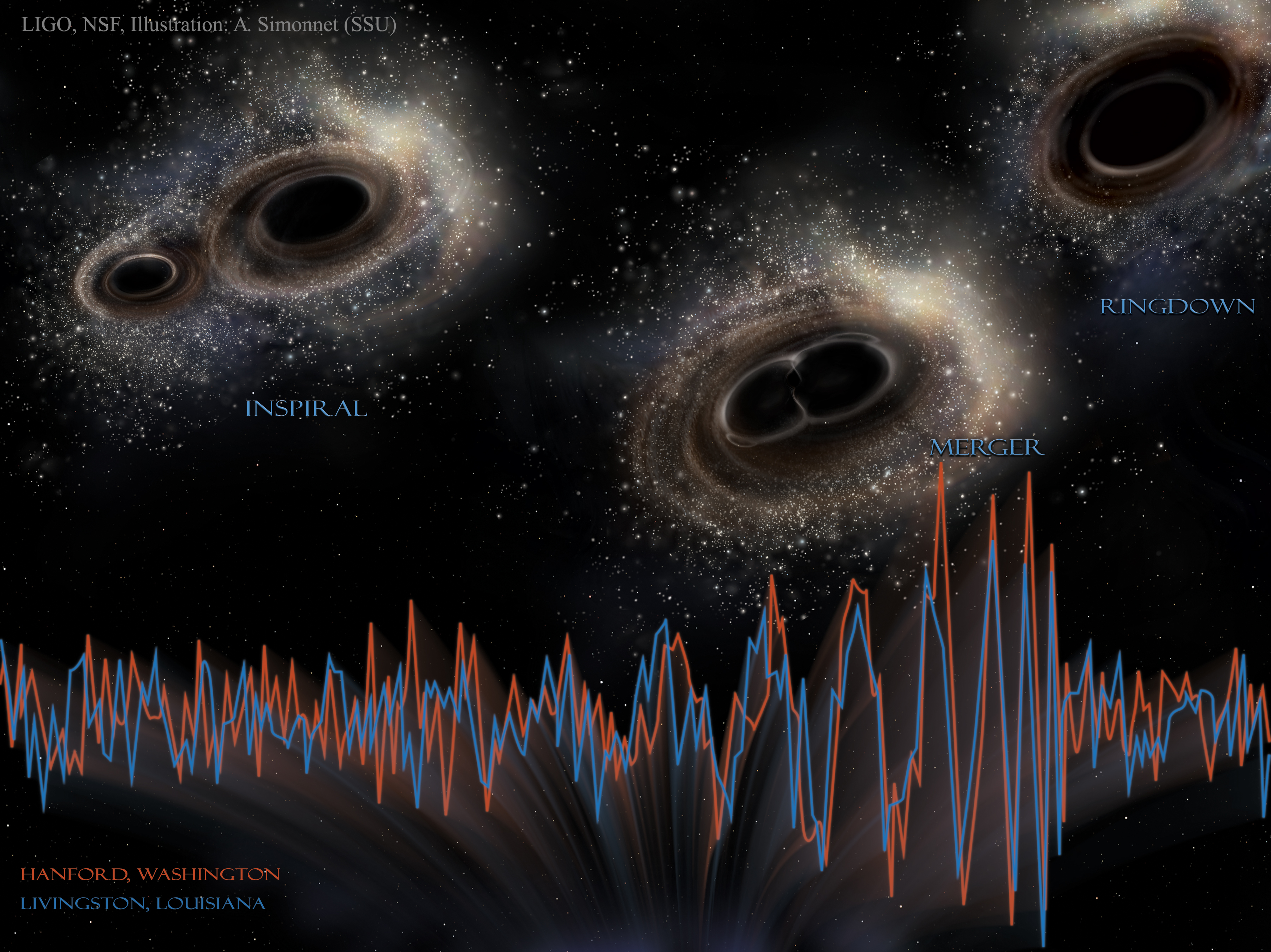
Gravitational radiation has been directly detected. The first-ever detection was made by both facilities of the Laser Interferometer Gravitational-Wave Observatory (LIGO) in Washington and Louisiana simultaneously last September. After numerous consistency checks, the resulting 5-sigma discovery was published today. The measured gravitational waves match those expected from two large black holes merging after a death spiral in a distant galaxy, with the resulting new black hole momentarily vibrating in a rapid ringdown. A phenomenon predicted by Einstein, the historic discovery confirms a cornerstone of humanity's understanding of gravity and basic physics. It is also the most direct detection of black holes ever. The featured illustration depicts the two merging black holes with the signal strength of the two detectors over 0.3 seconds superimposed across the bottom. Expected future detections by Advanced LIGO and other gravitational wave detectors may not only confirm the spectacular nature of this measurement but hold tremendous promise of giving humanity a new way to see and explore our universe.
La radiación gravitacional ha sido detectada directamente. La primera detección jamás realizada fue hecha simultáneamente por las dos instalaciones del Observatorio de Ondas Gravitacionales por Interferometría Láser (LIGO), ubicadas en Washington y Luisiana, el pasado septiembre. Después de numerosas verificaciones de consistencia, el descubrimiento con una significancia de 5 sigma fue publicado hoy. Las ondas gravitacionales medidas coinciden con las esperadas de dos agujeros negros grandes fusionándose tras una espiral de muerte en una galaxia distante, con el nuevo agujero negro resultante vibrando momentáneamente en un rápido anillo de vibración. Un fenómeno predicho por Einstein, este descubrimiento histórico confirma una piedra angular de la comprensión humana de la gravedad y la física básica. También es la detección más directa de agujeros negros jamás realizada. La ilustración destacada representa los dos agujeros negros fusionándose con la intensidad de la señal de los dos detectores superpuesta en la parte inferior durante 0.3 segundos. Las futuras detecciones esperadas por Advanced LIGO y otros detectores de ondas gravitacionales no solo confirmarán la espectacular naturaleza de esta medición, sino que también ofrecen grandes promesas de brindar a la humanidad una nueva manera de observar y explorar nuestro universo.