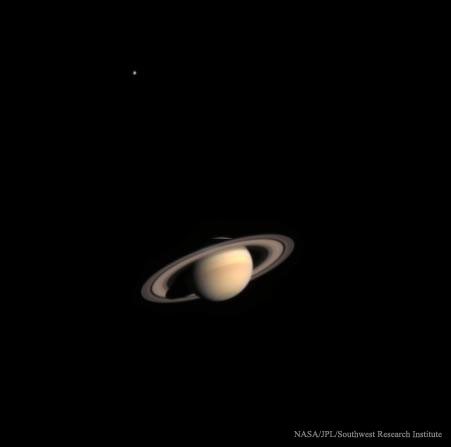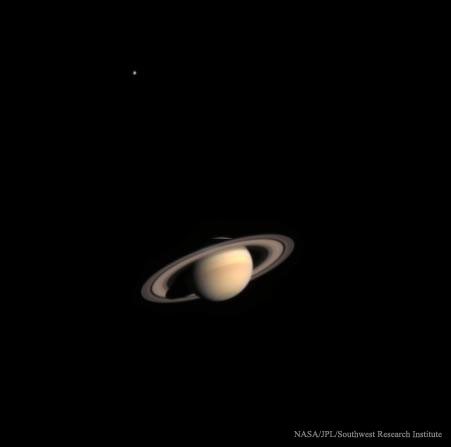
Cassini, a robot spacecraft launched in 1997 by NASA, became close enough in 2002 to resolve many rings and moons of its destination planet: Saturn. At that time, Cassini snapped several images during an engineering test. Several of those images were combined into the contrast-enhanced color composite featured here. Saturn's rings and cloud-tops are visible toward the image bottom, while Titan, its largest moon, is visible as the speck toward the top. When arriving at Saturn in July 2004, the Cassini orbiter began to circle and study the Saturnian system. A highlight was when Cassini launched the Huygens probe that made an unprecedented landing on Titan in 2005, sending back detailed pictures. Now nearing the end of its mission, Cassini is scheduled to embark on a Grand Finale phase in late 2016 where it will repeatedly dive between the giant planet and its innermost rings.
Cassini, una nave espacial robótica lanzada por NASA en 1997, se acercó lo suficiente en 2002 como para distinguir muchos anillos y lunas de su planeta destino: Saturno. En ese momento, Cassini capturó varias imágenes durante una prueba de ingeniería. Varias de esas imágenes se combinaron para crear la imagen en color mejorada de contraste que se muestra aquí. Los anillos y las cumbres nubladas de Saturno son visibles hacia la parte inferior de la imagen, mientras que Titán, su luna más grande, aparece como el punto hacia la parte superior. Al llegar a Saturno en julio de 2004, la nave orbitadora Cassini comenzó a orbitar y estudiar el sistema saturniano. Un hito fue cuando Cassini lanzó la sonda Huygens, que realizó un aterrizaje sin precedentes en Titán en 2005, enviando imágenes detalladas. Ahora, al acercarse al final de su misión, Cassini está programado para iniciar una fase denominada Grand Finale a finales de 2016, donde repetidamente se sumergirá entre el planeta gigante y sus anillos más internos.