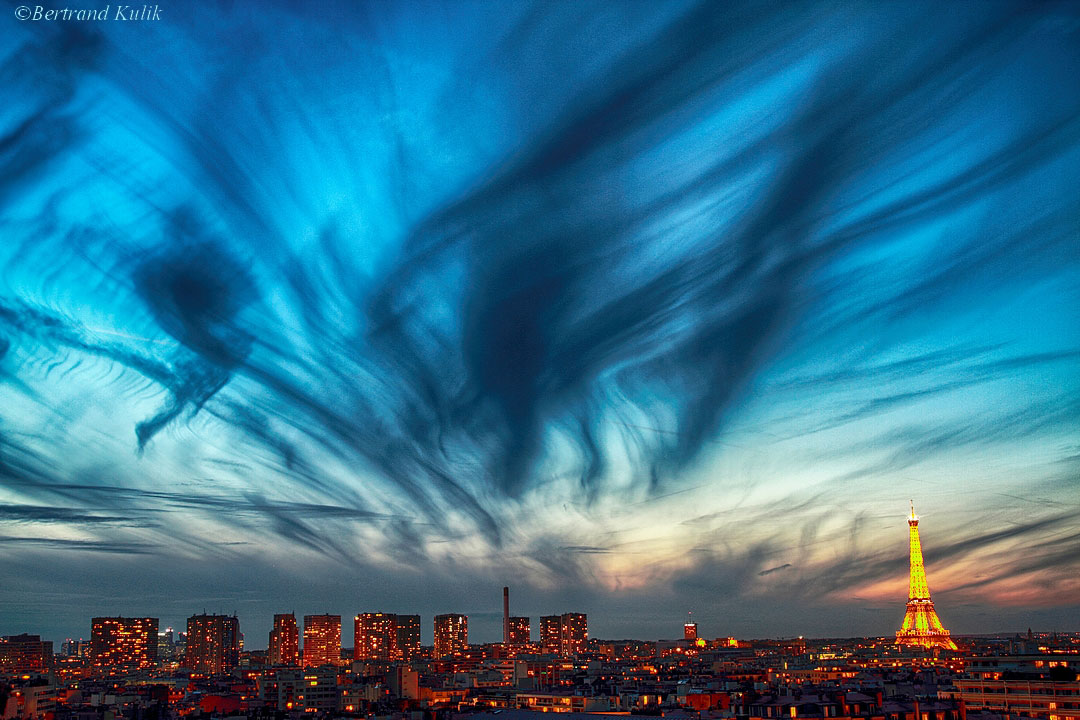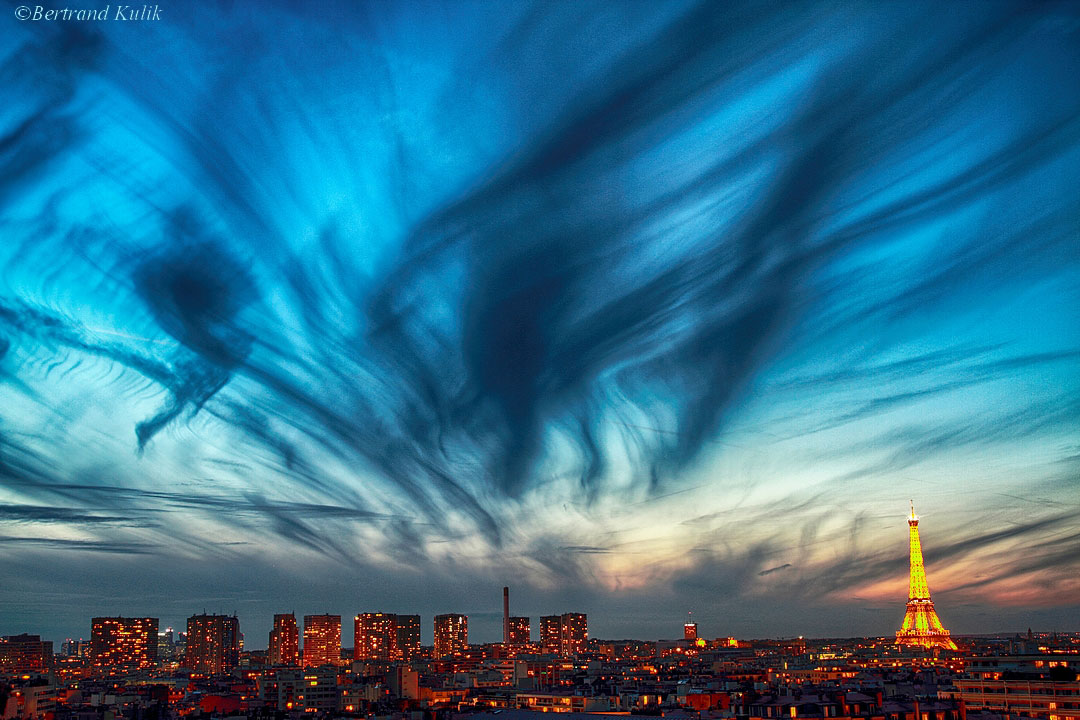
What's that over Paris? Cirrus. Typically, cirrus clouds appear white or gray when reflecting sunlight, can appear dark at sunset (or sunrise) against a better lit sky. Cirrus are among the highest types of clouds and are usually thin enough to see stars through. Cirrus clouds may form from moisture released above storm clouds and so may herald the arrival of a significant change in weather. Conversely, cirrus clouds have also been seen on Mars, Jupiter, Saturn, Titan, Uranus, and Neptune. The featured image was taken two days ago from a window in District 15, Paris, France, Earth. The brightly lit object on the lower right is, of course, the Eiffel Tower.
¿Qué se ve sobre París? Cirros. Normalmente, las nubes cirros aparecen blancas o grises cuando reflejan la luz solar, y pueden aparecer oscuras al atardecer (o al amanecer) contra un cielo mejor iluminado. Los cirros son uno de los tipos de nubes más altas y suelen ser lo suficientemente delgadas como para permitir ver las estrellas a través de ellas. Los cirros pueden formarse a partir de la humedad liberada por encima de nubes tormentosas y, por lo tanto, pueden anunciar la llegada de un cambio significativo en el clima. Por otro lado, también se han observado nubes cirros en Marte, Júpiter, Saturno, Titán, Urano y Neptuno. La imagen destacada fue tomada hace dos días desde una ventana en el Distrito 15, París, Francia, Tierra. El objeto brillante en la parte inferior derecha, por supuesto, es la Torre Eiffel.