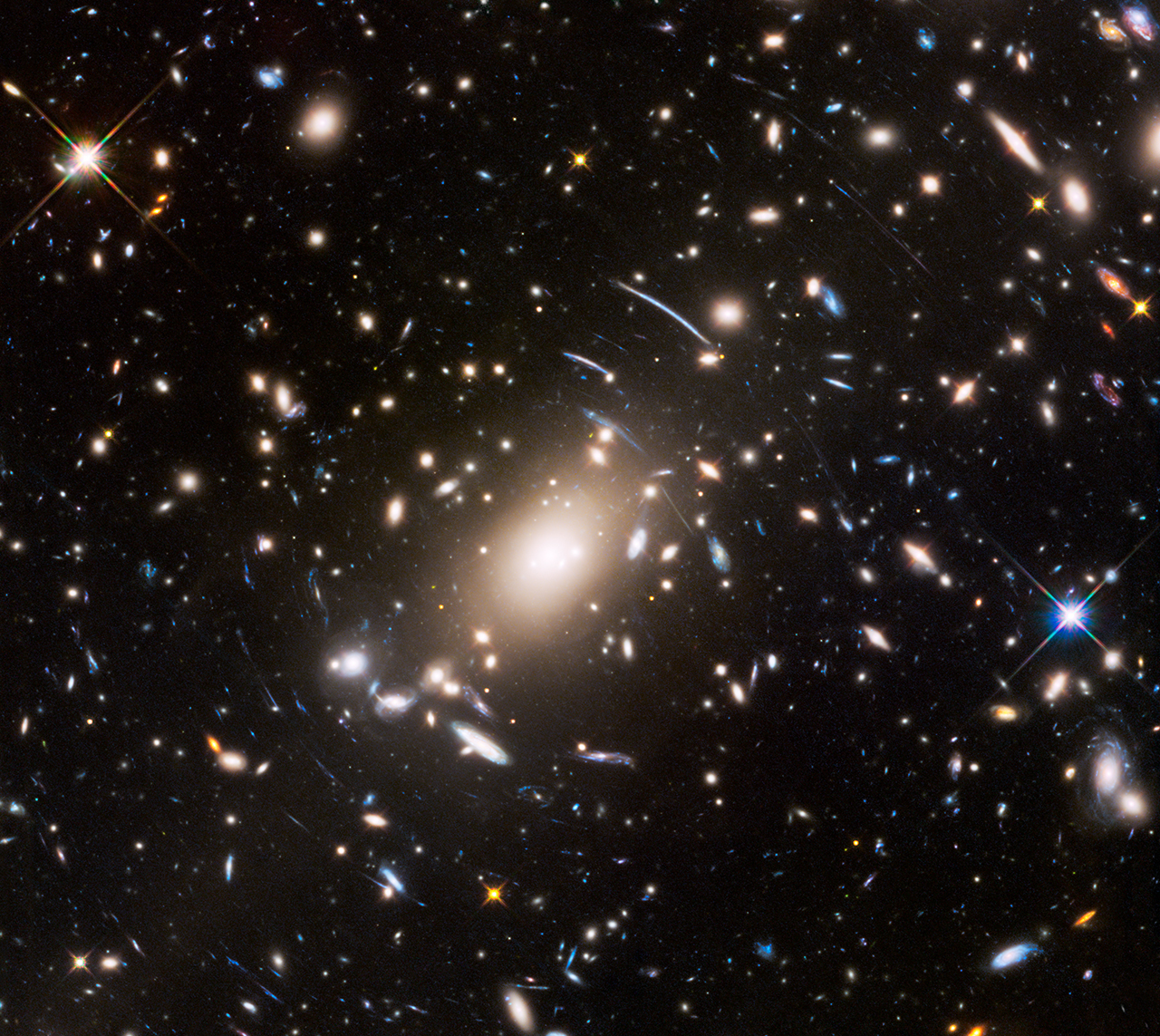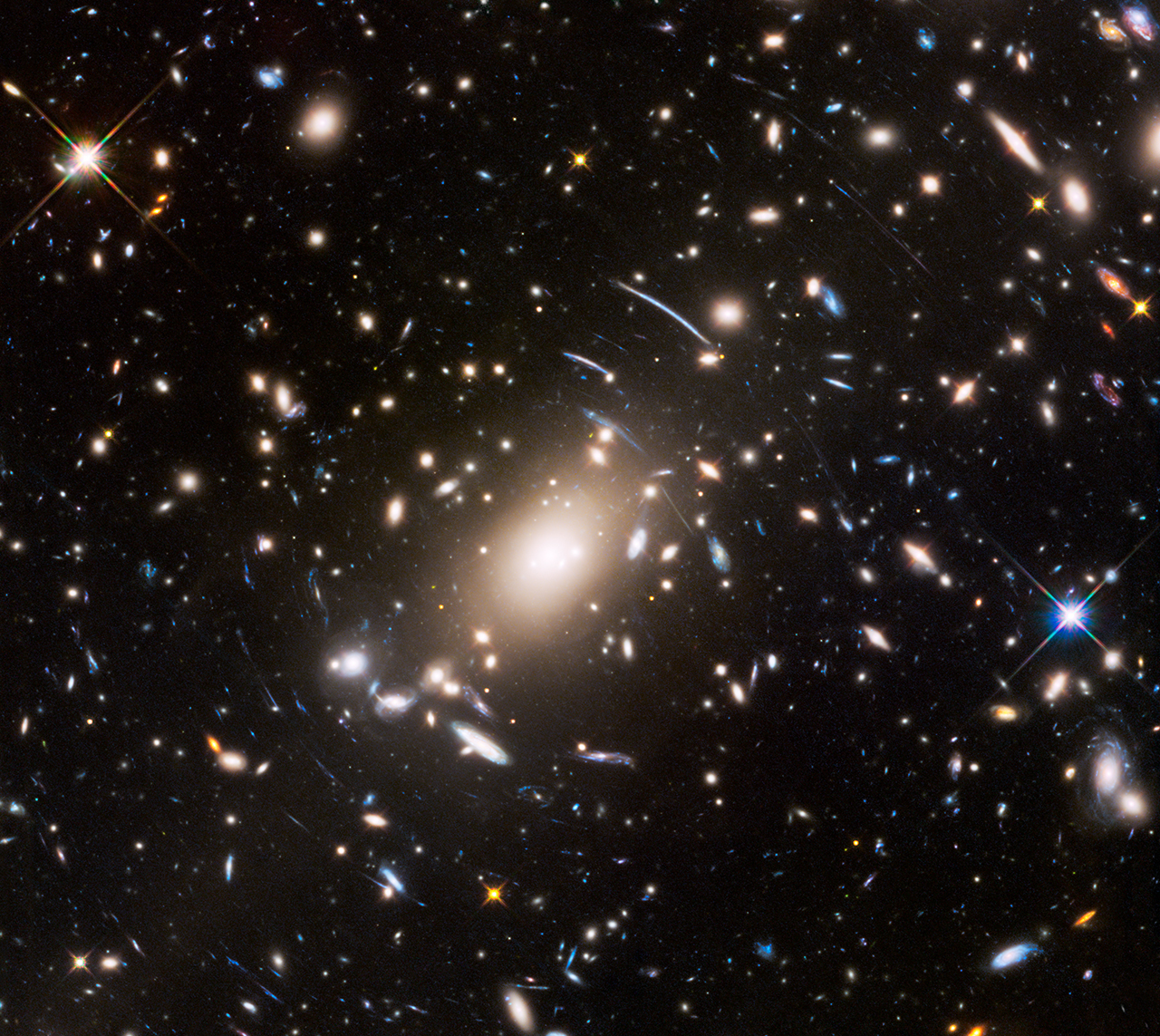
Some 4 billion light-years away, galaxies of massive Abell S1063 cluster near the center of this sharp Hubble Space Telescope snapshot. But the fainter bluish arcs are magnified images of galaxies that lie far beyond Abell S1063. About twice as distant, their otherwise undetected light is magnified and distorted by the cluster's largely unseen gravitational mass, approximately 100 trillion times the mass of the Sun. Providing a tantalizing glimpse of galaxies in the early universe, the effect is known as gravitational lensing. A consequence of warped spacetime it was first predicted by Einstein a century ago. The Hubble image is part of the Frontier Fields program to explore the Final Frontier.
A unos 4 mil millones de años luz de distancia, las galaxias del masivo cúmulo Abell S1063 se agrupan cerca del centro de esta nítida imagen captada por el Telescopio Espacial Hubble. Sin embargo, los arcos azules más tenues son imágenes ampliadas de galaxias que se encuentran mucho más allá de Abell S1063. A unas dos veces mayor distancia, su luz, de lo contrario indetectable, es amplificada y distorsionada por la masa gravitacional no visible del cúmulo, que es aproximadamente 100 billones de veces la masa del Sol. Este efecto, que ofrece una fascinante visión de galaxias en el universo primitivo, se conoce como lente gravitacional. Consecuencia del espacio-tiempo curvado, fue predicho por primera vez por Einstein hace un siglo. La imagen del Hubble forma parte del programa Frontier Fields para explorar la Última Frontera.