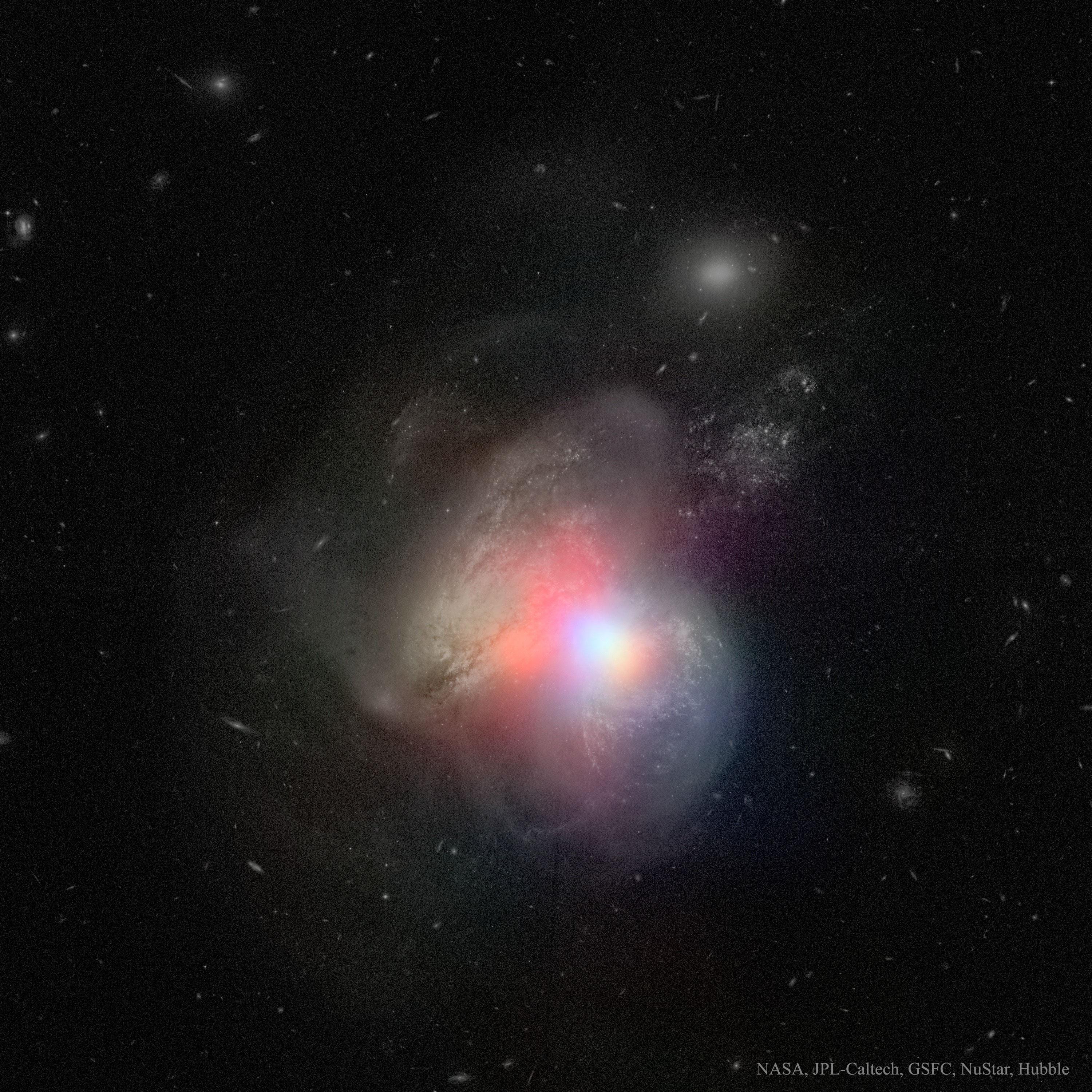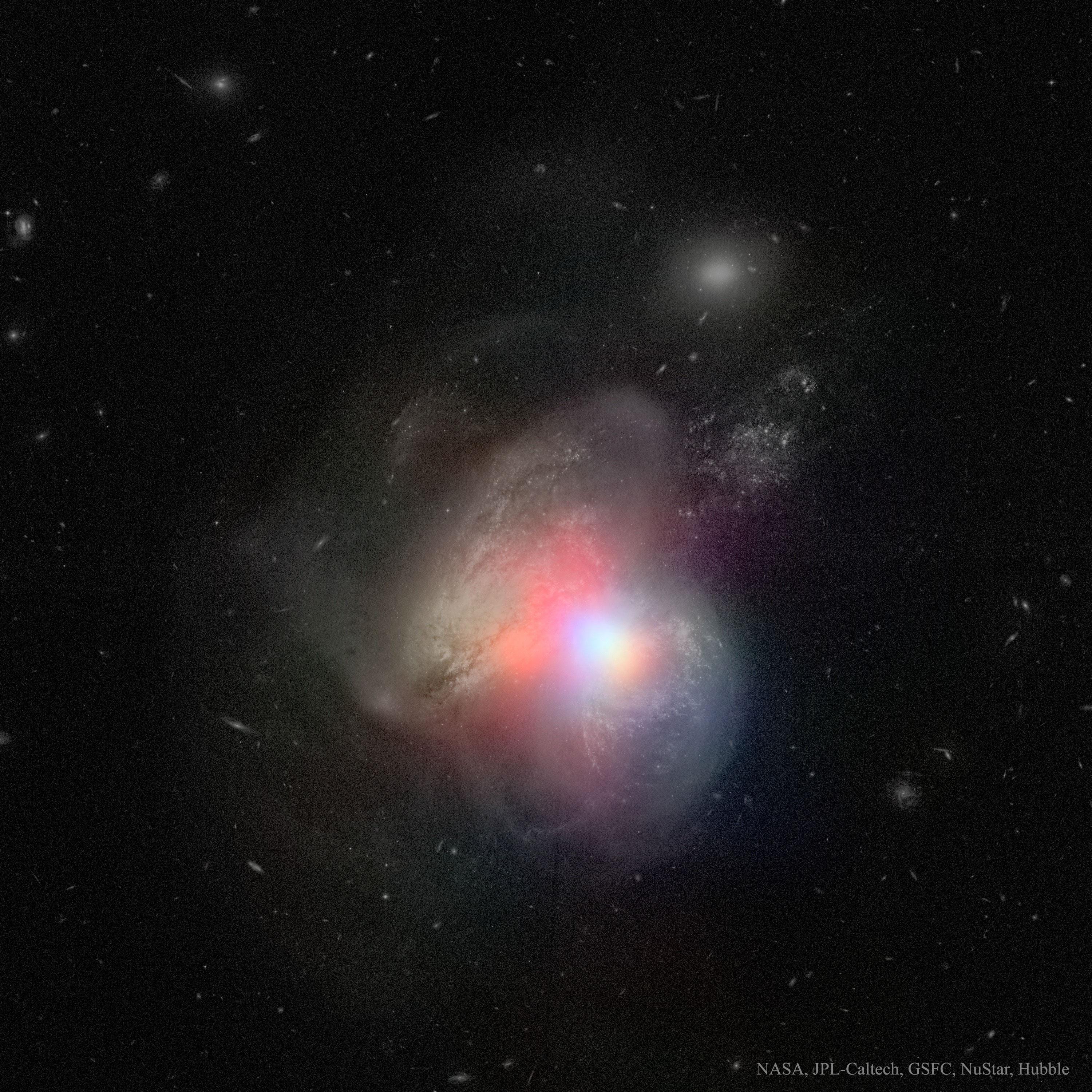
Is only one black hole spewing high energy radiation -- or two? To help find out, astronomers trained NASA's Earth-orbiting NuSTAR and Chandra telescopes on Arp 299, the enigmatic colliding galaxies expelling the radiation. The two galaxies of Arp 299 have been locked in a gravitational combat for millions of years, while their central black holes will soon do battle themselves. Featured, the high-resolution visible-light image was taken by Hubble, while the superposed diffuse glow of X-ray light was imaged by NuSTAR and shown in false-color red, green, and blue. NuSTAR observations show that only one of the central black holes is seen fighting its way through a region of gas and dust -- and so absorbing matter and emitting X-rays. The energetic radiation, coming only from the galaxy center on the right, is surely created nearby -- but outside -- the central black hole's event horizon. In a billion years or so, only one composite galaxy will remain, and only one central supermassive black hole. Soon thereafter, though, another galaxy may enter the fray. Transparent Science: Browse 1,350+ codes in the Astrophysics Source Code Library
¿Es solo un agujero negro el que emite radiación de alta energía, o son dos? Para ayudar a descubrirlo, los astrónomos dirigieron los telescopios orbitales de la NASA NuSTAR y Chandra hacia Arp 299, las enigmáticas galaxias colisionando que expulsan esa radiación. Las dos galaxias de Arp 299 han estado en una lucha gravitacional durante millones de años, mientras que sus agujeros negros centrales pronto se enfrentarán ellos mismos. La imagen de alta resolución en luz visible mostrada aquí fue tomada por el telescopio Hubble, mientras que el brillo difuso de la luz X superpuesto fue capturado por NuSTAR y mostrado en colores falsos rojo, verde y azul. Las observaciones de NuSTAR muestran que solo uno de los agujeros negros centrales se ve luchando para atravesar una región de gas y polvo, absorbiendo materia y emitiendo rayos X. La radiación energética, que proviene solo del centro de la galaxia de la derecha, seguramente se genera cerca, pero fuera, del horizonte de sucesos del agujero negro central. En unos mil millones de años, solo quedará una galaxia compuesta, y solo un agujero negro supermasivo central. Poco después, sin embargo, otra galaxia podría unirse a la batalla.