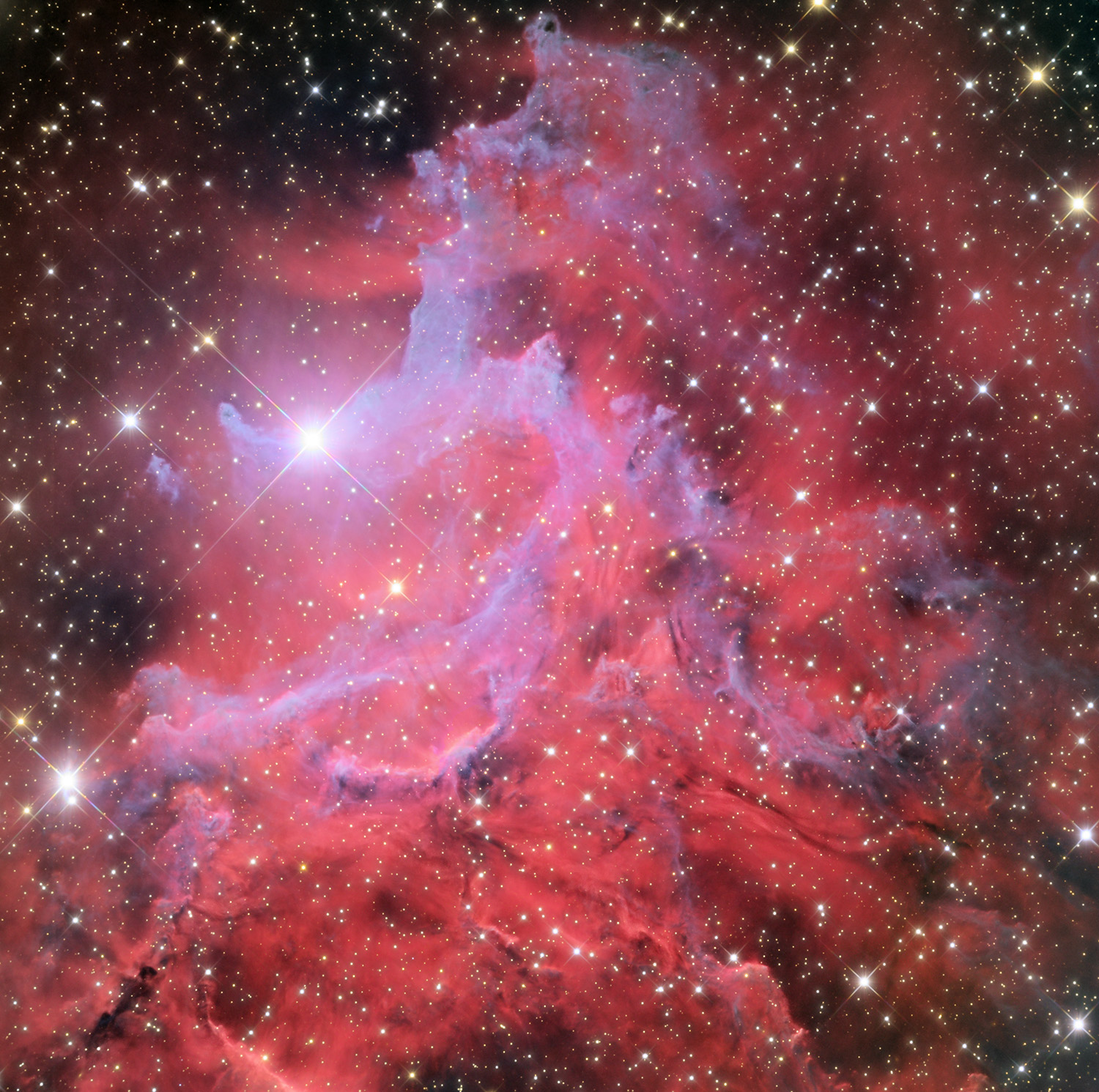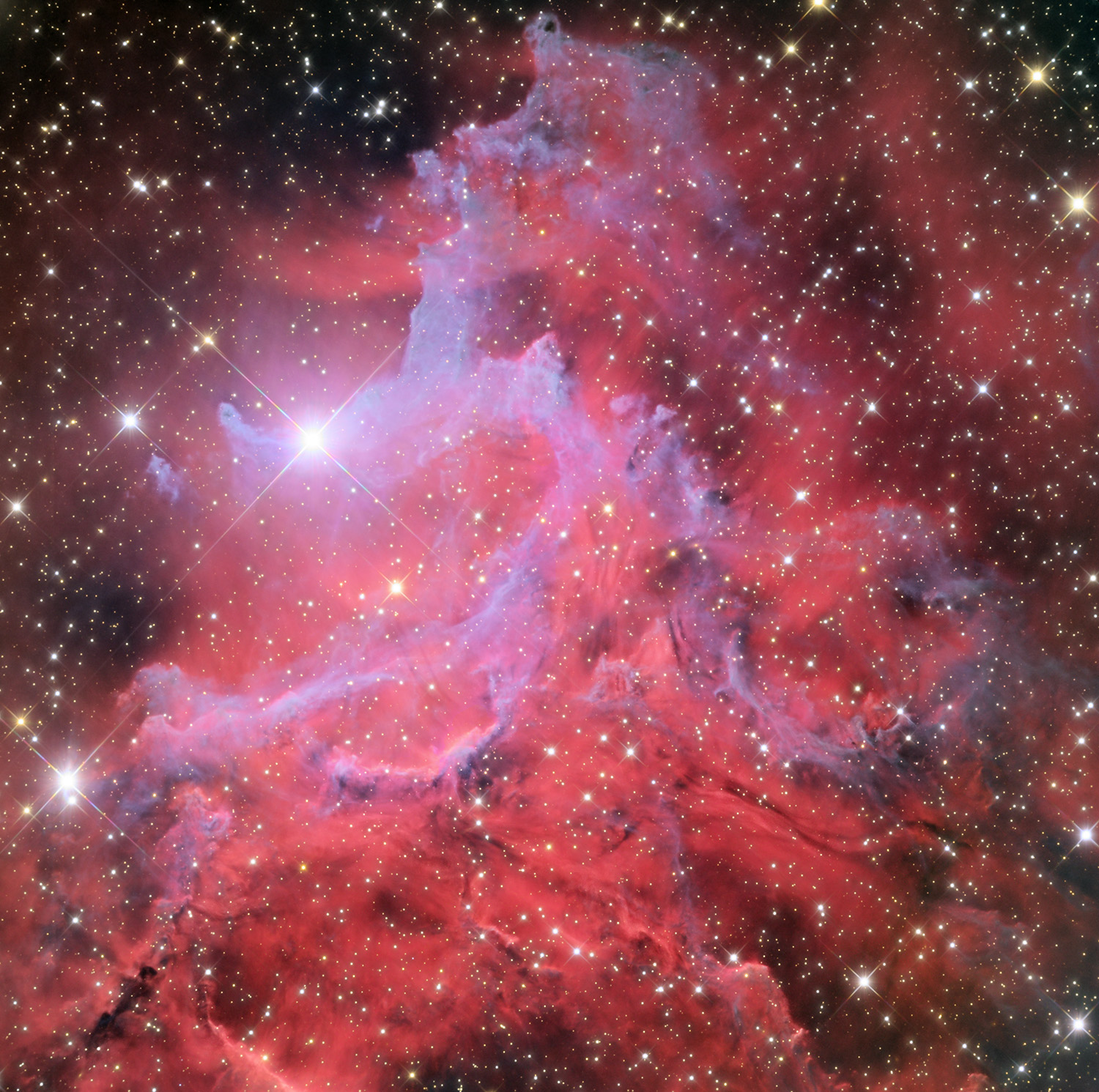
A runaway star lights the Flaming Star Nebula in this cosmic scene. Otherwise known as IC 405, the Flaming Star Nebula's billowing interstellar clouds of gas and dust lie about 1,500 light-years away toward the constellation of Auriga. AE Aurigae, the bright star at upper left in the frame, is a massive and intensely hot O-type star moving rapidly through space, likely ejected from a collision of multiple star-systems in the vicinity of the Orion Nebula millions of years ago. Now close to IC 405, the high-speed star's ionizing ultraviolet radiation powers the visible reddish glow as the nebula's hydrogen atoms are stripped of their electrons and recombine. Its intense blue starlight is reflected by the nebula's dusty filaments. Like all massive stars AE Aurigae will be short-lived though, furiously burning through its supply of fuel for nuclear fusion and exploding as a supernova. The colorful telescopic snapshot spans about 5 light-years at the estimated distance of the Flaming Star Nebula.
Una estrella errante ilumina la Nebulosa Estrella en Llamas en esta escena cósmica. También conocida como IC 405, las nubes interestelares de gas y polvo que componen la Nebulosa Estrella en Llamas se encuentran a unos 1.500 años luz de distancia, hacia la constelación de Auriga. AE Aurigae, la estrella brillante en la parte superior izquierda de la imagen, es una estrella masiva y extremadamente caliente de tipo O que se mueve rápidamente a través del espacio, probablemente expulsada como resultado de una colisión entre múltiples sistemas estelares en las cercanías de la Nebulosa de Orión hace millones de años. Ahora cerca de IC 405, la radiación ultravioleta ionizante de la estrella de alta velocidad alimenta el brillo rojizo visible, ya que los átomos de hidrógeno de la nebulosa se ven privados de sus electrones y se recombinan. Su intensa luz azul es reflejada por los filamentos polvorientos de la nebulosa. Al igual que todas las estrellas masivas, AE Aurigae tendrá una vida corta, quemando furiosamente su suministro de combustible para la fusión nuclear y explotando como una supernova. La imagen telescópica de colores abarca aproximadamente 5 años luz a la distancia estimada de la Nebulosa Estrella en Llamas.