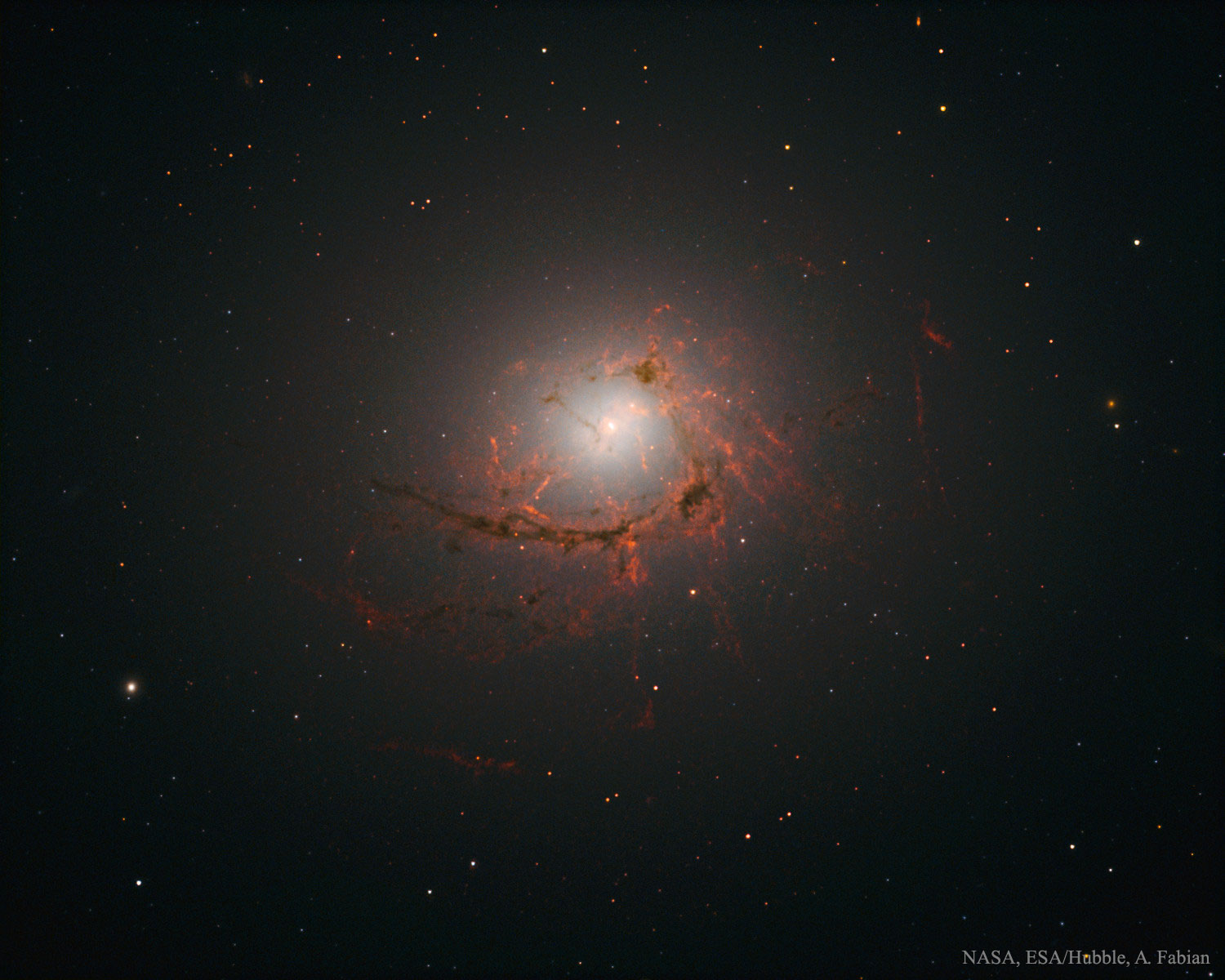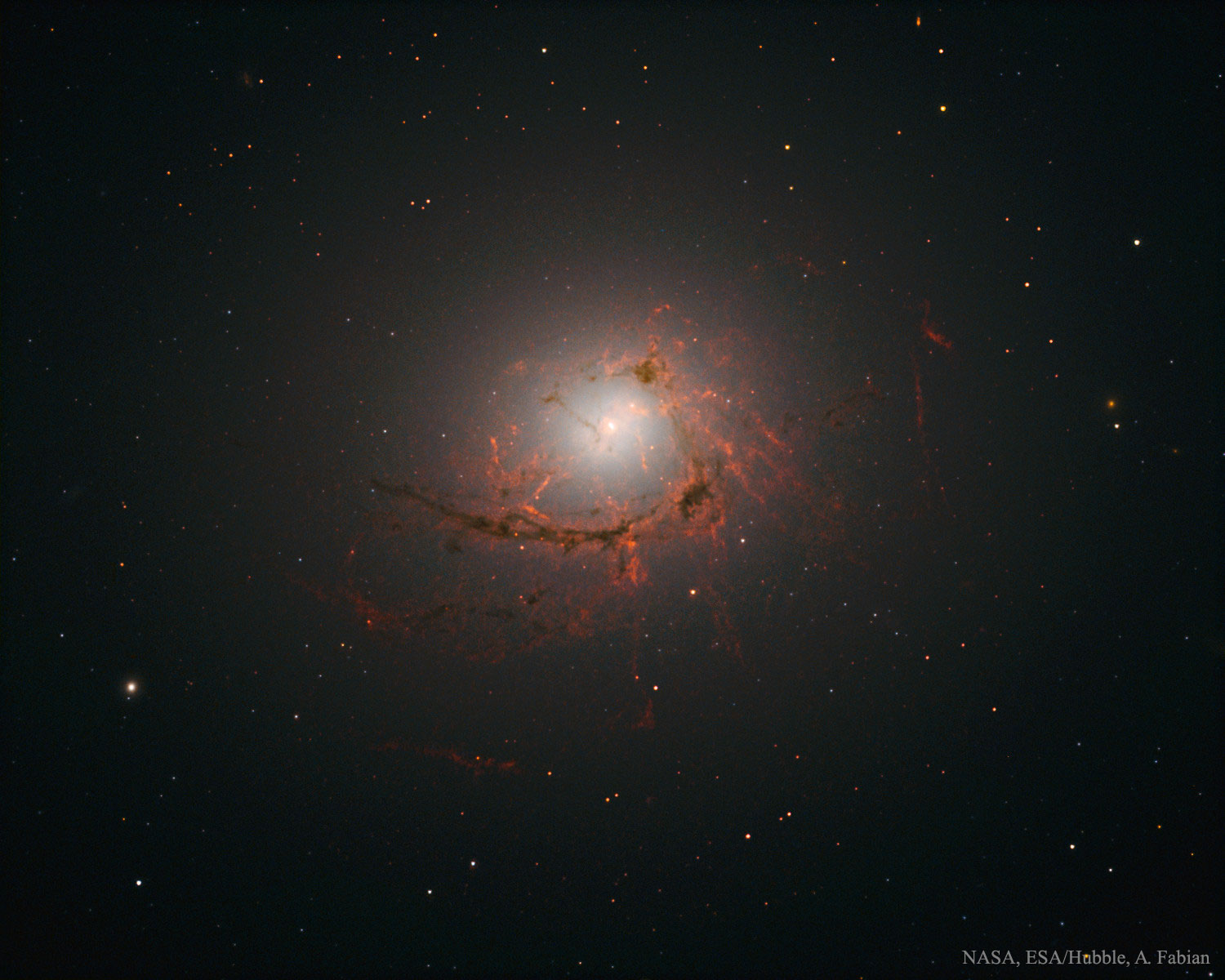
What's happening at the center of elliptical galaxy NGC 4696? There, long tendrils of gas and dust have been imaged in great detail as shown by this recently released image from the Hubble Space Telescope. These filaments appear to connect to the central region of the galaxy, a region thought occupied by a supermassive black hole. Speculation holds that this black hole pumps out energy that heats surrounding gas, pushes out cooler filaments of gas and dust, and shuts down star formation. Balanced by magnetic fields, these filaments then appear to spiral back in toward and eventually circle the central black hole. NGC 4696 is the largest galaxy in the Centaurus Cluster of Galaxies, located about 150 million light years from Earth. The featured image shows a region about 45,000 light years across.
¿Qué está ocurriendo en el centro de la galaxia elíptica NGC 4696? Allí, largos tentáculos de gas y polvo han sido capturados en gran detalle, como se muestra en esta imagen recientemente publicada del Telescopio Espacial Hubble. Estos filamentos parecen conectarse a la región central de la galaxia, una región que se cree que alberga un agujero negro supermasivo. Se especula que este agujero negro emite energía que calienta el gas circundante, empuja hacia afuera los filamentos de gas y polvo más fríos y detiene la formación estelar. Equilibrados por campos magnéticos, estos filamentos luego parecen enrollarse de nuevo hacia adentro y eventualmente rodear el agujero negro central. NGC 4696 es la galaxia más grande del Grupo de Galaxias de Centauro, ubicada aproximadamente a 150 millones de años luz de la Tierra. La imagen destacada muestra una región de aproximadamente 45 000 años luz de ancho.