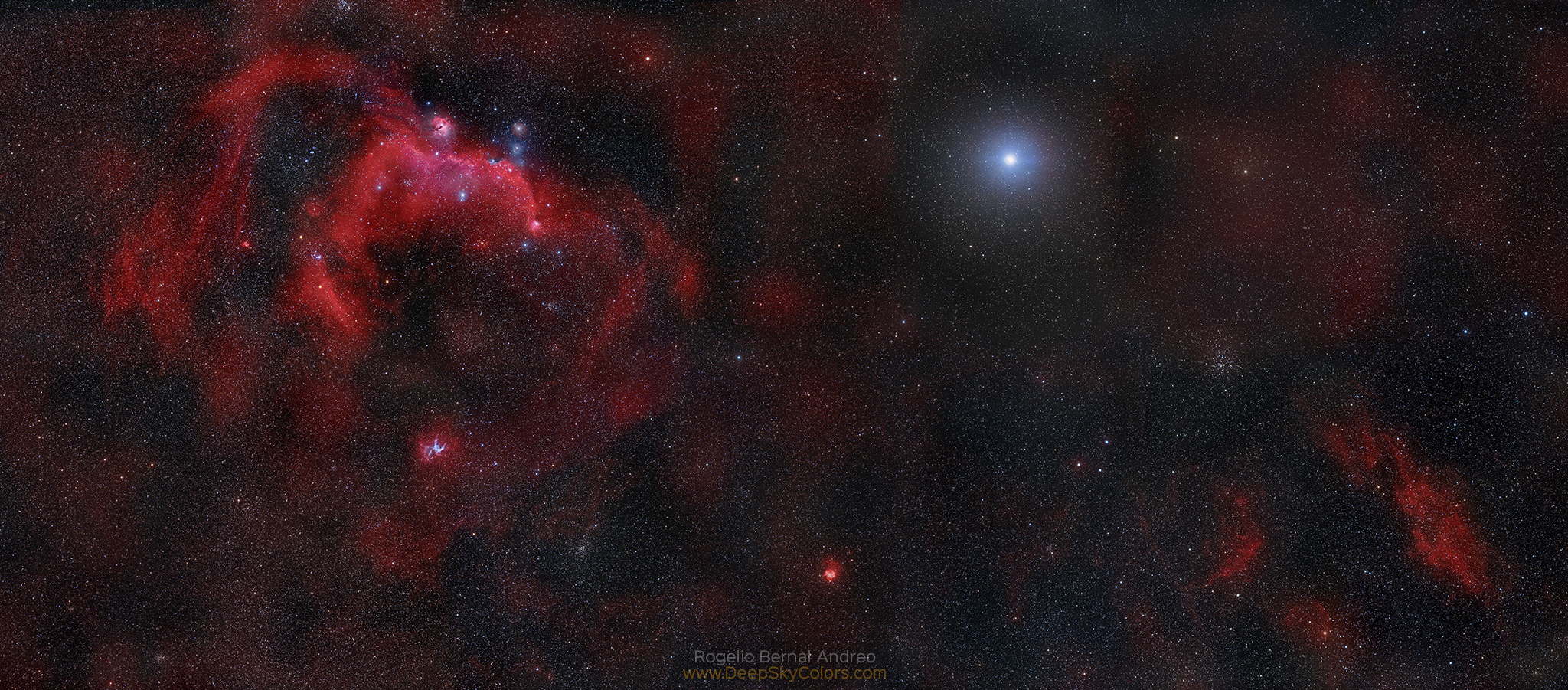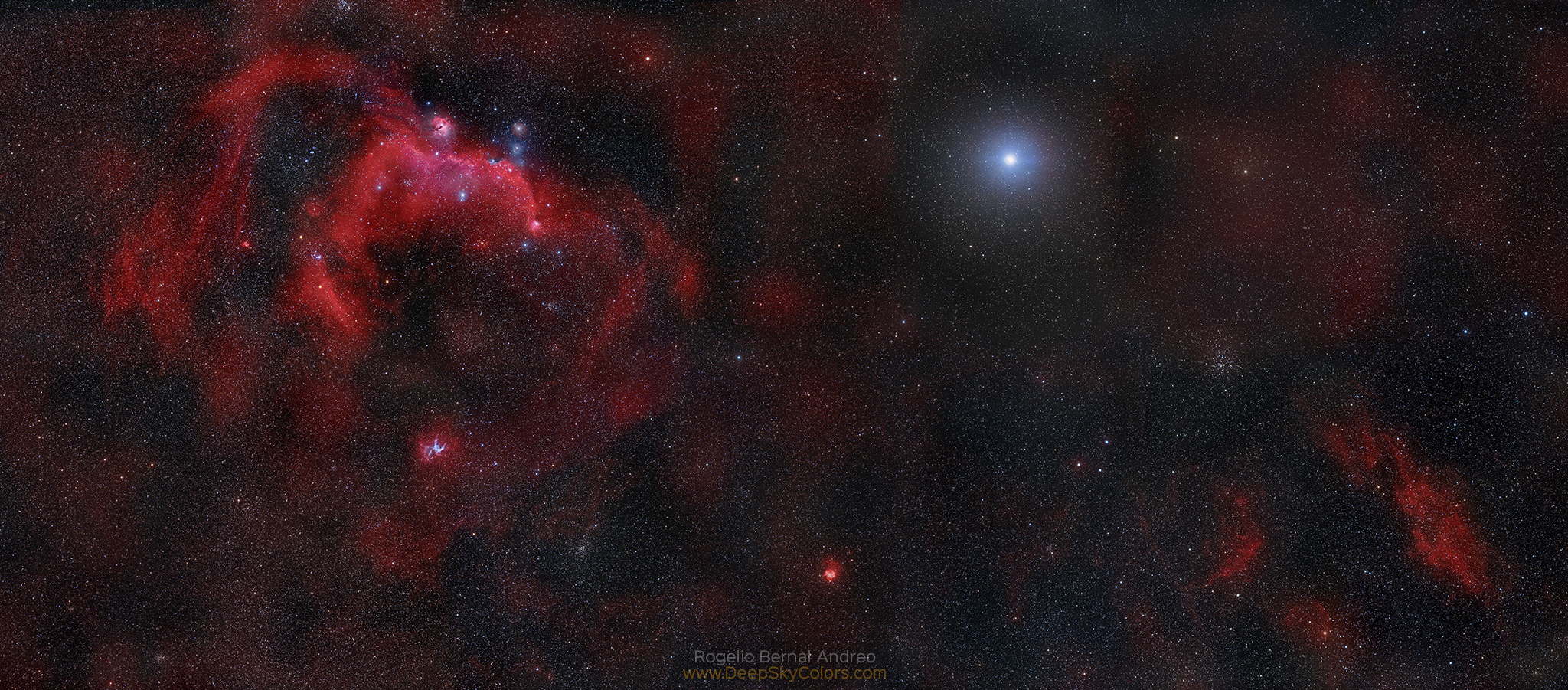
This broad, beautiful mosaic spans almost 20 degrees across planet Earth's sky. The nebula-rich region lies near the edge of the Orion-Eridanus superbubble, filled with looping, expanding shells of gas and dust embedded in molecular clouds near the plane of the Milky Way Galaxy. Recognizable at the left is the expansive Seagull Nebula, composed of emission nebula NGC 2327, seen as the seagull's head, with the more diffuse IC 2177 as the wings and body. Some 3,800 light-years away, the wings of the Seagull Nebula spread about 240 light-years, still within our local spiral arm. The bluish light of Sirius, alpha star of Canis Major and brightest star in the night, easily dominates the scene at right but shines from a distance of only 8.6 light-years. Study the big picture and you should also be rewarded with star cluster Messier 41, also known as NGC 2287, not to mention the mighty Thor's Helmet.
Este amplio y hermoso mosaico abarca casi 20 grados del cielo terrestre. La región rica en nebulosas se encuentra cerca del borde de la superburbuja de Orion-Eridanus, llena de capas en forma de bucle y expansivas de gas y polvo incrustadas en nubes moleculares cerca del plano de la Galaxia de la Vía Láctea. A la izquierda se reconoce la extensa Nebulosa Seagull, compuesta por la nebulosa emisora NGC 2327, que se ve como la cabeza del gull, con la más difusa IC 2177 como alas y cuerpo. A unos 3800 años luz de distancia, las alas de la Nebulosa Seagull se extienden aproximadamente 240 años luz, aún dentro de nuestro brazo espiral local. La luz azulada de Sirius, estrella alfa de Canis Major y la estrella más brillante del cielo nocturno, domina fácilmente la escena a la derecha, pero brilla desde una distancia de solo 8,6 años luz. Al estudiar la imagen completa, también se debe recompensar con el cúmulo estelar Messier 41, también conocido como NGC 2287, sin mencionar el poderoso casco de Thor.