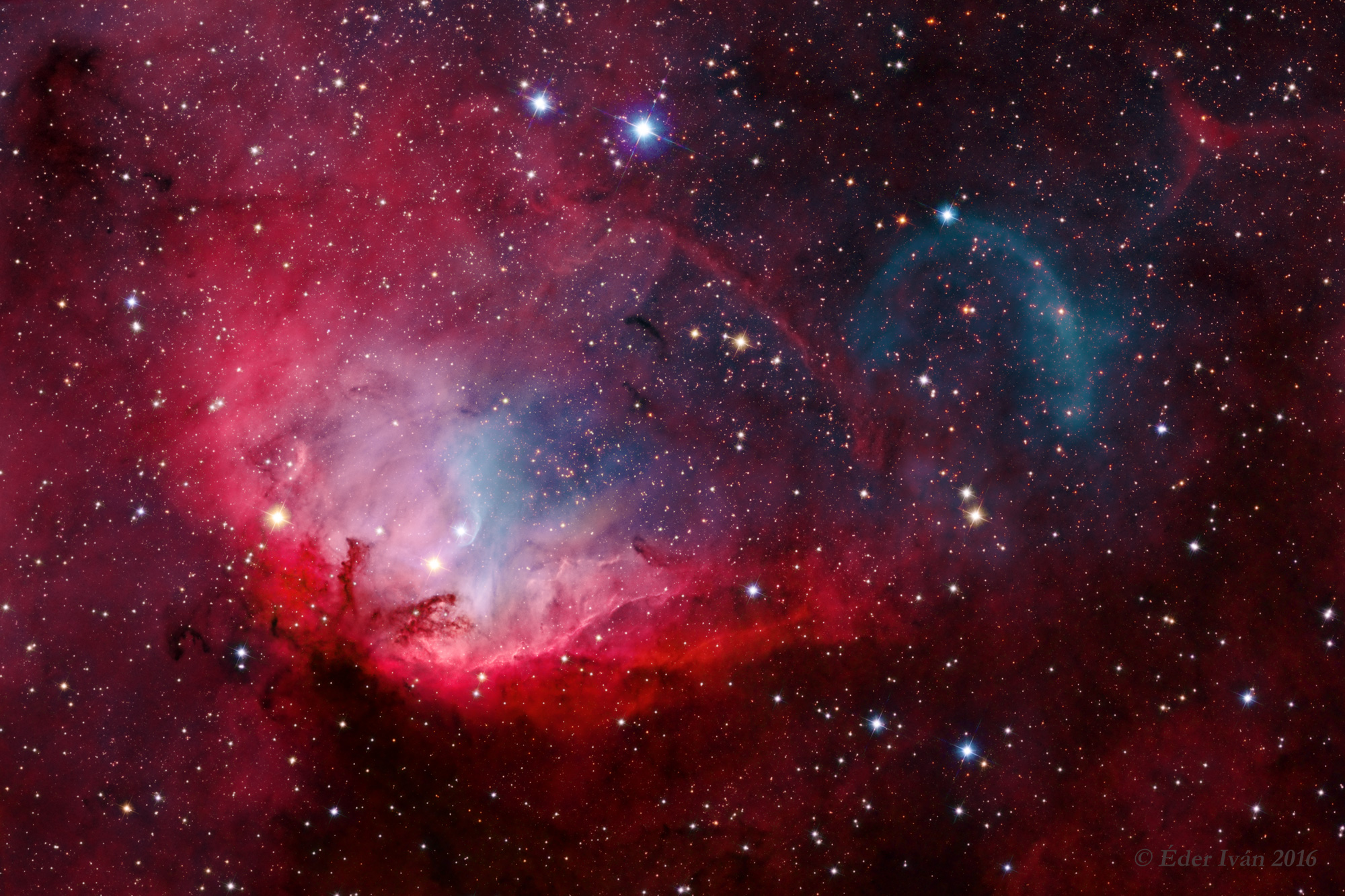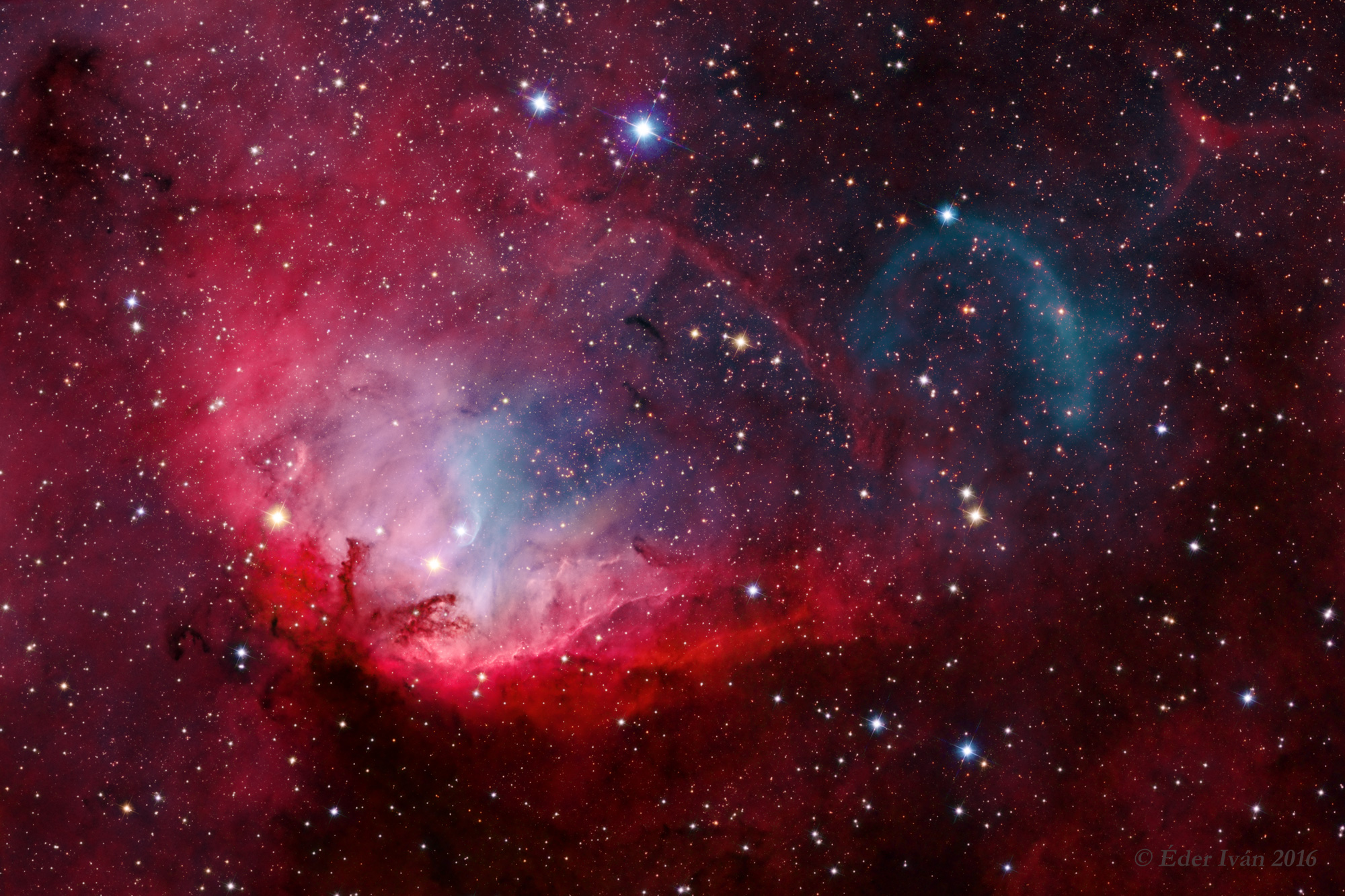
Framing a bright emission region, this telescopic view looks out along the plane of our Milky Way Galaxy toward the nebula rich constellation Cygnus the Swan. Popularly called the Tulip Nebula, the reddish glowing cloud of interstellar gas and dust is also found in the 1959 catalog by astronomer Stewart Sharpless as Sh2-101. About 8,000 light-years distant and 70 light-years across the complex and beautiful nebula blossoms at the center of this composite image. Ultraviolet radiation from young energetic stars at the edge of the Cygnus OB3 association, including O star HDE 227018, ionizes the atoms and powers the emission from the Tulip Nebula. HDE 227018 is the bright star near the center of the nebula. Also framed in the field of view is microquasar Cygnus X-1, one of the strongest X-ray sources in planet Earth's sky. Driven by powerful jets from a black hole accretion disk, its fainter visible curved shock front lies above and right, just beyond the cosmic Tulip's petals
Enfocando una región brillante de emisión, esta imagen telescópica mira a lo largo del plano de nuestra Galaxia Vía Láctea hacia la constelación rica en nebulosas de Cisne. Popularmente conocida como la Nebulosa Tulipán, la nube rojiza de gas y polvo interestelar que brilla es también encontrada en el catálogo de 1959 del astrónomo Stewart Sharpless como Sh2-101. A unos 8,000 años luz de distancia y con un diámetro de 70 años luz, la compleja y bella nebulosa florece en el centro de esta imagen compuesta. La radiación ultravioleta de estrellas jóvenes y energéticas en el borde de la asociación OB3 de Cisne, incluyendo la estrella O HDE 227018, ioniza los átomos y alimenta la emisión de la Nebulosa Tulipán. HDE 227018 es la estrella brillante cerca del centro de la nebulosa. También enmarcado en el campo de visión está el microcuásar Cygnus X-1, uno de los fuertes fuentes de rayos X en el cielo terrestre. Movido por potentes chorros de un disco de acreción de un agujero negro, su frente de choque visible más tenue se encuentra arriba y a la derecha, justo más allá de las pétalos de la tulipán cósmica.