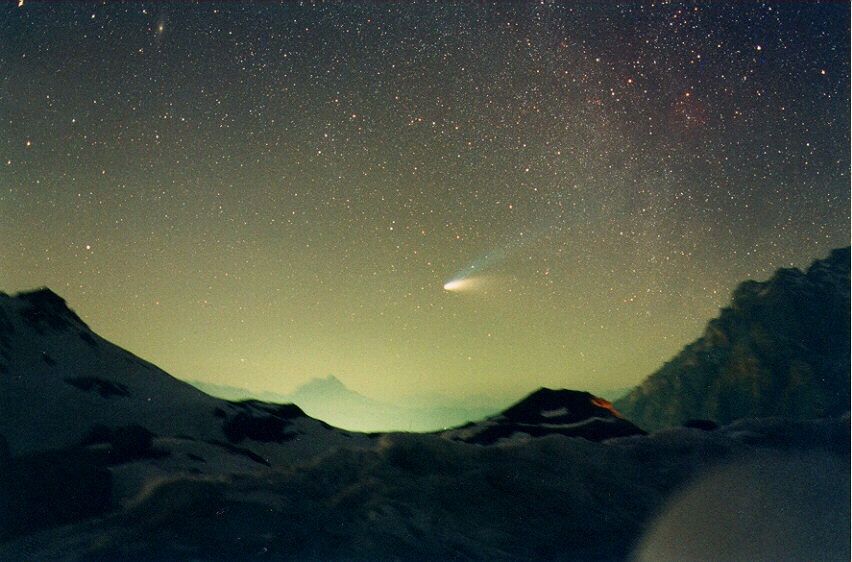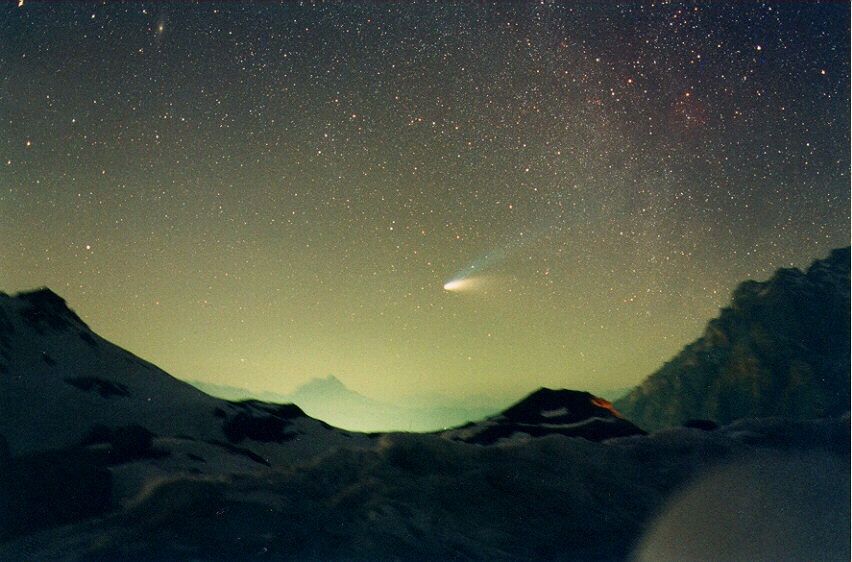
Comet Hale-Bopp, the Great Comet of 1997, became much brighter than any surrounding stars. It was seen even over bright city lights. Away from city lights, however, it put on quite a spectacular show. Here Comet Hale-Bopp was photographed above Val Parola Pass in the Dolomite mountains surrounding Cortina d'Ampezzo, Italy. Comet Hale-Bopp's blue ion tail, consisting of ions from the comet's nucleus, is pushed out by the solar wind. The white dust tail is composed of larger particles of dust from the nucleus driven by the pressure of sunlight, that orbit behind the comet. Comet Hale-Bopp (C/1995 O1) remained visible to the unaided eye for 18 months -- longer than any other comet in recorded history. This year marks the 20th anniversary of Comet Hale-Bopp's last trip to the inner Solar System. The large comet is next expected to return around the year 4385.
El Cometa Hale-Bopp, el Gran Cometa de 1997, se volvió mucho más brillante que cualquier estrella circundante. Fue visible incluso sobre las luces brillantes de las ciudades. Sin embargo, lejos de las luces urbanas, ofreció una espectacular demostración. Aquí se fotografió el Cometa Hale-Bopp sobre el Paso de Val Parola en las montañas Dolomitas que rodean Cortina d'Ampezzo, Italia. La cola ionizada azul del Cometa Hale-Bopp, compuesta por iones provenientes del núcleo del cometa, es empujada hacia afuera por el viento solar. La cola de polvo blanca está compuesta por partículas más grandes de polvo del núcleo, impulsadas por la presión de la luz solar, que orbitan detrás del cometa. El Cometa Hale-Bopp (C/1995 O1) estuvo visible a simple vista durante 18 meses — más tiempo que cualquier otro cometa en la historia registrada. Este año marca el 20 aniversario de la última visita del Cometa Hale-Bopp al Sistema Solar interior. El gran cometa se espera que regrese alrededor del año 4385.