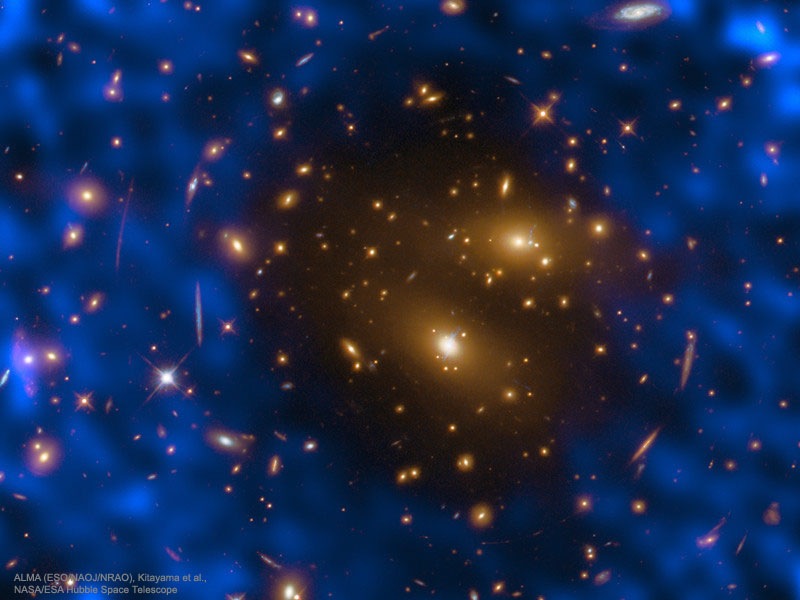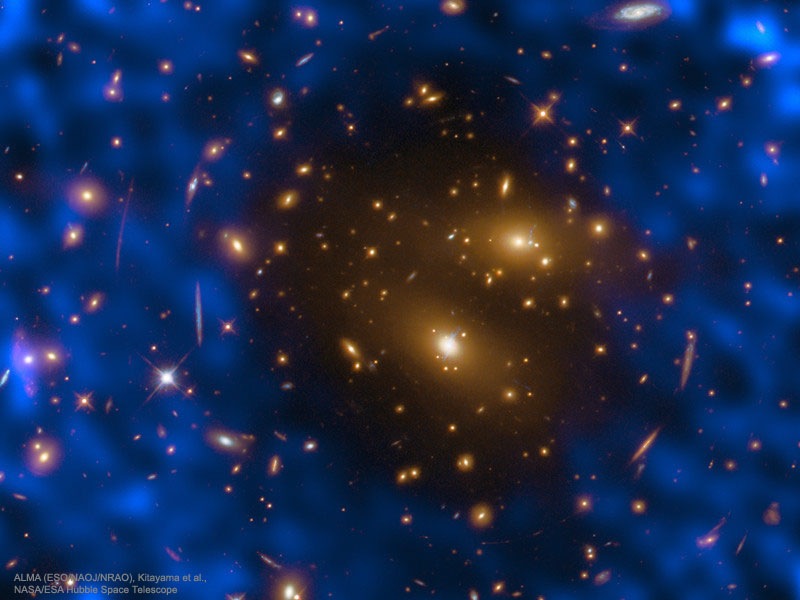
Why would this cluster of galaxy punch a hole in the cosmic microwave background (CMB)? First, the famous CMB was created by cooling gas in the early universe and flies right through most gas and dust in the universe. It is all around us. Large clusters of galaxies have enough gravity to contain very hot gas -- gas hot enough to up-scatter microwave photons into light of significantly higher energy, thereby creating a hole in CMB maps. This Sunyaev�Zel'dovich (SZ) effect has been used for decades to reveal new information about hot gas in clusters and even to help discover galaxy clusters in a simple yet uniform way. Pictured is the most detailed image yet obtained of the SZ effect, now using both ALMA to measure the CMB and the Hubble Space Telescope to measure the galaxies in the massive galaxy cluster RX J1347.5-1145. False-color blue depicts light from the CMB, while almost every yellow object is a galaxy. The shape of the SZ hole indicates not only that hot gas is present in this galaxy cluster, but also that it is distributed in a surprisingly uneven manner.
¿Por qué este cúmulo de galaxias crearía un hueco en el fondo cósmico de microondas (CMB)? En primer lugar, el famoso CMB fue creado por el enfriamiento del gas en el universo temprano y atraviesa la mayor parte del gas y el polvo del universo. Está todo a nuestro alrededor. Los grandes cúmulos de galaxias tienen suficiente gravedad para contener gas muy caliente — gas lo suficientemente caliente como para dispersar hacia arriba los fotones de microondas en luz de energía significativamente mayor, creando así un hueco en los mapas del CMB. Este efecto Sunyaev–Zel'dovich (SZ) ha sido utilizado durante décadas para revelar nueva información sobre el gas caliente en los cúmulos y, incluso, para ayudar a descubrir cúmulos de galaxias de una manera simple y uniforme. La imagen mostrada es la más detallada obtenida hasta ahora del efecto SZ, utilizando ahora tanto ALMA para medir el CMB como el Telescopio Espacial Hubble para medir las galaxias en el cúmulo de galaxias masivo RX J1347.5-1145. El color azul falso representa la luz del CMB, mientras que casi todos los objetos amarillos son galaxias. La forma del hueco SZ indica no solo que hay gas caliente presente en este cúmulo de galaxias, sino también que está distribuido de una manera sorprendentemente desigual.