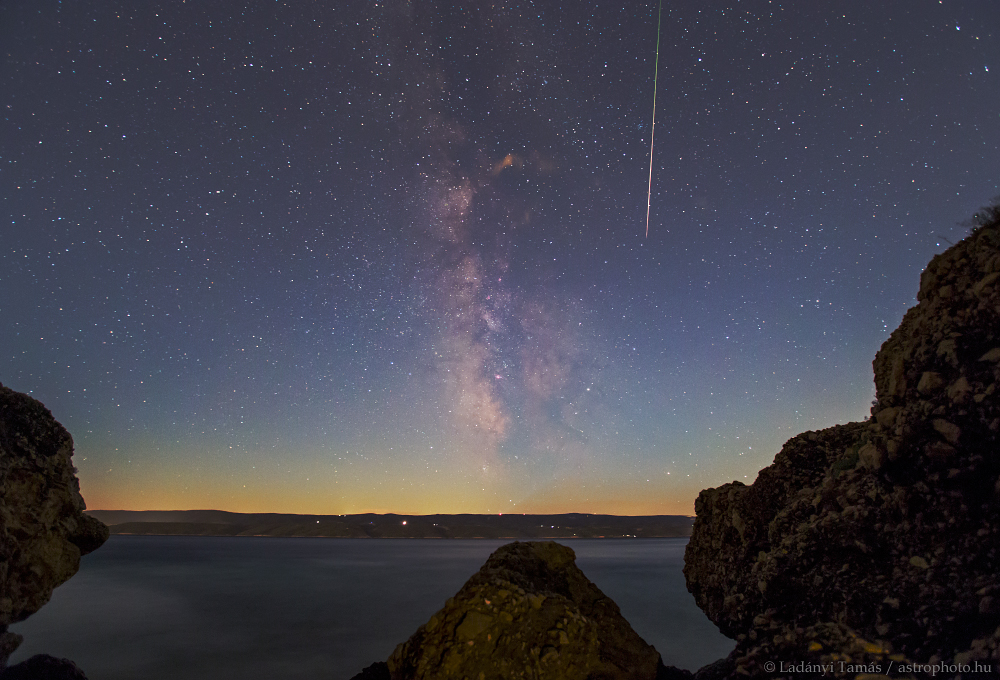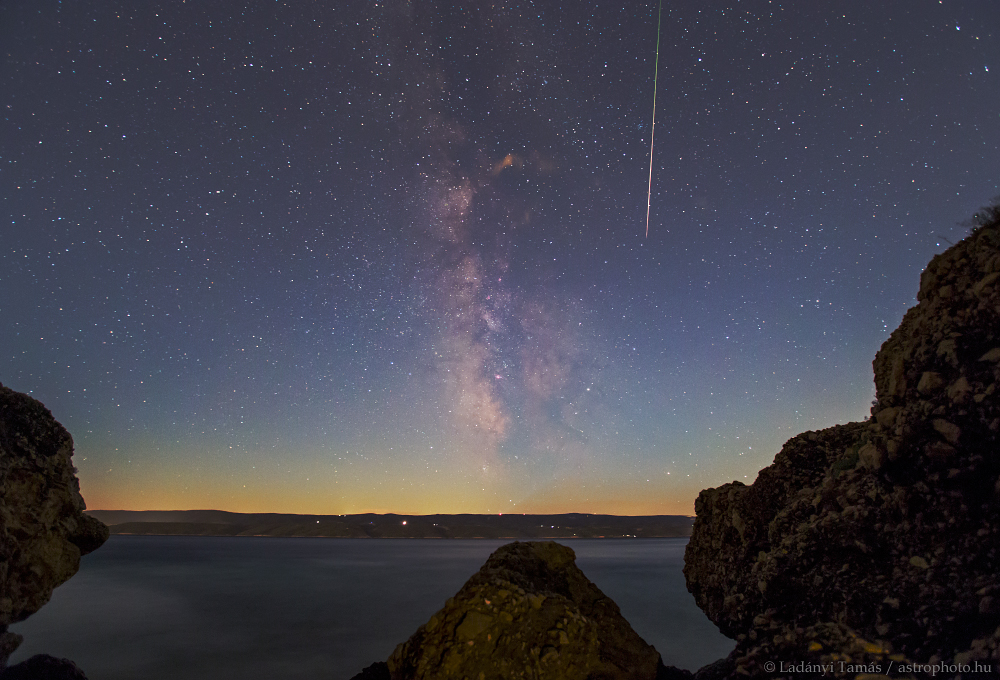
Just after moonrise on August 12 this grain of cosmic sand fell by the sea, its momentary flash part of the annual Perseid Meteor Shower. To create the Perseid meteors, dust along the orbit of periodic comet Swift-Tuttle is swept up by planet Earth. The cometary debris plows through the atmosphere at nearly 60 kilometers per second and is quickly vaporized at altitudes of 100 kilometers or so. Perseid meteors are often bright and colorful, like the one captured in this sea and night skyscape. Against starry sky and faint Milky Way the serene view looks south and west across the Adriatic Sea, from the moonlit Dalmatian coast toward the island of Brac.
Poco después de la salida de la luna el 12 de agosto, esta partícula de arena cósmica cayó junto al mar, su breve destello formando parte de la anual lluvia de meteoros Perseidas. Para crear los meteoros Perseidas, el polvo a lo largo de la órbita del cometa periódico Swift-Tuttle es recogido por la Tierra. El material cometario atraviesa la atmósfera a casi 60 kilómetros por segundo y es rápidamente vaporizado a altitudes de unos 100 kilómetros. Los meteoros Perseidas suelen ser brillantes y coloridos, como el capturado en este paisaje marino y nocturno. Frente al cielo estrellado y la tenue Vía Láctea, la tranquila vista mira hacia el sur y el oeste sobre el Mar Adriático, desde la costa de Dalmacia iluminada por la luna hacia la isla de Brač.