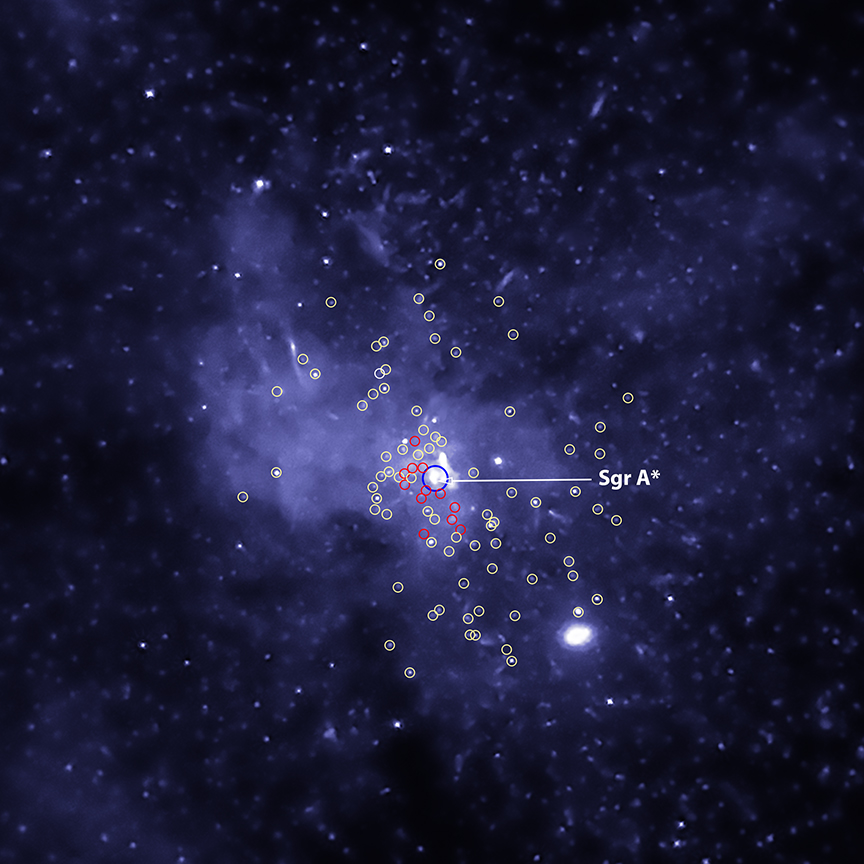
A recent informal poll found that astronomers don't yet have a good collective noun for a group of black holes, but they need one. The red circles in this Chandra Observatory X-ray image identify a group of a dozen black holes that are members of binary star systems. With 5 to 30 times the mass of the Sun, the black hole binaries are swarming within about 3 light-years of the center of our galaxy where the supermassive black hole identified as Sagittarius A* (Sgr A*) resides. Yellow circles indicate X-ray sources that are likely less massive neutron stars or white dwarf stars in binary star systems. Alone, black holes would be invisible, but as part of a binary star system they accrete material from their normal companion star and generate X-rays. At the distance of the galactic center Chandra can detect only the brighter of these black hole binary systems as point-like sources of X-rays, hinting that many fainter X-ray emitting black hole binaries should exist there, as yet undetected.
Una reciente encuesta informal reveló que los astrónomos aún no tienen un sustantivo colectivo adecuado para un grupo de agujeros negros, pero lo necesitan. Los círculos rojos en esta imagen en rayos X del Observatorio Chandra identifican un grupo de una docena de agujeros negros que son miembros de sistemas binarios de estrellas. Con una masa de 5 a 30 veces la del Sol, los sistemas binarios de agujeros negros se agrupan dentro de aproximadamente 3 años luz del centro de nuestra galaxia, donde reside el agujero negro supermasivo identificado como Sagitario A* (Sgr A*). Los círculos amarillos indican fuentes de rayos X que probablemente sean estrellas de neutrones o enanas blancas menos masivas en sistemas binarios de estrellas. Por sí solos, los agujeros negros serían invisibles, pero como parte de un sistema binario de estrellas, atraen material de su estrella compañera normal y generan rayos X. A la distancia del centro galáctico, Chandra solo puede detectar los sistemas binarios de agujeros negros más brillantes como fuentes puntuales de rayos X, lo que sugiere que allí existen muchos sistemas binarios de agujeros negros emisores de rayos X más débiles, aún no detectados.