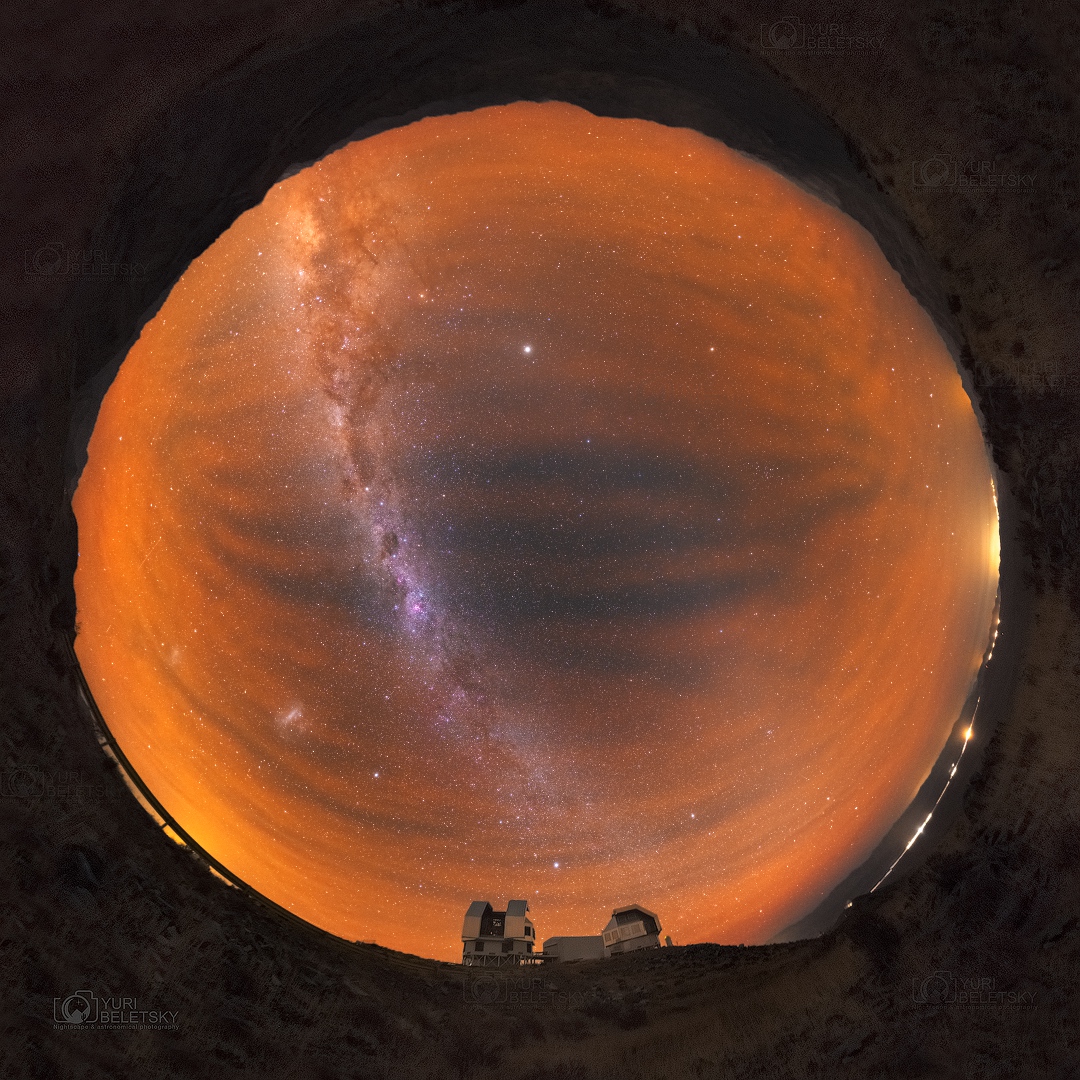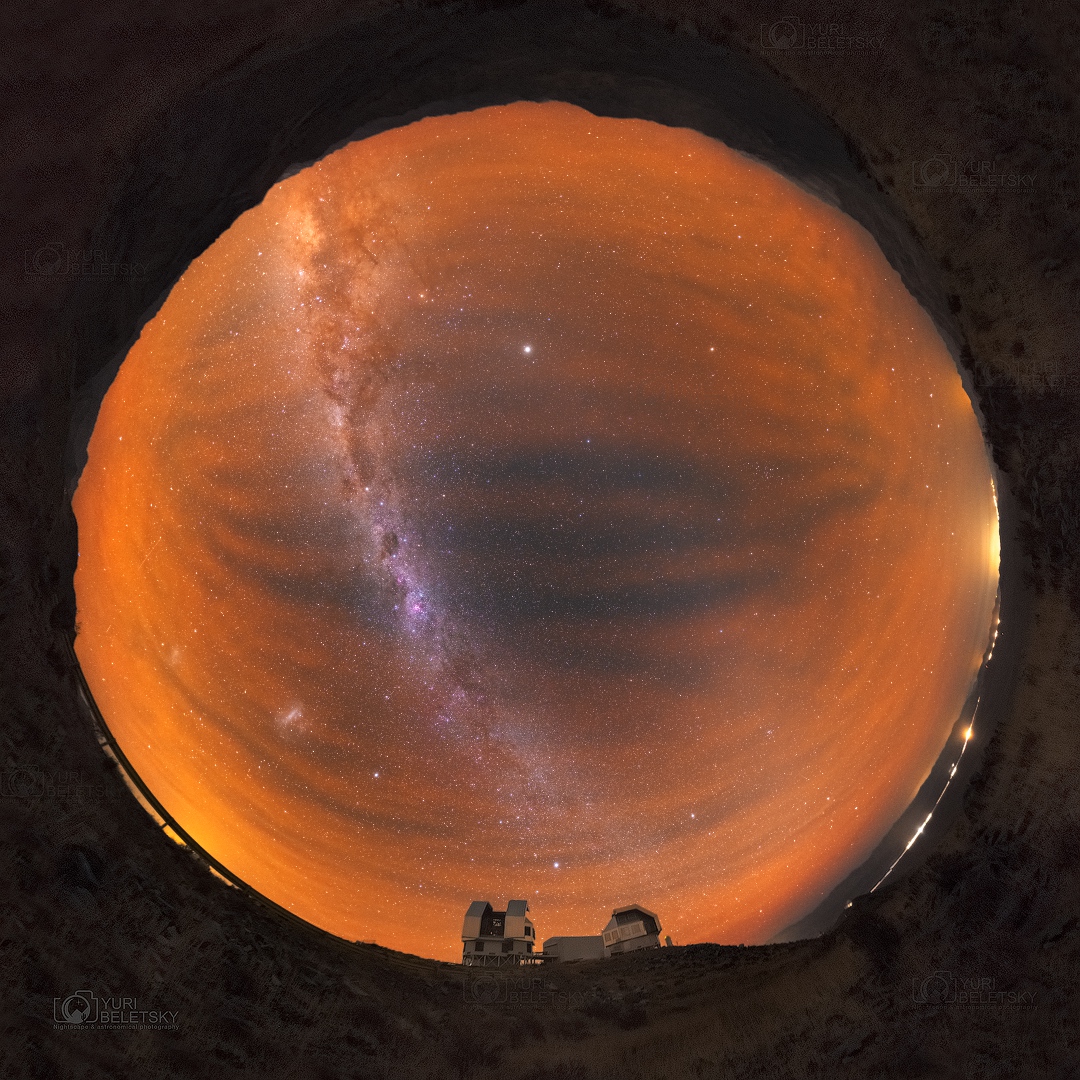
Captured last week after sunset on a Chilean autumn night, an exceptional airglow floods this allsky view from Las Campanas Observatory. The airglow was so intense it diminished parts of the Milky Way as it arced horizon to horizon above the high Atacama desert. Originating at an altitude similar to aurorae, the luminous airglow is due to chemiluminescence, the production of light through chemical excitation. Commonly recorded in color by sensitive digital cameras, the airglow emission here is fiery in appearance. It is predominately from atmospheric oxygen atoms at extremely low densities and has often been present during southern hemisphere nights over the last few years. Like the Milky Way, on that dark night the strong airglow was very visible to the eye, but seen without color. Jupiter is the brightest celestial beacon though, standing opposite the Sun and near the central bulge of the Milky Way rising above the eastern (top) horizon. The Large and Small Magellanic clouds both shine through the airglow to the lower left of the galactic plane, toward the southern horizon.
Capturada la semana pasada después del atardecer en una noche de otoño chilena, un brillo atmosférico excepcional inunda esta vista de todo el cielo desde el Observatorio Las Campanas. El brillo atmosférico fue tan intenso que atenuó partes de la Vía Láctea mientras se arqueaba del horizonte al horizonte sobre el alto desierto del Atacama. Originado a una altitud similar a la de las auroras, el luminoso brillo atmosférico se debe a la quimiluminiscencia, la producción de luz mediante la excitación química. A menudo grabado en color por cámaras digitales sensibles, la emisión de brillo atmosférico aquí tiene un aspecto ardiente. Predominantemente proviene de átomos de oxígeno atmosférico a densidades extremadamente bajas y ha estado presente con frecuencia durante las noches del hemisferio sur en los últimos años. Al igual que la Vía Láctea, en esa noche oscura el fuerte brillo atmosférico era muy visible a simple vista, aunque sin color. Júpiter es, sin embargo, la fuente celeste más brillante, situándose opuesto al Sol y cerca del bulbo central de la Vía Láctea que asciende sobre el horizonte oriental (superior). Las Nubes de Magallanes, tanto la Grande como la Pequeña, ambas brillan a través del brillo atmosférico, hacia la izquierda inferior del plano galáctico, en dirección al horizonte sur.