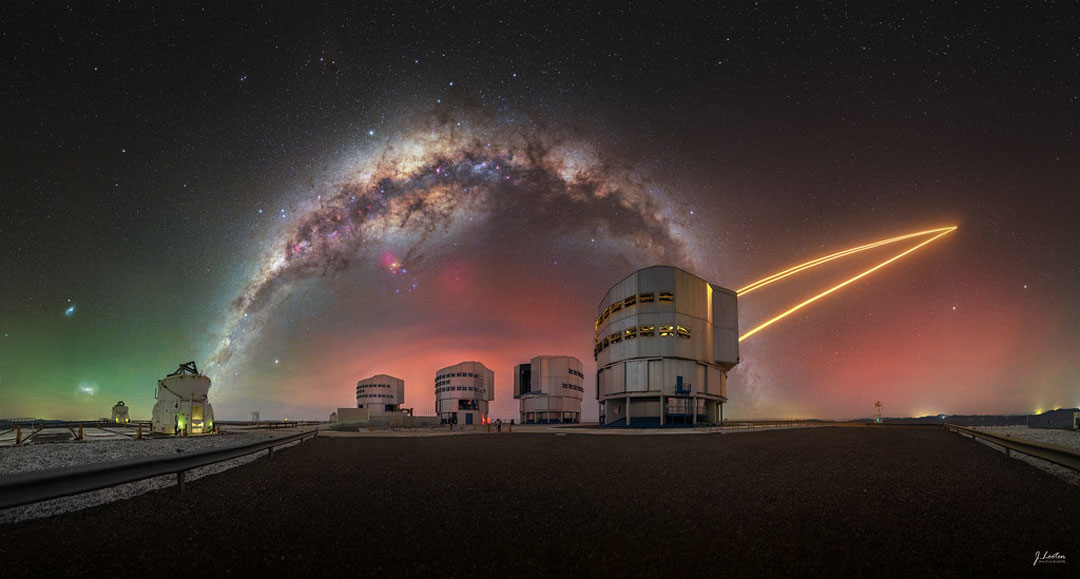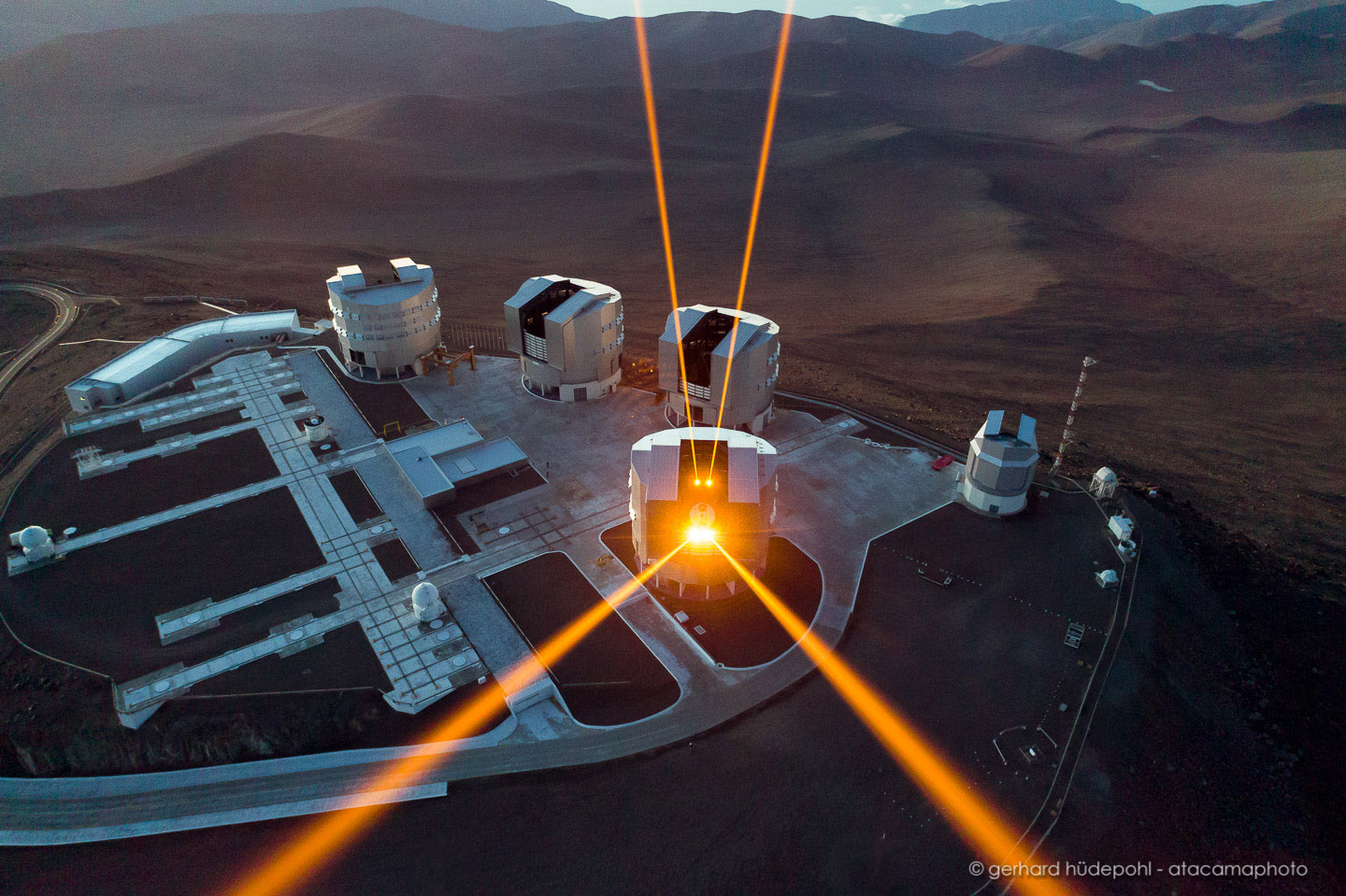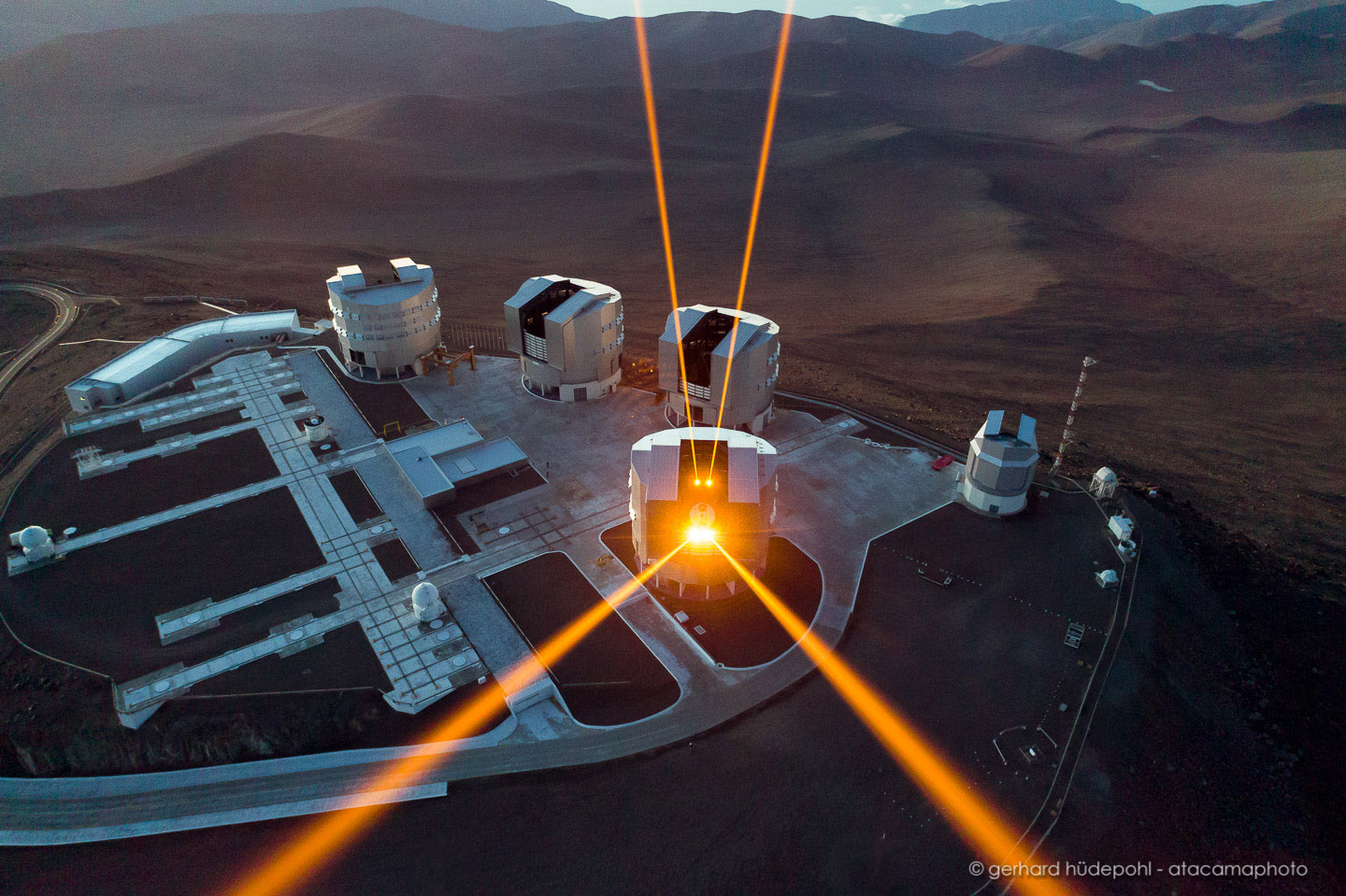
Dodging powerful laser beams, a drone captured this stunning aerial view. The confrontation took place above the 8.2 meter diameter Very Large Telescopes of the Paranal Observatory on planet Earth. Firing during a test of the observatory's 4 Laser Guide Star Facility, the lasers are ultimately battling against the blurring effect of atmospheric turbulence by creating artificial guide stars. The guide stars are actually emission from laser excited sodium atoms at high altitudes within the telescopic field of view. Guide star image fluctuations are used in real-time to correct for atmospheric blurring by controlling a deformable mirror in the telescope's optical path. Known as adaptive optics, the technique can produce images at the diffraction limit of the telescope. That's the same sharpness you would get if the telescope were in space.
Evitando haces láser de gran potencia, un dron capturó esta impresionante vista aérea. El enfrentamiento tuvo lugar sobre los telescopios de 8,2 metros de diámetro del Observatorio de Paranal en la Tierra. Durante una prueba del Sistema de 4 Estrellas Guía Láser del observatorio, los láseres luchan contra el efecto desenfocante de la turbulencia atmosférica creando estrellas guía artificiales. Estas estrellas guía son en realidad emisiones de átomos de sodio excitados por láser a altas altitudes dentro del campo de visión del telescopio. Las fluctuaciones en la imagen de las estrellas guía se utilizan en tiempo real para corregir el desenfoque atmosférico mediante el control de un espejo deformable en la trayectoria óptica del telescopio. Conocida como óptica adaptativa, esta técnica puede producir imágenes al límite de difracción del telescopio. Esa es la misma nitidez que obtendrías si el telescopio estuviera en el espacio.