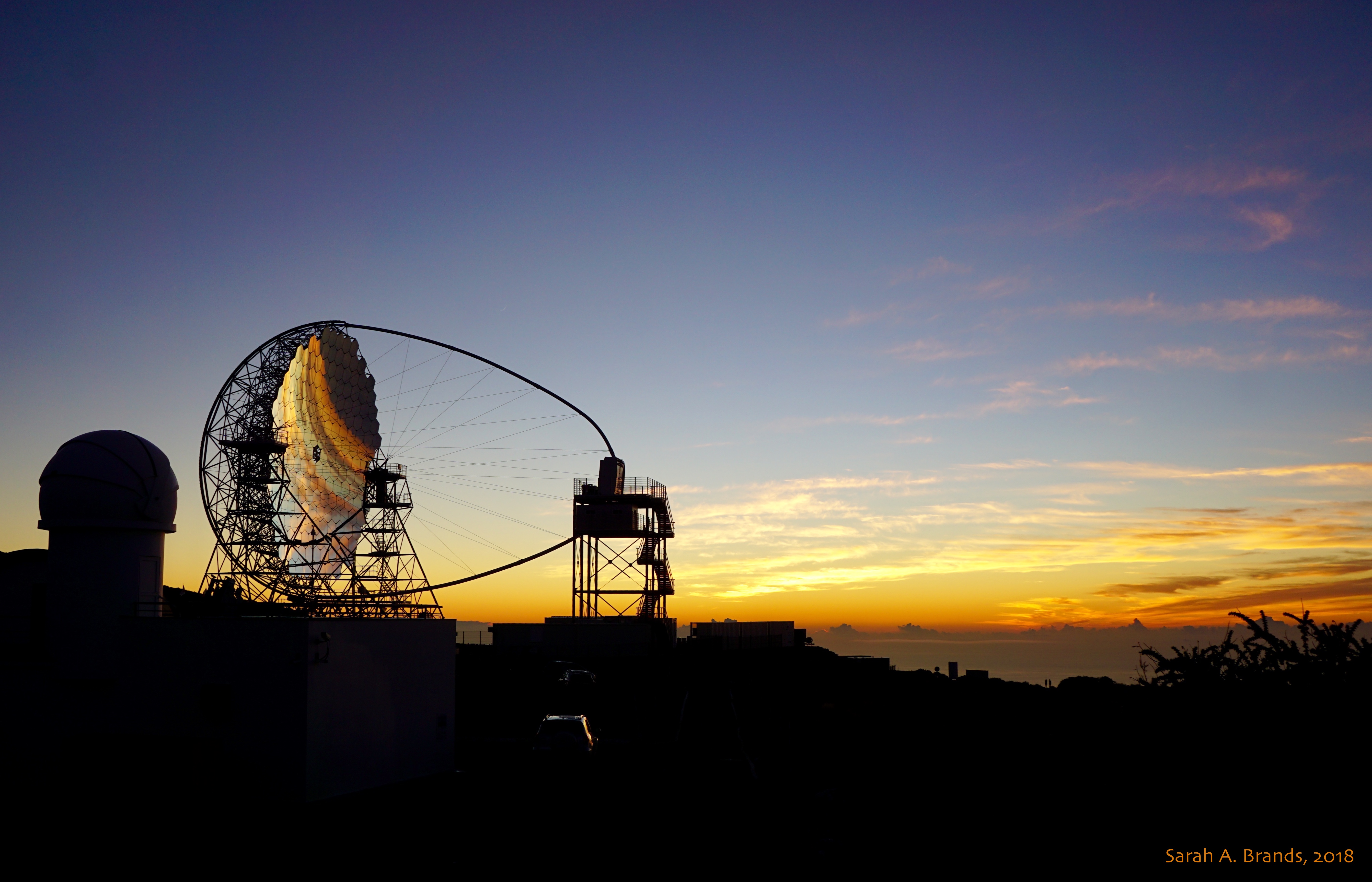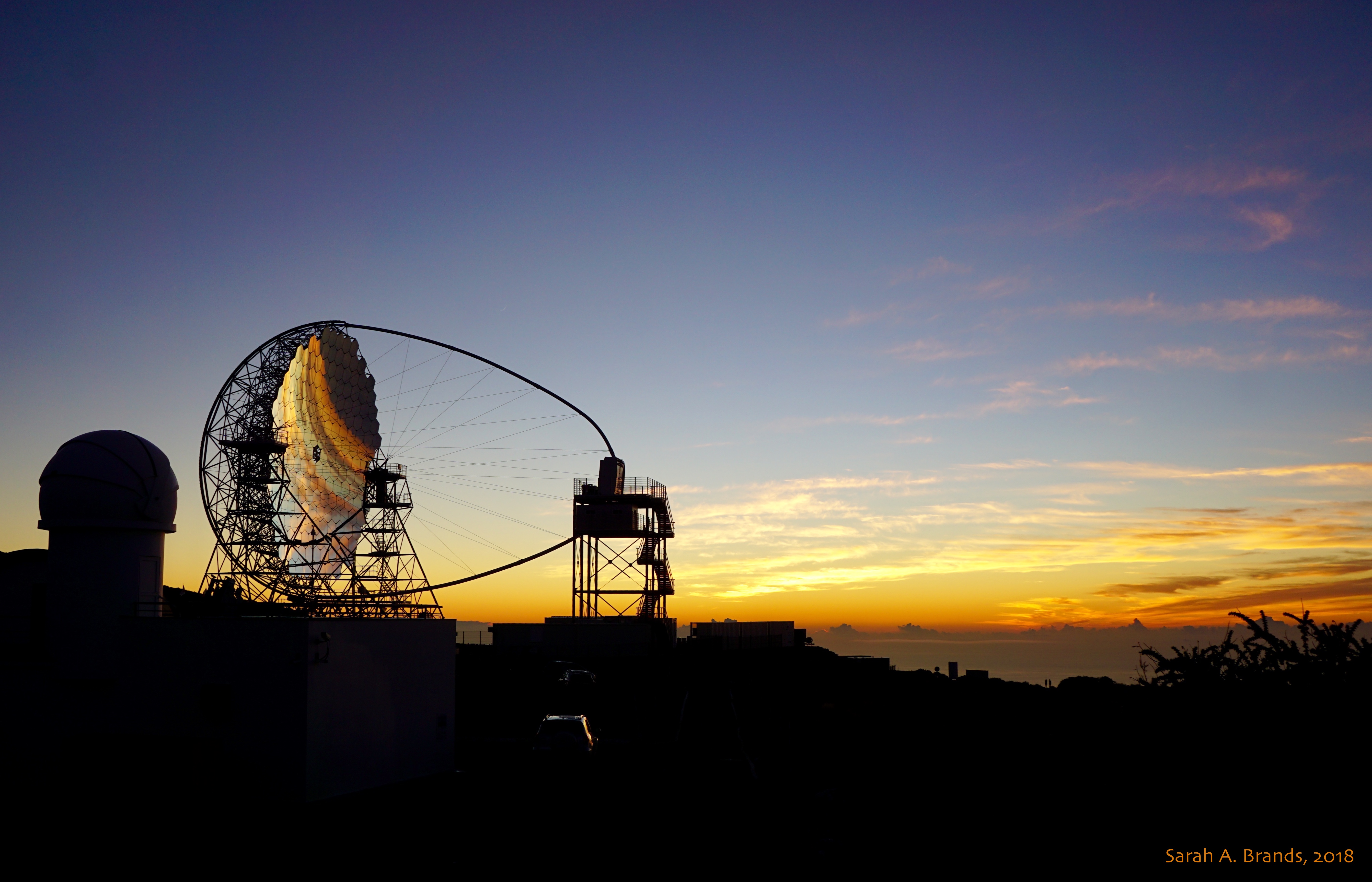
On October 10, a new telescope reflected the light of the setting Sun. With dark horizon above and sunset colors below, its segmented mirror inverts an image of the beautiful evening sky in this snapshot from the Roque del Los Muchachos Observatory on the Canary Island of La Palma. The mirror segments cover a 23 meter diameter and are mounted in the open structure of the Large Scale Telescope 1, inaugurated as the first component of the Cherenkov Telescope Array (CTA). Most ground-based telescopes are hindered by the atmosphere that blurs, scatters, and absorbs light. But cherenkov telescopes are designed to detect very high energy gamma rays and actually require the atmosphere to operate. As the gamma rays impact the upper atmosphere they produce air showers of high-energy particles. A large, fast camera at the common focus images the brief flashes of optical light, called Cherenkov light, created by the air shower particles. The flashes reveal the incoming gamma ray timing, direction, and energy. Ultimately more than 100 Cherenkov telescopes are planned for the CTA at locations in both northern and southern hemispheres on planet Earth.
El 10 de octubre, un nuevo telescopio reflejó la luz del Sol poniente. Con un horizonte oscuro arriba y colores del atardecer abajo, su espejo segmentado invierte una imagen del hermoso cielo de la tarde en esta instantánea tomada en la Observación del Roque de Los Muchachos en la isla canaria de La Palma. Los segmentos del espejo cubren un diámetro de 23 metros y están montados en la estructura abierta del Gran Telescopio 1, inaugurado como el primer componente del Cherenkov Telescope Array (CTA). La mayoría de los telescopios terrestres se ven obstaculizados por la atmósfera, que desenfoca, dispersa y absorbe la luz. Pero los telescopios Cherenkov están diseñados para detectar rayos gamma de muy alta energía y, de hecho, requieren la atmósfera para operar. Cuando los rayos gamma impactan la atmósfera superior, producen lluvias de partículas de alta energía. Una gran cámara rápida en el foco común captura los breves destellos de luz óptica, llamados luz Cherenkov, creados por las partículas de la lluvia atmosférica. Estos destellos revelan la hora de llegada, la dirección y la energía de los rayos gamma entrantes. Finalmente, se planea instalar más de 100 telescopios Cherenkov en el CTA en ubicaciones en ambos hemisferios norte y sur de la Tierra.