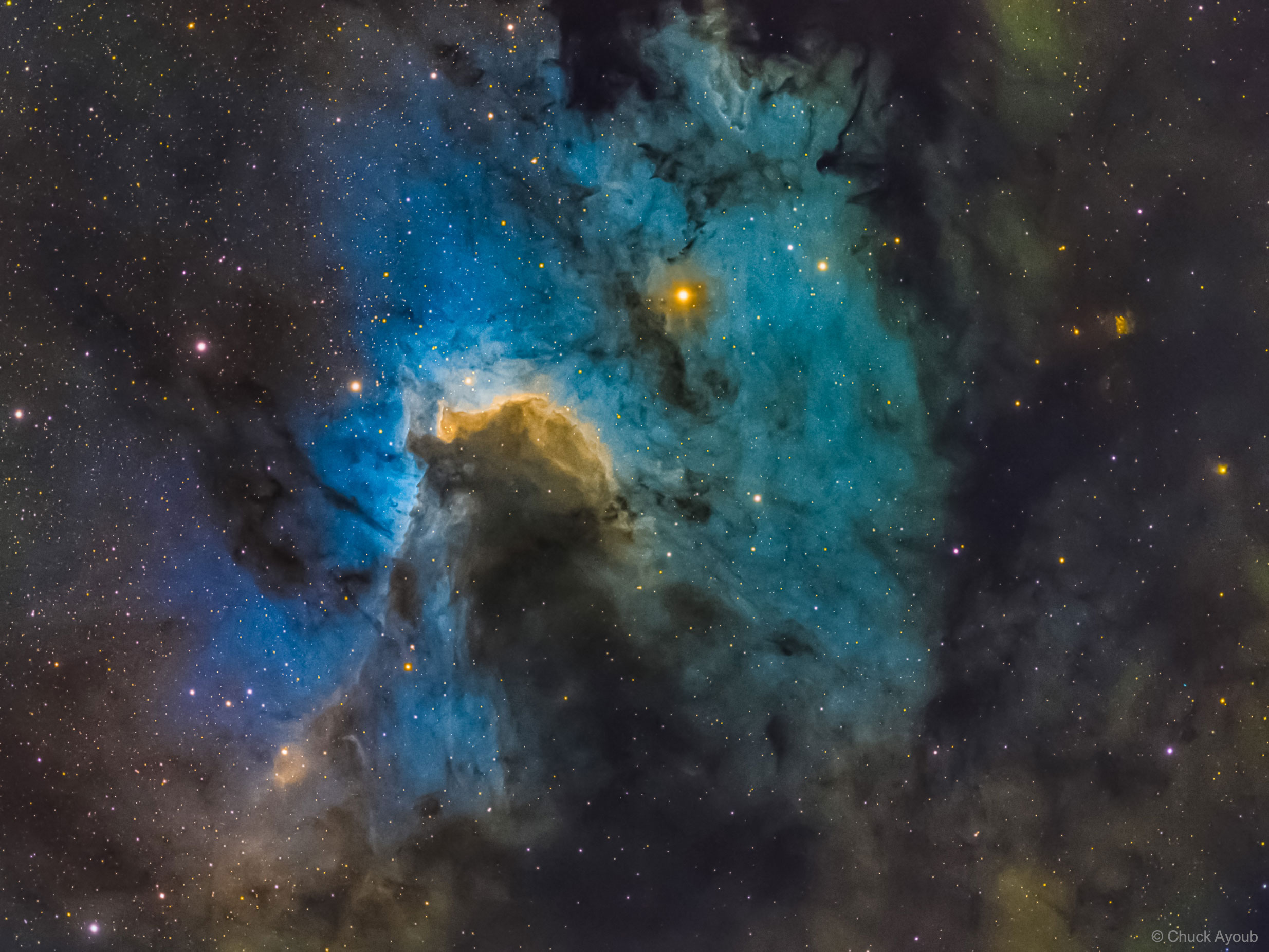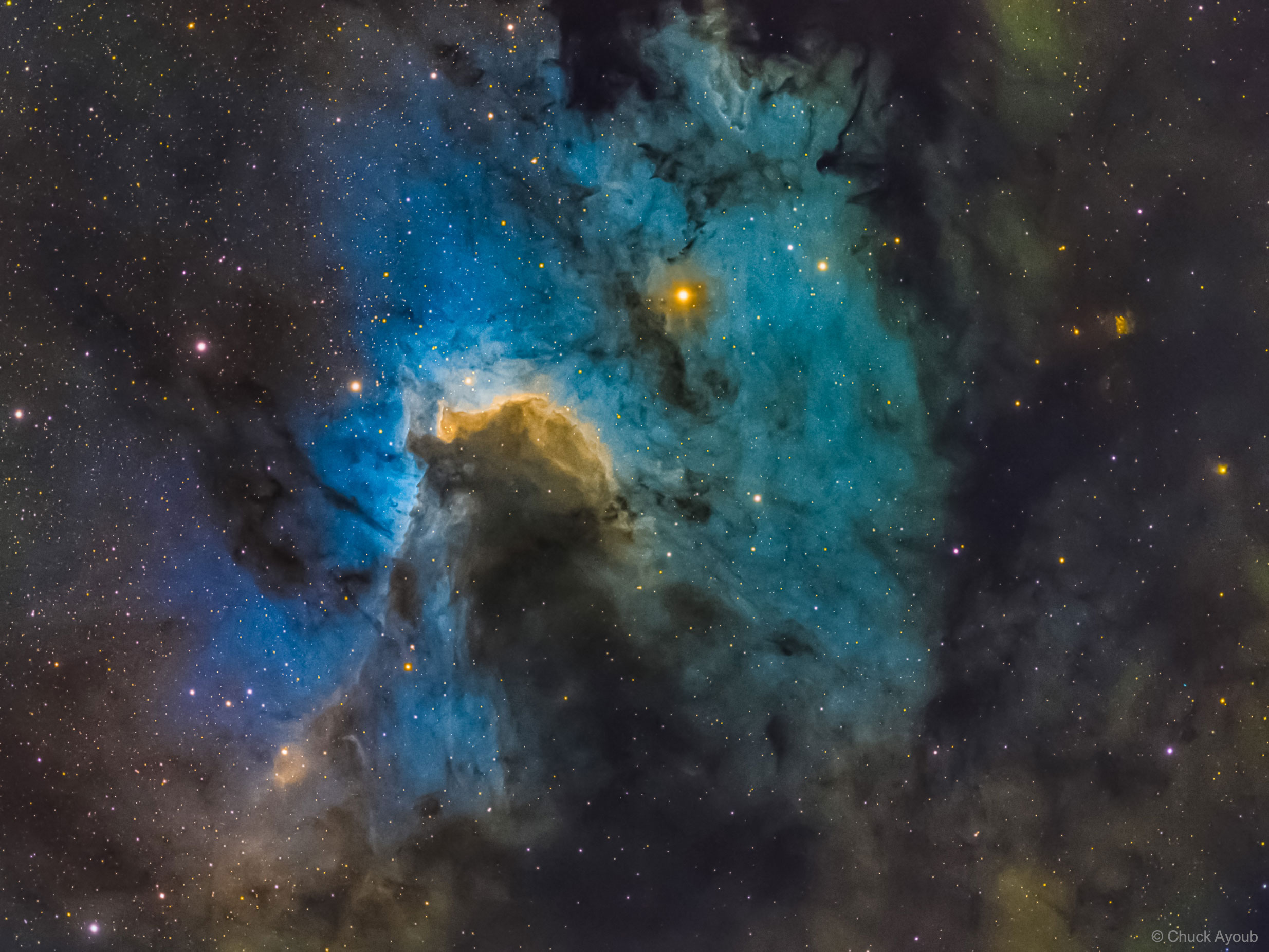
What's inside this cosmic cave? A stellar nursery 10 light-years deep. The featured skyscape is dominated by dusty Sh2-155, the Cave Nebula. In the telescopic image, data taken through a narrowband filters tracks the nebular glow of hydrogen, oxygen, and sulfur, colors that together form the Hubble Palette. About 2,400 light-years away, the scene lies along the plane of our Milky Way Galaxy toward the royal northern constellation of Cepheus. Astronomical explorations of the region reveal that it has formed at the boundary of the massive Cepheus B molecular cloud and the hot, young stars of the Cepheus OB 3 association. The bright rim of ionized hydrogen gas is energized by radiation from the hot stars, dominated by the bright star just to the left of the cave entrance. Radiation driven ionization fronts are likely triggering collapsing cores and new star formation within.
¿Qué hay dentro de esta cueva cósmica? Una nursery estelar de 10 años luz de profundidad. El paisaje mostrado está dominado por la nebulosa Sh2-155, la Nebulosa Cueva, llena de polvo. En la imagen obtenida con telescopio, los datos captados a través de filtros de banda estrecha rastrean el brillo nebuloso del hidrógeno, oxígeno y azufre, colores que juntos forman el Hubble Palette. A unos 2.400 años luz de distancia, la escena se encuentra a lo largo del plano de nuestra galaxia, la Vía Láctea, hacia la constelación norteña de Cefeo. Las exploraciones astronómicas de la región revelan que se formó en el límite de la nube molecular masiva Cepheus B y las estrellas jóvenes y calientes de la asociación Cepheus OB 3. El borde brillante del gas de hidrógeno ionizado es energizado por la radiación de las estrellas calientes, dominada por la estrella brillante justo a la izquierda de la entrada de la cueva. Frentes de ionización impulsados por radiación probablemente estén desencadenando colapsos de núcleos y formación de nuevas estrellas dentro.