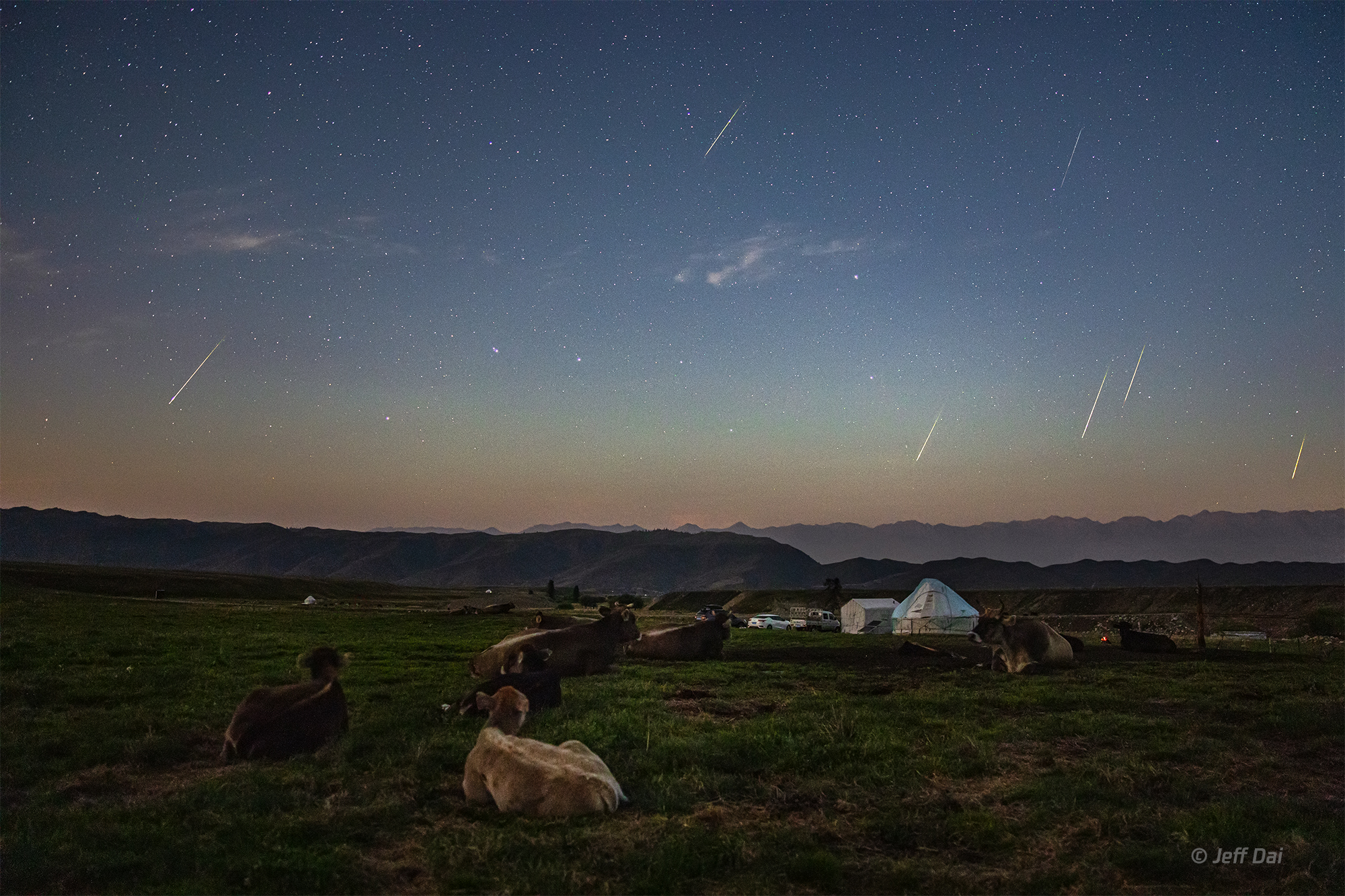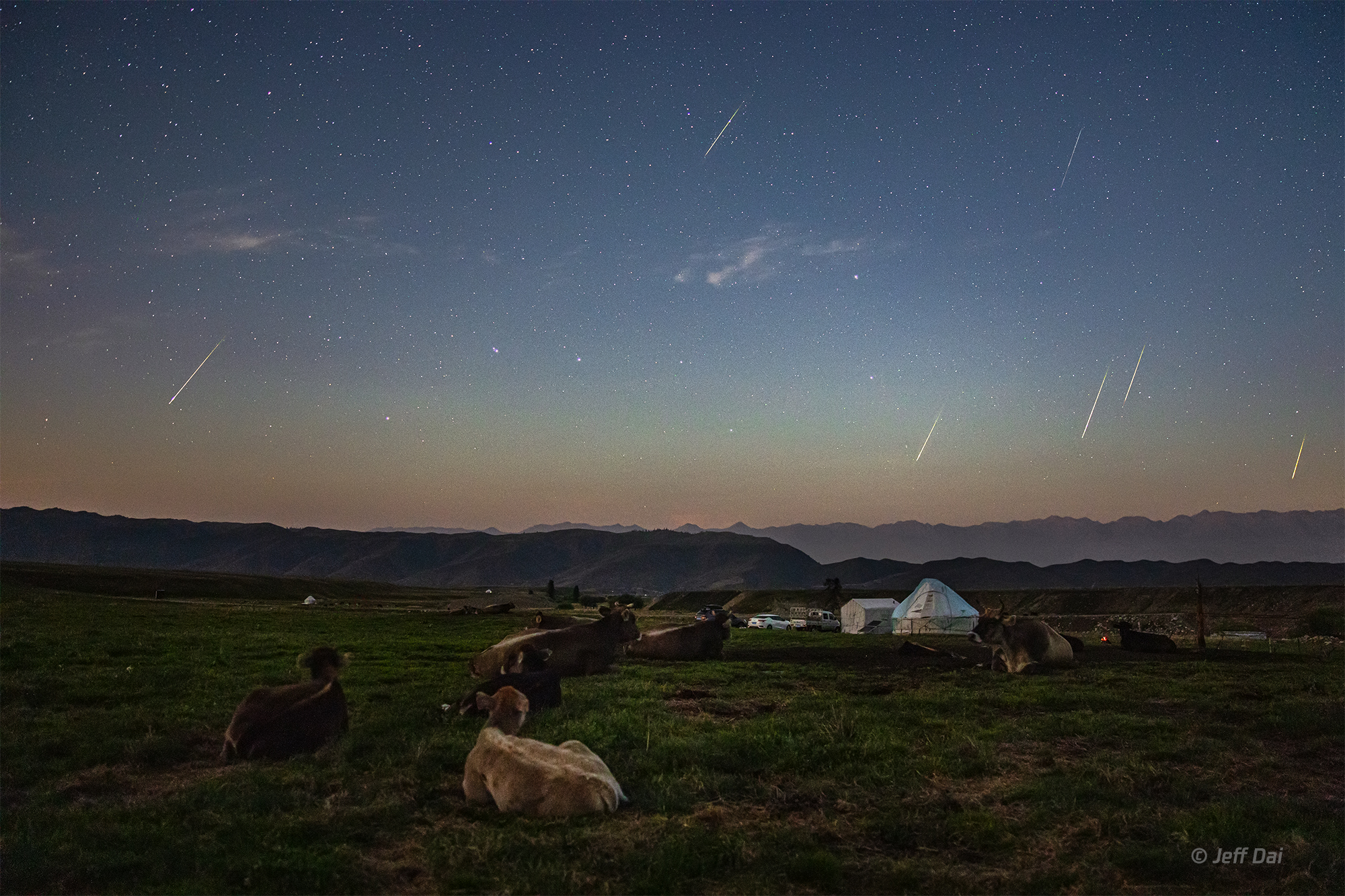
Despite interfering moonlight, many denizens of planet Earth were able to watch this year's Perseid meteor shower. This pastoral scene includes local skygazers admiring the shower's brief, heavenly flashes in predawn hours near peak activity on August 13 from Nalati Grassland in Xinjiang, China. A composite, the image registers seven frames taken during a two hour span recording Perseid meteor streaks against a starry sky. Centered along the horizon is the Plough, the north's most famous asterism, though some might see the familiar celestial kitchen utensil known as the Big Dipper. Perhaps the year's most easily enjoyed meteor shower, Perseid meteors are produced as Earth itself sweeps through dust from periodic comet Swift-Tuttle. The dust particles are vaporized at altitudes of 100 kilometers or so as they plow through the atmosphere at 60 kilometers per second.
A pesar de la luz lunar interferente, muchos habitantes del planeta Tierra pudieron observar este año la lluvia de meteoros de los Perseidas. Esta escena campestre incluye a observadores locales admirando los breves destellos celestes de la lluvia en horas previas al amanecer, cerca del pico de actividad del 13 de agosto en la Pradera de Nalati en Xinjiang, China. Una imagen compuesta, registra siete fotogramas tomados durante un periodo de dos horas, registrando las trayectorias de los meteoros Perseidas contra un cielo estrellado. Centrado a lo largo del horizonte se encuentra la Cuchara, el asterismo más famoso del norte, aunque algunos podrían reconocer el utensilio de cocina celeste conocido como el Cazo Mayor. Quizás la lluvia de meteoros más fácil de disfrutar del año, los meteoros Perseidas se producen cuando la Tierra misma atraviesa polvo del cometa periódico Swift-Tuttle. Las partículas de polvo se vaporizan a altitudes de unos 100 kilómetros al atravesar la atmósfera a 60 kilómetros por segundo.