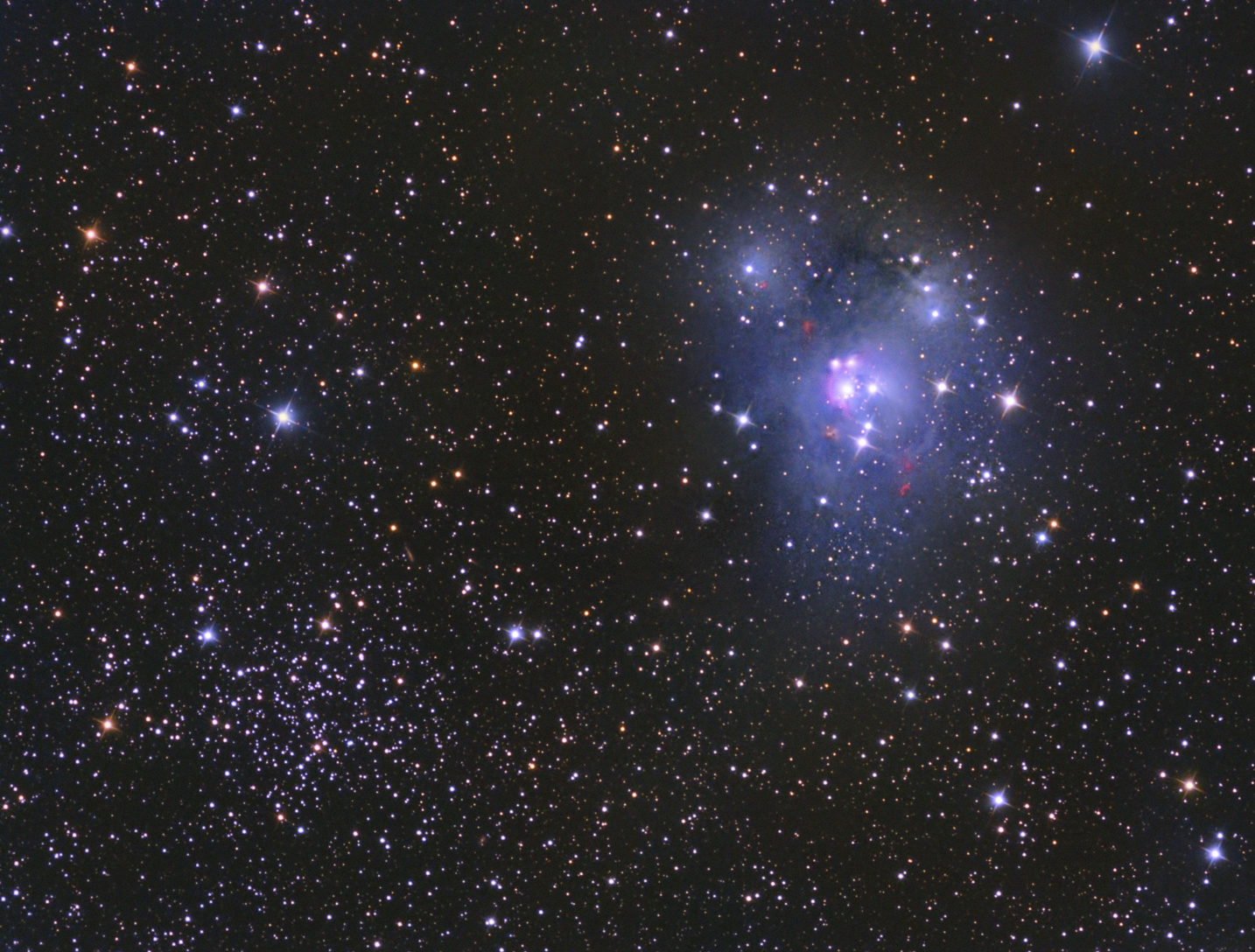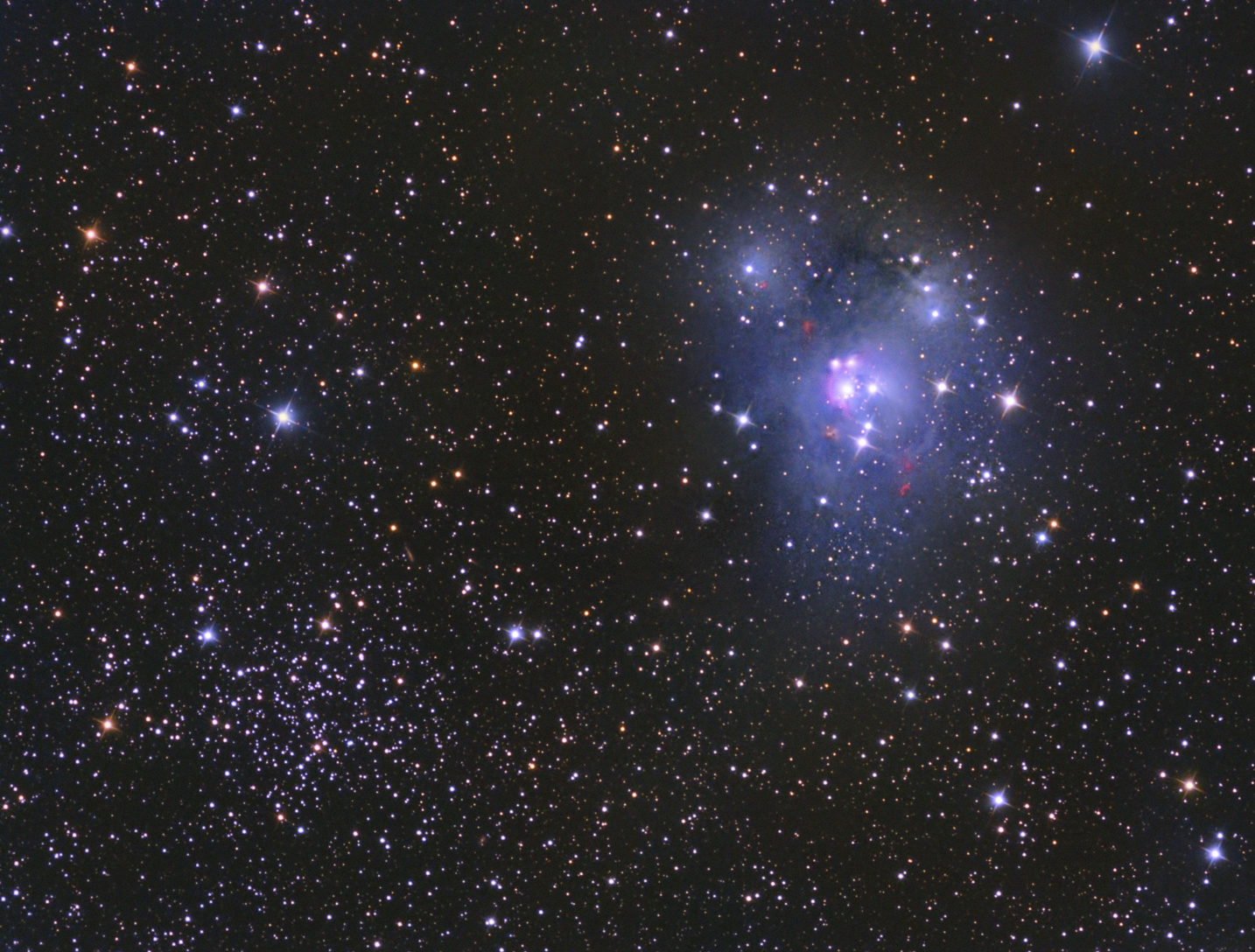
This wide-field telescopic image looks toward the constellation Cepheus and an intriguing visual pairing of dusty reflection nebula NGC 7129 (right) and open star cluster NGC 7142. The two appear separated by only half a degree on the sky, but they actually lie at quite different distances. In the foreground, dusty nebula NGC 7129 is about 3,000 light-years distant, while open cluster NGC 7142 is likely over 6,000 light-years away. In fact, pervasive and clumpy foreground dust clouds in this region redden the light from NGC 7142, complicating astronomical explorations of the cluster. Still, NGC 7142 is thought to be an older open star cluster, while the bright stars embedded in NGC 7129 are perhaps a few million years young. The telltale reddish crescent shapes around NGC 7129 are associated with energetic jets streaming away from newborn stars.
Esta imagen telescópica de campo amplio se dirige hacia la constelación de Cefeo y muestra un intrigante par visual formado por la nebulosa de reflexión polvorienta NGC 7129 (a la derecha) y el cúmulo estelar abierto NGC 7142. Aunque en el cielo parecen separados por solo medio grado, en realidad se encuentran a distancias muy diferentes. En primer plano, la nebulosa polvorienta NGC 7129 se encuentra a unos 3000 años luz de distancia, mientras que el cúmulo abierto NGC 7142 probablemente se encuentra a más de 6000 años luz. De hecho, las nubes de polvo delantero que abundan en esta región enrojecen la luz proveniente de NGC 7142, complicando las exploraciones astronómicas del cúmulo. Sin embargo, se cree que NGC 7142 es un cúmulo estelar abierto más antiguo, mientras que las estrellas brillantes incrustadas en NGC 7129 podrían tener solo unos pocos millones de años. Las formas crecientes rojizas características alrededor de NGC 7129 están asociadas con chorros energéticos que se alejan de estrellas recién nacidas.