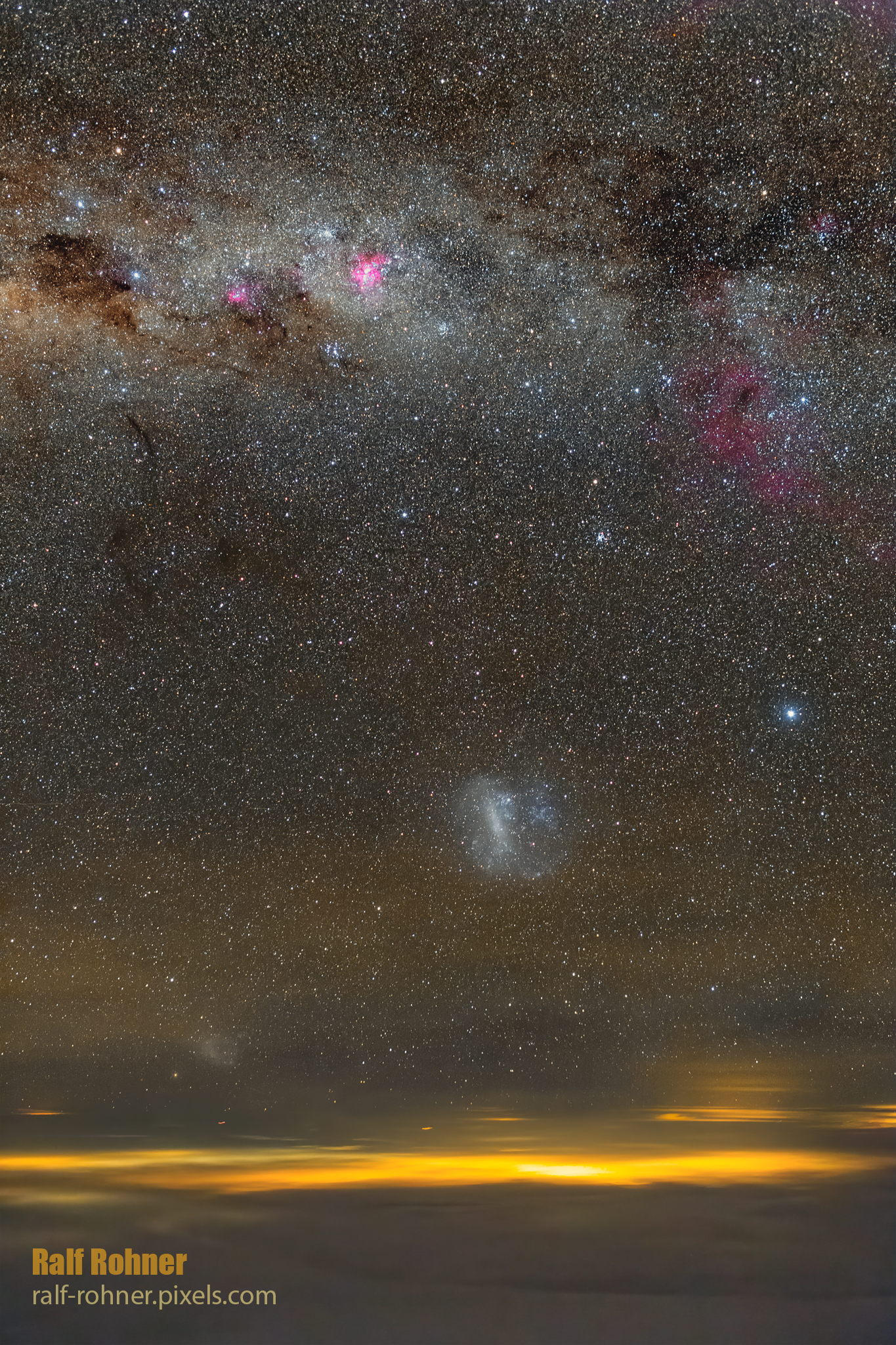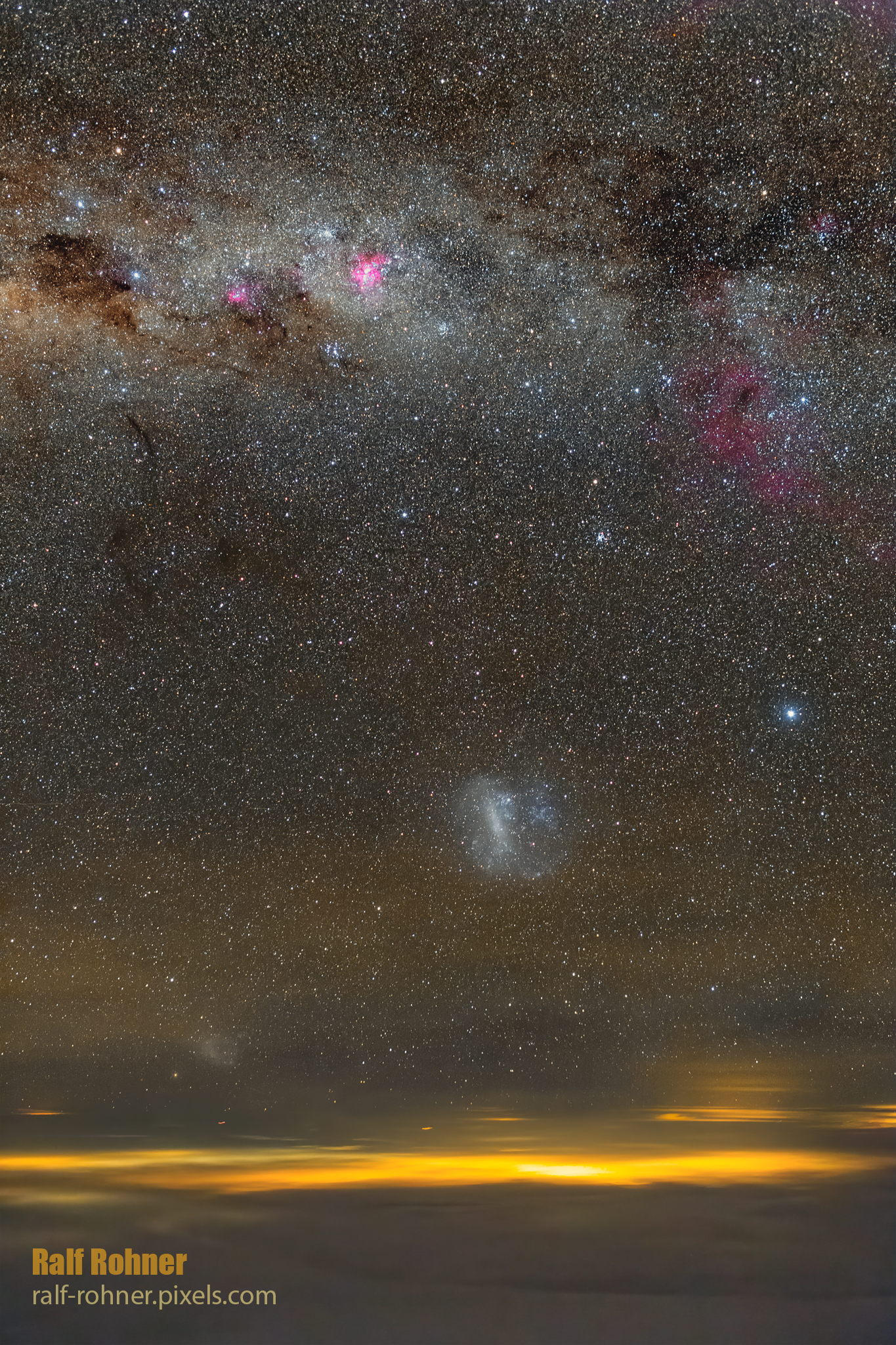
Celestial sights of the southern sky shine above a cloudy planet Earth in this gorgeous night sky view. The scene was captured from an airliner's flight deck at 38,000 feet on a steady westbound ride to Lima, Peru. To produce the sharp airborne astrophotograph, the best of a series of short exposures were selected and digitally stacked. The broad band of the southern Milky Way begins at top left with the dark Coalsack Nebula and Southern Cross. Its expanse of diffuse starlight encompasses the the Carina Nebula and large Gum Nebula toward the right. Canopus, alpha star of Carina and second brightest star in Earth's night is easy to spot below the Milky Way, as is the dwarf galaxy known as the Large Magellanic Cloud. The Small Magellanic cloud just peeks above the cloudy horizon. Of course, the South Celestial Pole also lies within the starry southern frame.
Las vistas celestiales del cielo sur brillan sobre un planeta Tierra nuboso en esta hermosa imagen de la noche. La escena fue capturada desde la cabina de un avión comercial a 38,000 pies durante un viaje estable hacia el oeste hacia Lima, Perú. Para producir esta nítida fotografía astronómica aérea, se seleccionaron las mejores de una serie de exposiciones cortas y se apilaron digitalmente. La amplia banda de la Vía Láctea del sur comienza en la esquina superior izquierda con la Nebulosa Coalsack y la Cruz del Sur. Su extensión de luz estelar difusa abarca la Nebulosa de Carina y la gran Nebulosa de Gum hacia la derecha. Canopus, la estrella alfa de Carina y la segunda estrella más brillante del cielo nocturno terrestre, es fácil de identificar debajo de la Vía Láctea, así como la galaxia enana conocida como la Gran Nube de Magallanes. La Pequeña Nube de Magallanes apenas asoma por encima del horizonte nuboso. Por supuesto, el Polo Celeste Sur también se encuentra dentro del marco estrellado del sur.