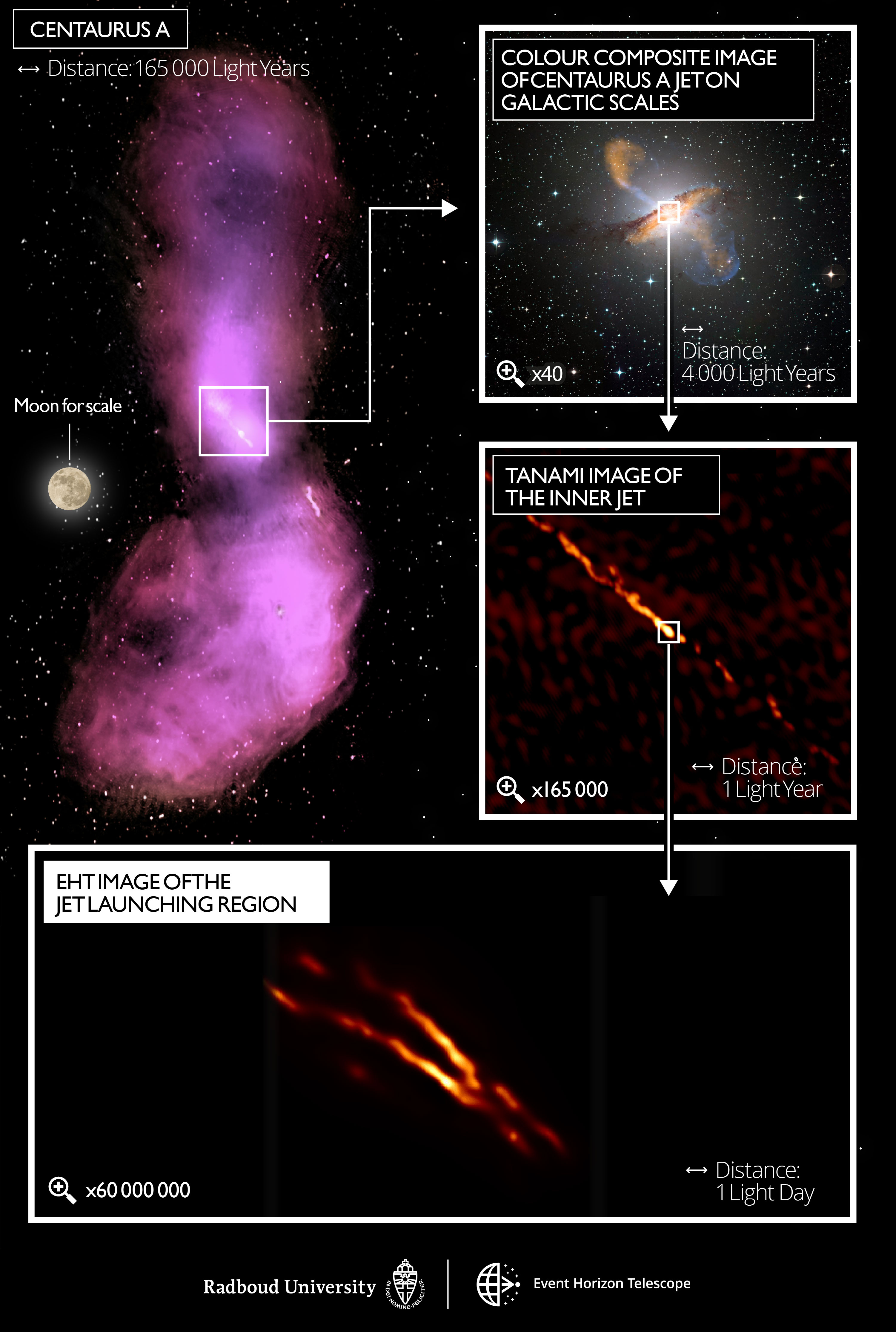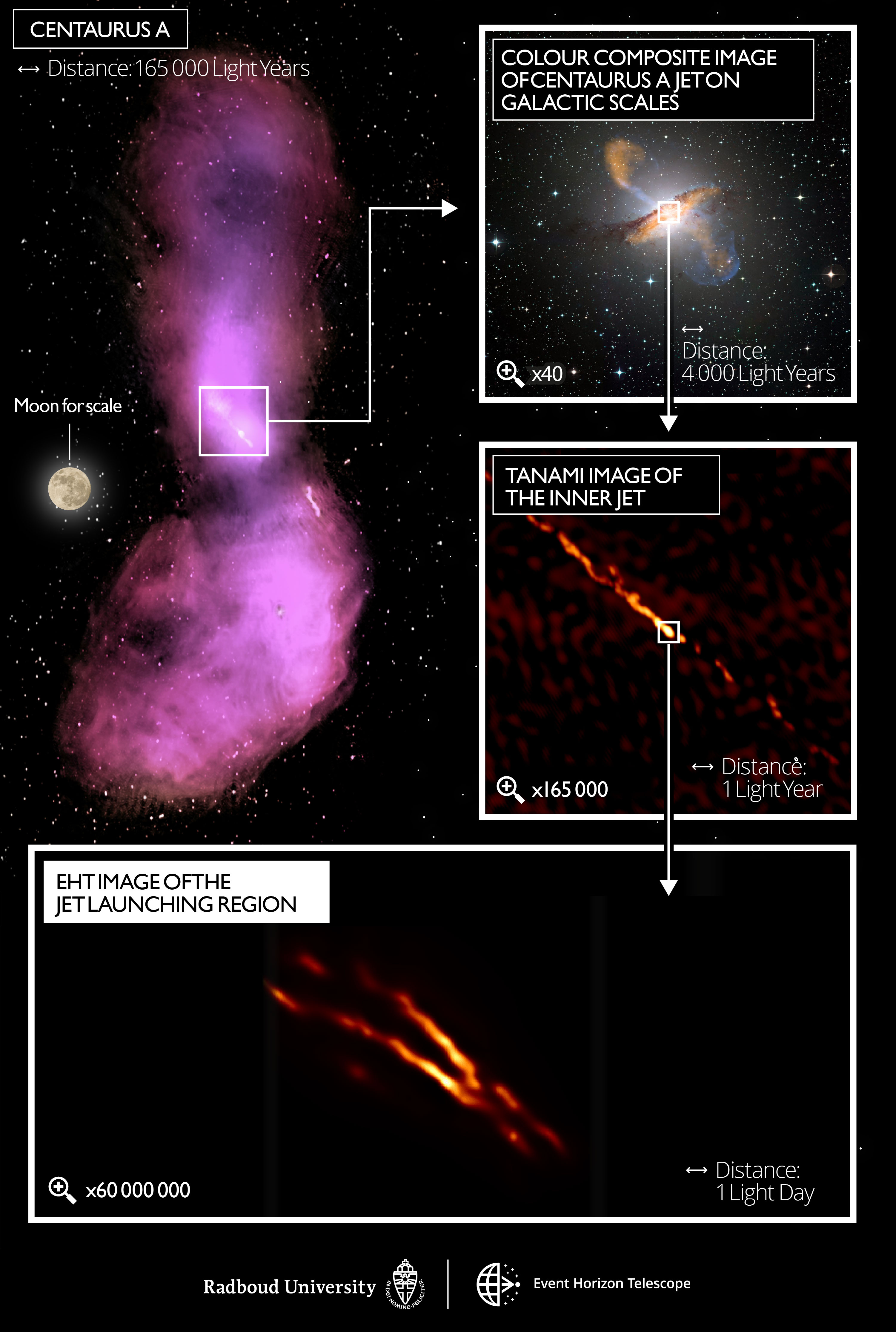
How do supermassive black holes create powerful jets? To help find out, the Event Horizon Telescope (EHT) imaged the center of the nearby active galaxy Centaurus A. The cascade of featured inset images shows Cen A from it largest, taking up more sky than many moons, to its now finest, taking up only as much sky as an golf ball on the moon. The new image shows what may look like two jets -- but is actually two sides of a single jet. This newly discovered jet-edge brightening does not solve the jet-creation mystery, but does imply that the particle outflow is confined by a strong pressure -- possibly involving a magnetic field. The EHT is a coordination of radio telescopes from around the Earth -- from the Caltech Submillimeter Observatory in Hawaii USA, to ALMA in Chile, to NOEMA in France, and more. The EHT will continue to observe massive, nearby black holes and their energetic surroundings.
¿Cómo crean los agujeros negros supermasivos chorros poderosos? Para ayudar a descubrirlo, el Telescopio del Horizonte de Sucesos (EHT, por sus siglas en inglés) tomó una imagen del centro de la galaxia activa cercana Centaurus A. La cascada de imágenes insertadas muestra a Cen A desde su tamaño más grande, ocupando más del cielo que muchos satélites, hasta su ahora más fino, ocupando solo tanto cielo como una pelota de golf en la Luna. La nueva imagen muestra lo que podría parecer dos chorros, pero en realidad son dos lados de un solo chorro. Este recién descubierto acentuamiento del brillo en el borde del chorro no resuelve el misterio de la creación de los chorros, pero sí implica que el flujo de partículas está confinado por una presión fuerte, posiblemente involucrando un campo magnético. El EHT es una coordinación de telescopios de radio de todo el mundo, desde el Observatorio Submilimétrico de Caltech en Hawái, EE.UU., hasta ALMA en Chile, hasta NOEMA en Francia, y más. El EHT continuará observando agujeros negros masivos y sus entornos energéticos cercanos.