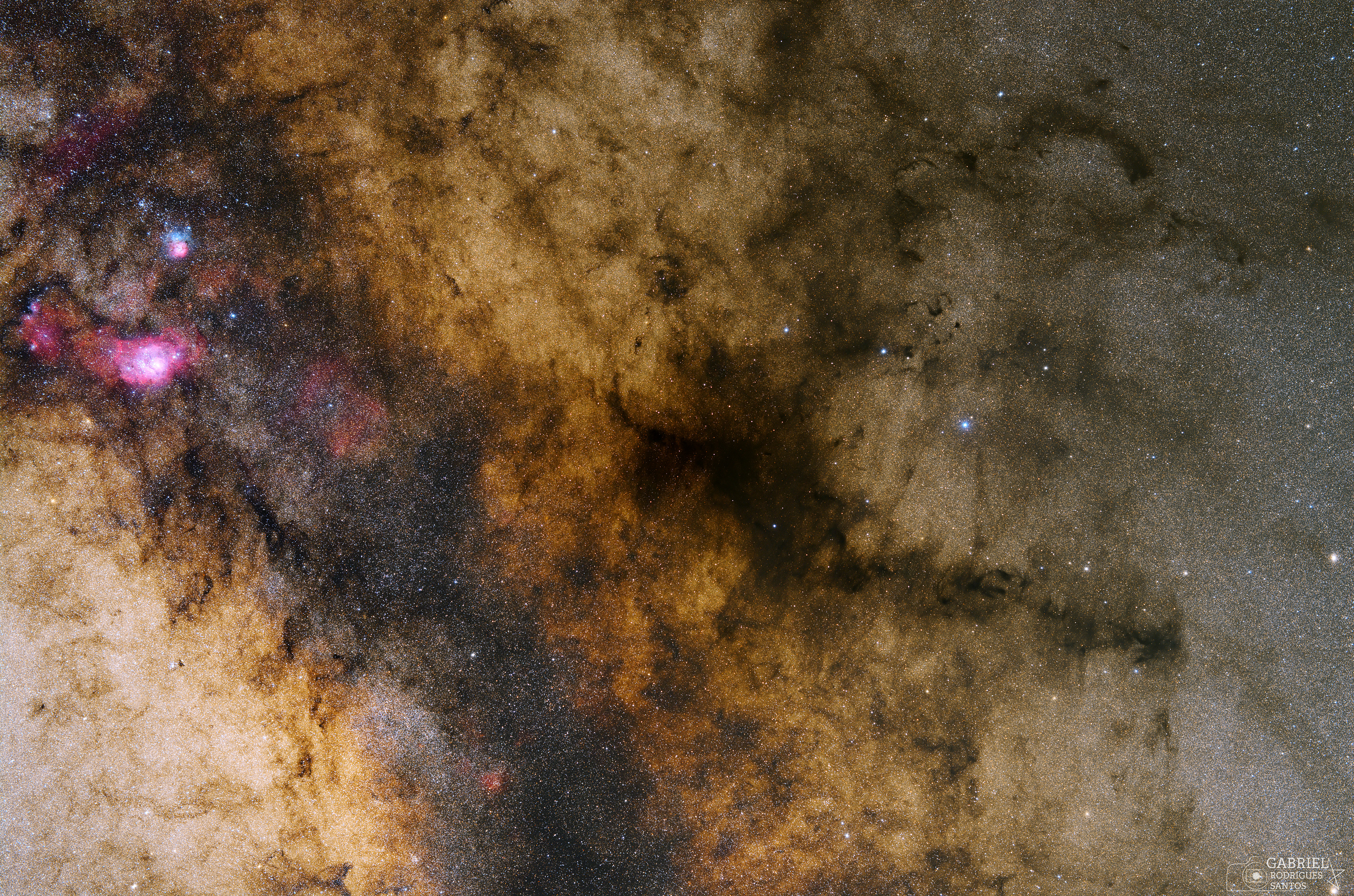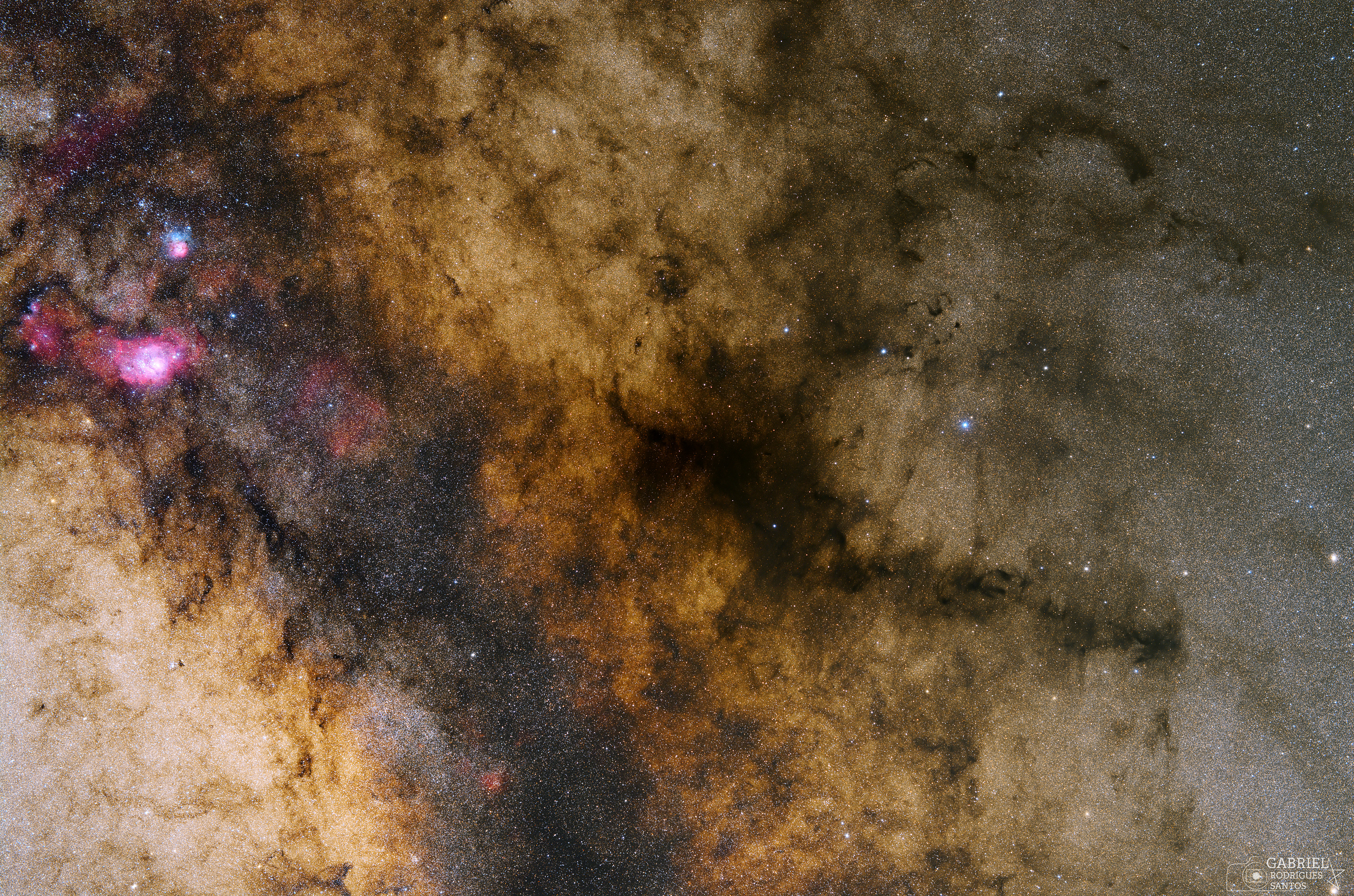
Dark markings and colorful clouds inhabit this stellar landscape. The deep and expansive view spans more than 30 full moons across crowded star fields toward the center of our Milky Way Galaxy. Cataloged in the early 20th century by astronomer E. E. Barnard, the obscuring interstellar dust clouds seen toward the right include B59, B72, B77 and B78, part of the Ophiuchus molecular cloud complex a mere 450 light-years away. To the eye their combined shape suggests a pipe stem and bowl, and so the dark nebula's popular name is the Pipe Nebula. Three bright nebulae gathered on the left are stellar nurseries some 5,000 light-years distant toward the constellation Sagittarius. In the 18th century astronomer Charles Messier included two of them in his catalog of bright clusters and nebulae; M8, the largest of the triplet, and colorful M20 just above. The third prominent emission region includes NGC 6559 at the far left. Itself divided by obscuring dust lanes, M20 is also known as the Trifid. M8's popular moniker is the Lagoon Nebula.
Marcas oscuras y nubes coloridas habitan esta paisaje estelar. Esta profunda y extensa vista abarca más de 30 veces el diámetro de la Luna llena, atravesando campos estelares densos hacia el centro de nuestra galaxia, la Vía Láctea. Catalogadas a principios del siglo XX por el astrónomo E. E. Barnard, las nubes de polvo interestelar que se ven hacia la derecha incluyen B59, B72, B77 y B78, parte del complejo de nubes moleculares de Ofiuco, a solo 450 años luz de distancia. A simple vista, su forma combinada sugiere un tallo y una boquilla de pipa, y por eso el nombre popular de esta nebulosa oscura es la Nebulosa de la Pipa. Tres nebulosas brillantes reunidas a la izquierda son regiones de formación estelar, a unos 5000 años luz de distancia, en la constelación de Sagitario. En el siglo XVIII, el astrónomo Charles Messier incluyó dos de ellas en su catálogo de objetos brillantes: M8, la más grande del trío, y la colorida M20, justo encima. La tercera región destacada de emisión incluye a NGC 6559, muy a la izquierda. Dividida por bandas de polvo oscuro, M20 también se conoce como la Nebulosa Trífida. El nombre popular de M8 es la Nebulosa del Lago.