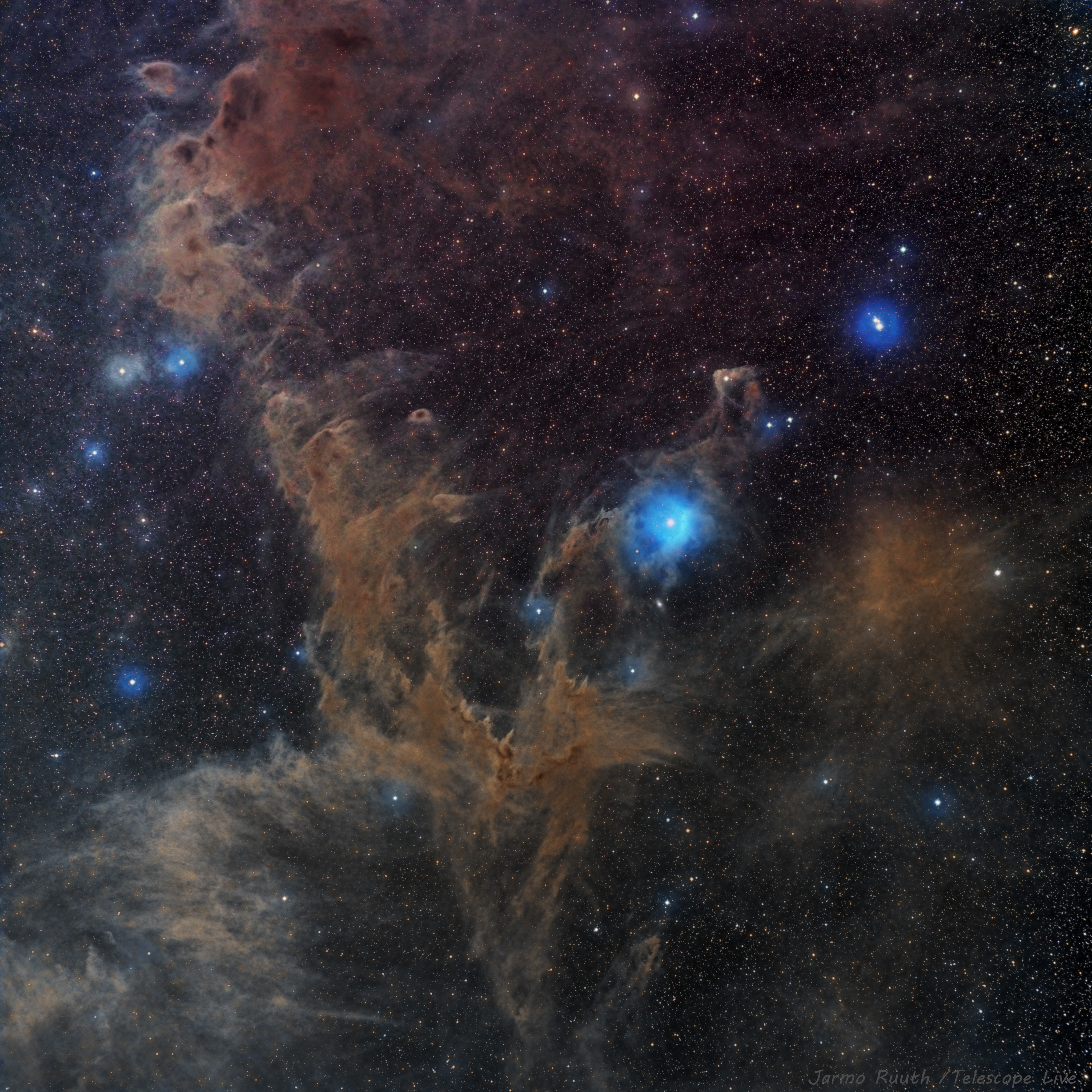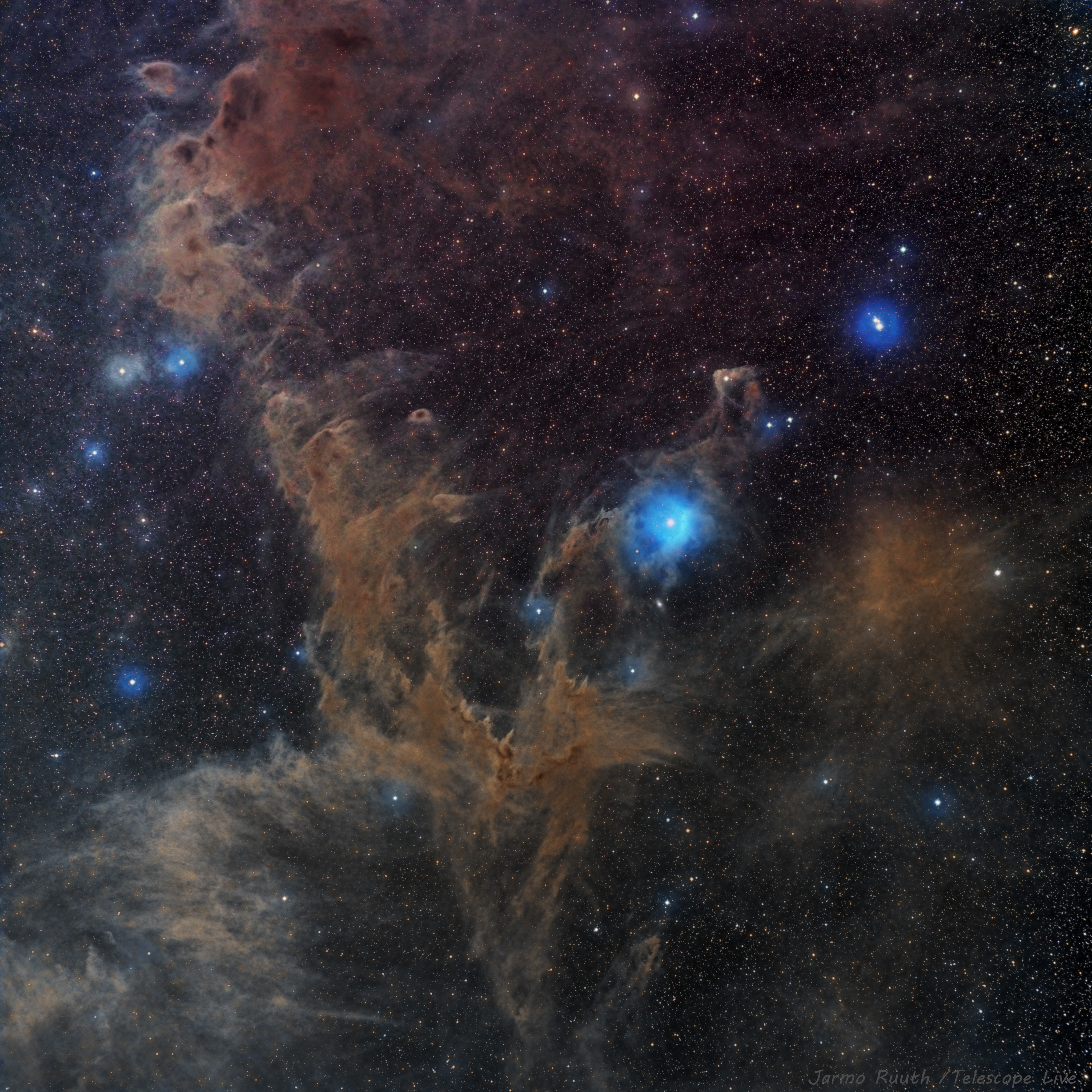
Sometimes the dark dust of interstellar space has an angular elegance. Such is the case toward the far-south constellation of Chamaeleon. Normally too faint to see, dark dust is best known for blocking visible light from stars and galaxies behind it. In this four-hour exposure, however, the dust is seen mostly in light of its own, with its strong red and near-infrared colors giving creating a brown hue. Contrastingly blue, the bright star Beta Chamaeleontis is visible just to the right of center, with the dust that surrounds it preferentially reflecting blue light from its primarily blue-white color. All of the pictured stars and dust occur in our own Milky Way Galaxy with -- but one notable exception: the white spot just below Beta Chamaeleontis is the galaxy IC 3104 which lies far in the distance. Interstellar dust is mostly created in the cool atmospheres of giant stars and dispersed into space by stellar light, stellar winds, and stellar explosions such as supernovas.
A veces, el polvo oscuro del espacio interestelar tiene una elegancia angular. Este es el caso hacia la constelación del extremo sur de Chamaleón. Normalmente demasiado tenue para verse, el polvo oscuro es mejor conocido por bloquear la luz visible de las estrellas y galaxias que hay detrás. En esta exposición de cuatro horas, sin embargo, el polvo se ve principalmente con su propia luz, con sus fuertes colores rojo y cercano al infrarrojo creando un tono marrón. En contraste azul, la brillante estrella Beta Chamaeleontis es visible justo a la derecha del centro, con el polvo que la rodea reflejando preferentemente la luz azul de su color principalmente azul-plateado. Todas las estrellas y el polvo mostrados ocurren en nuestra propia galaxia Vía Láctea, con una notable excepción: el punto blanco justo debajo de Beta Chamaeleontis es la galaxia IC 3104, que se encuentra muy lejos. El polvo interestelar se forma principalmente en las atmósferas frías de estrellas gigantes y se dispersa en el espacio por la luz estelar, los vientos estelares y explosiones estelares como supernovas.