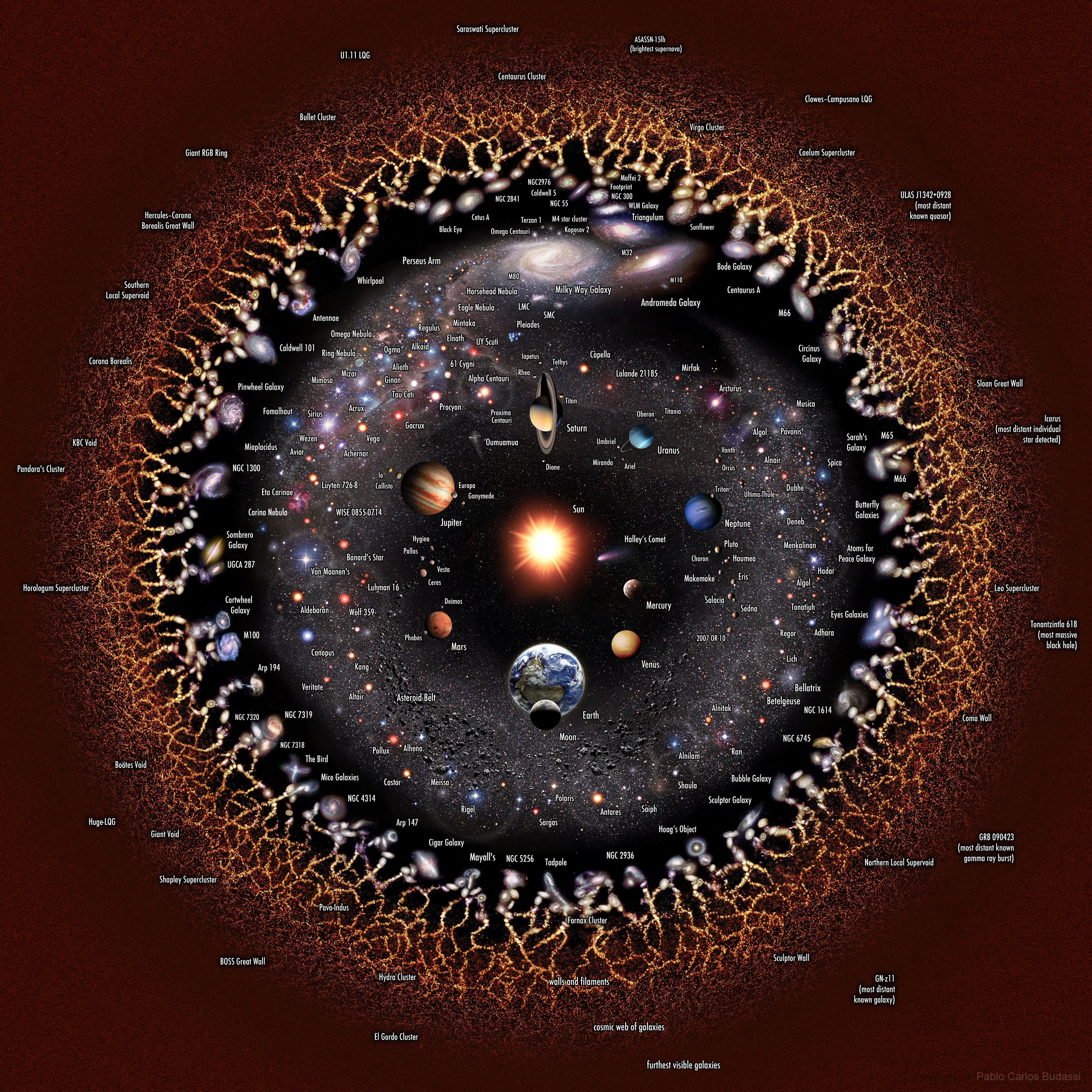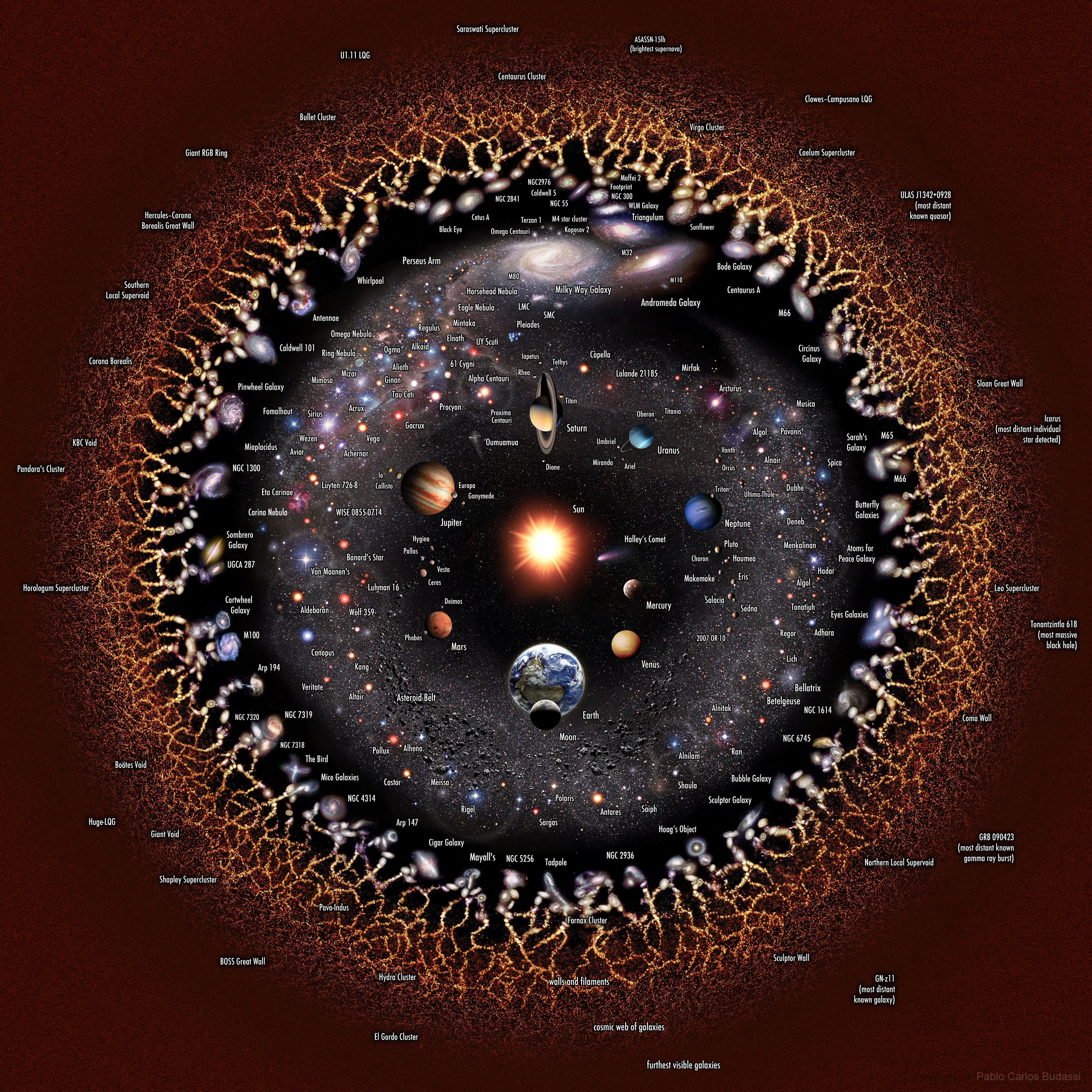
How far can you see? Everything you can see, and everything you could possibly see, right now, assuming your eyes could detect all types of radiations around you -- is the observable universe. In light, the farthest we can see comes from the cosmic microwave background, a time 13.8 billion years ago when the universe was opaque like thick fog. Some neutrinos and gravitational waves that surround us come from even farther out, but humanity does not yet have the technology to detect them. The featured image illustrates the observable universe on an increasingly compact scale, with the Earth and Sun at the center surrounded by our Solar System, nearby stars, nearby galaxies, distant galaxies, filaments of early matter, and the cosmic microwave background. Cosmologists typically assume that our observable universe is just the nearby part of a greater entity known as "the universe" where the same physics applies. However, there are several lines of popular but speculative reasoning that assert that even our universe is part of a greater multiverse where either different physical constants occur, different physical laws apply, higher dimensions operate, or slightly different-by-chance versions of our standard universe exist. Available: High res image version with readable annotations | Clickable annotation version
¿Cuán lejos puedes ver? Todo lo que puedes ver, y todo lo que podrías ver posiblemente, ahora mismo, asumiendo que tus ojos pudieran detectar todos los tipos de radiación a tu alrededor, es el universo observable. En luz visible, lo más lejano que podemos ver proviene del fondo de microondas cósmico, una época hace 13.8 mil millones de años cuando el universo era opaco como una niebla espesa. Algunos neutrinos y ondas gravitacionales que nos rodean provienen de aún más lejos, pero la humanidad aún no tiene la tecnología para detectarlos. La imagen destacada ilustra el universo observable en escalas cada vez más compactas, con la Tierra y el Sol en el centro rodeados por nuestro Sistema Solar, estrellas cercanas, galaxias cercanas, galaxias distantes, filamentos de materia primordial, y el fondo de microondas cósmico. Los cosmólogos típicamente asumen que nuestro universo observable es solo la parte cercana de una entidad mayor conocida como "el universo" donde se aplica la misma física. Sin embargo, hay varios razonamientos populares pero especulativos que afirman que incluso nuestro universo es parte de un multiverso mayor donde ocurren constantes físicas diferentes, se aplican leyes físicas distintas, operan dimensiones superiores, o existen versiones ligeramente diferentes por azar de nuestro universo estándar. Disponible: Versión de imagen de alta resolución con anotaciones legibles | Versión de anotación interactiva