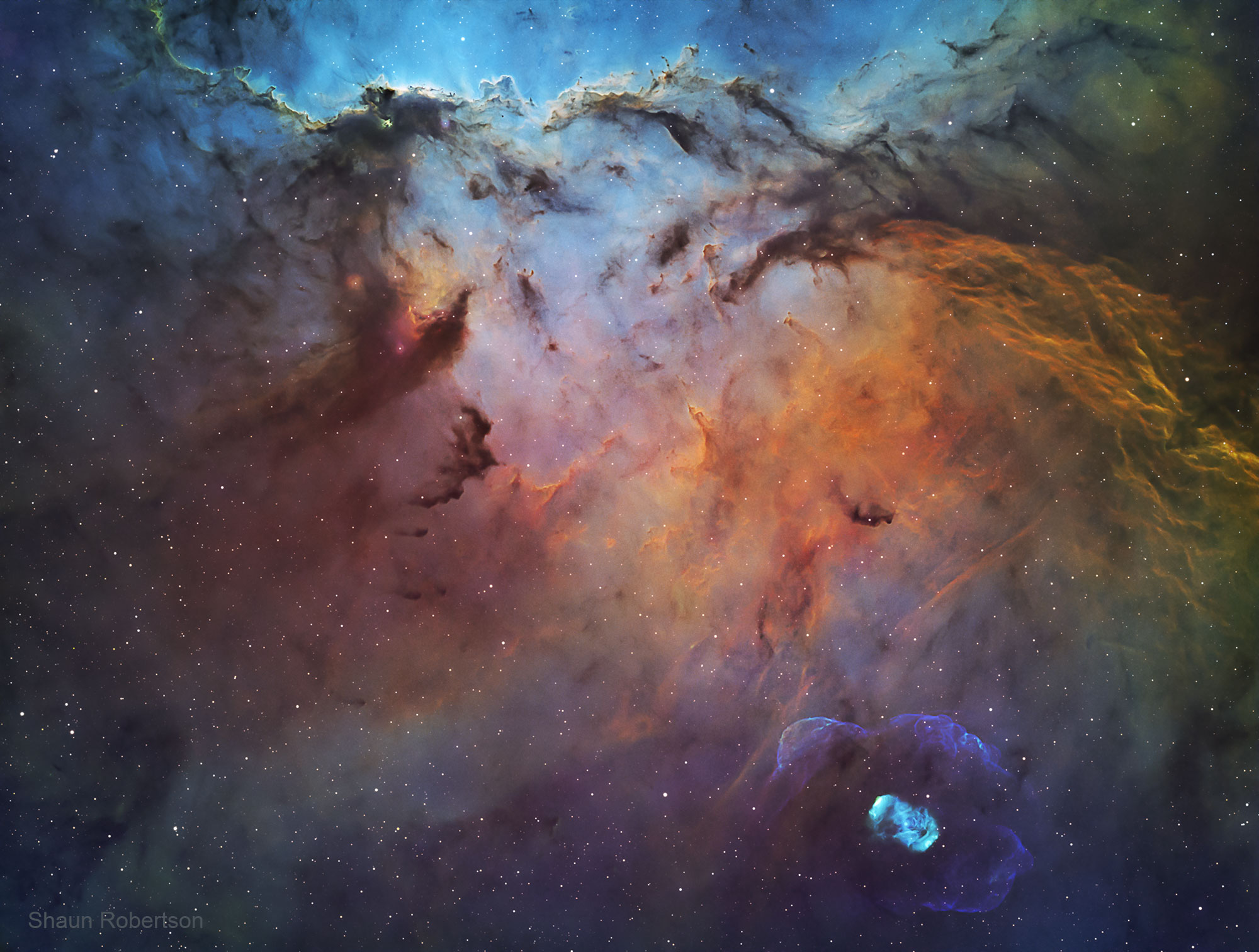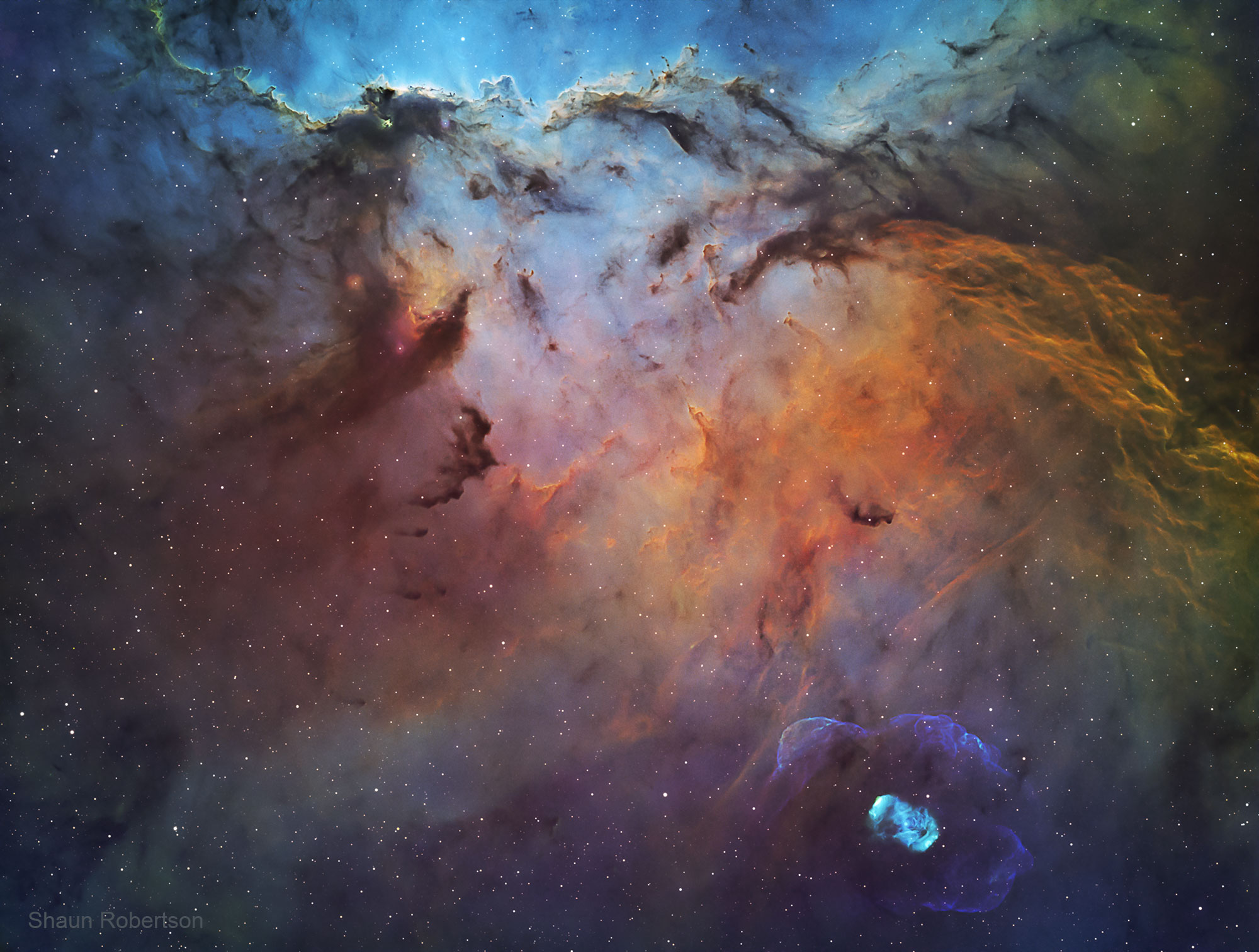
Do dragons fight on the altar of the sky? Although it might appear that way, these dragons are illusions made of thin gas and dust. The emission nebula NGC 6188, home to the glowing clouds, is found about 4,000 light years away near the edge of a large molecular cloud unseen at visible wavelengths, in the southern constellation Ara (the Altar). Massive, young stars of the embedded Ara OB1 association were formed in that region only a few million years ago, sculpting the dark shapes and powering the nebular glow with stellar winds and intense ultraviolet radiation. The recent star formation itself was likely triggered by winds and supernova explosions, from previous generations of massive stars, that swept up and compressed the molecular gas. Joining NGC 6188 on this cosmic canvas, visible toward the lower right, is rare emission nebula NGC 6164, also created by one of the region's massive O-type stars. Similar in appearance to many planetary nebulae, NGC 6164's striking, symmetric gaseous shroud and faint halo surround its bright central star near the bottom edge. This impressively wide field of view spans over 2 degrees (four full Moons), corresponding to over 150 light years at the estimated distance of NGC 6188.
¿Luchan dragones en el altar del cielo? Aunque podría parecer así, estos dragones son ilusiones formadas por gas y polvo delgado. La nebulosa de emisión NGC 6188, hogar de las nubes brillantes, se encuentra a unos 4000 años luz de distancia, cerca del borde de una gran nube molecular invisible a longitudes de onda visibles, en la constelación austral Ara (el Altar). Estrellas masivas y jóvenes de la asociación Ara OB1, incrustadas en esa región, se formaron hace solo unos pocos millones de años, moldeando las formas oscuras y alimentando el brillo de la nebulosa con vientos estelares y radiación ultravioleta intensa. La formación estelar reciente probablemente fue desencadenada por vientos y explosiones de supernova, provenientes de generaciones anteriores de estrellas masivas, que recogieron y comprimieron el gas molecular. Junto a NGC 6188 en esta pintura cósmica, visible hacia la parte inferior derecha, se encuentra la rara nebulosa de emisión NGC 6164, también creada por una de las estrellas masivas de tipo O de la región. Similar en apariencia a muchas nebulosas planetarias, el impresionante manto gaseoso simétrico y el tenue halo de NGC 6164 rodean su estrella central brillante, situada cerca del borde inferior. Este amplio campo de visión abarca más de 2 grados (cuatro lunas llenas), lo que corresponde a más de 150 años luz a la distancia estimada de NGC 6188.