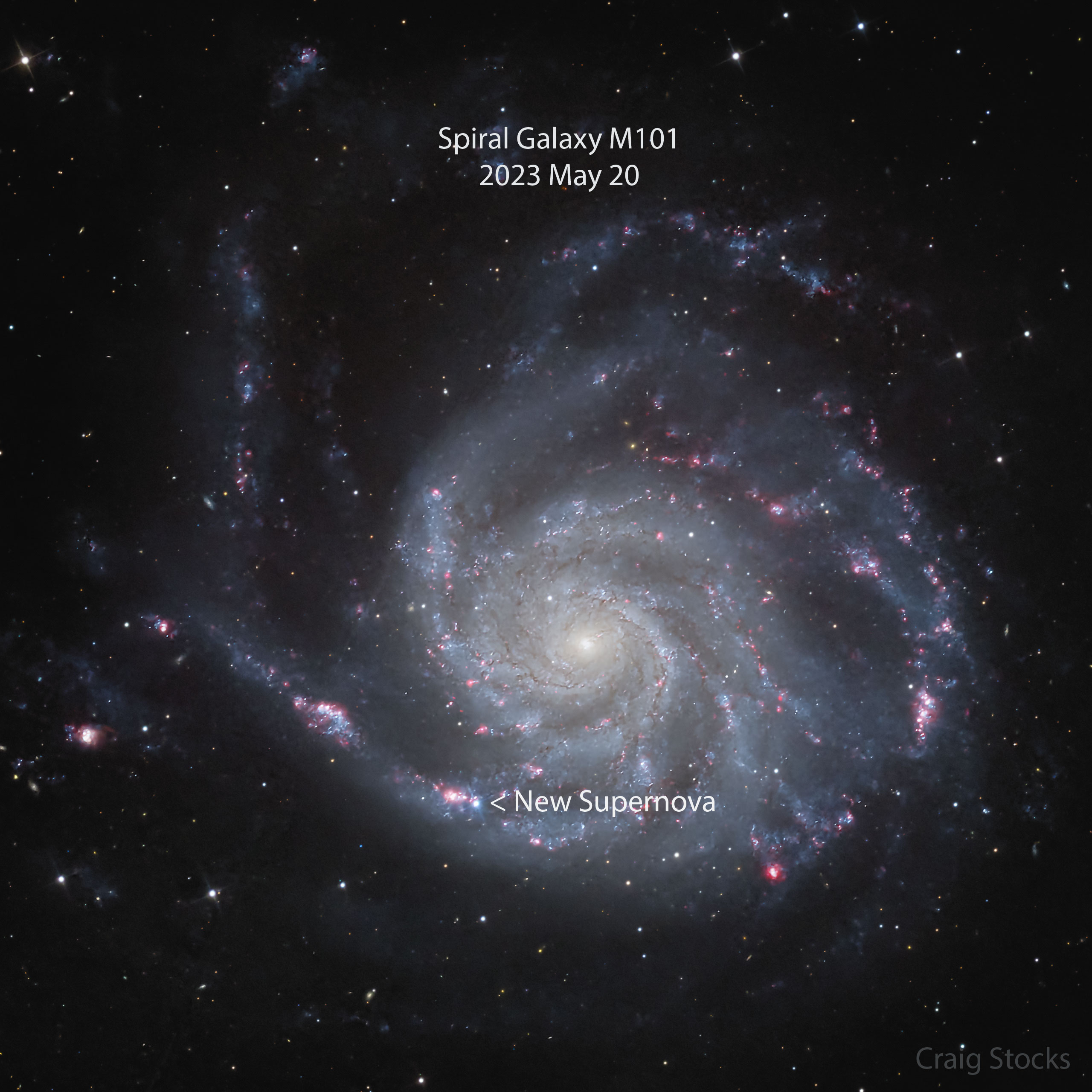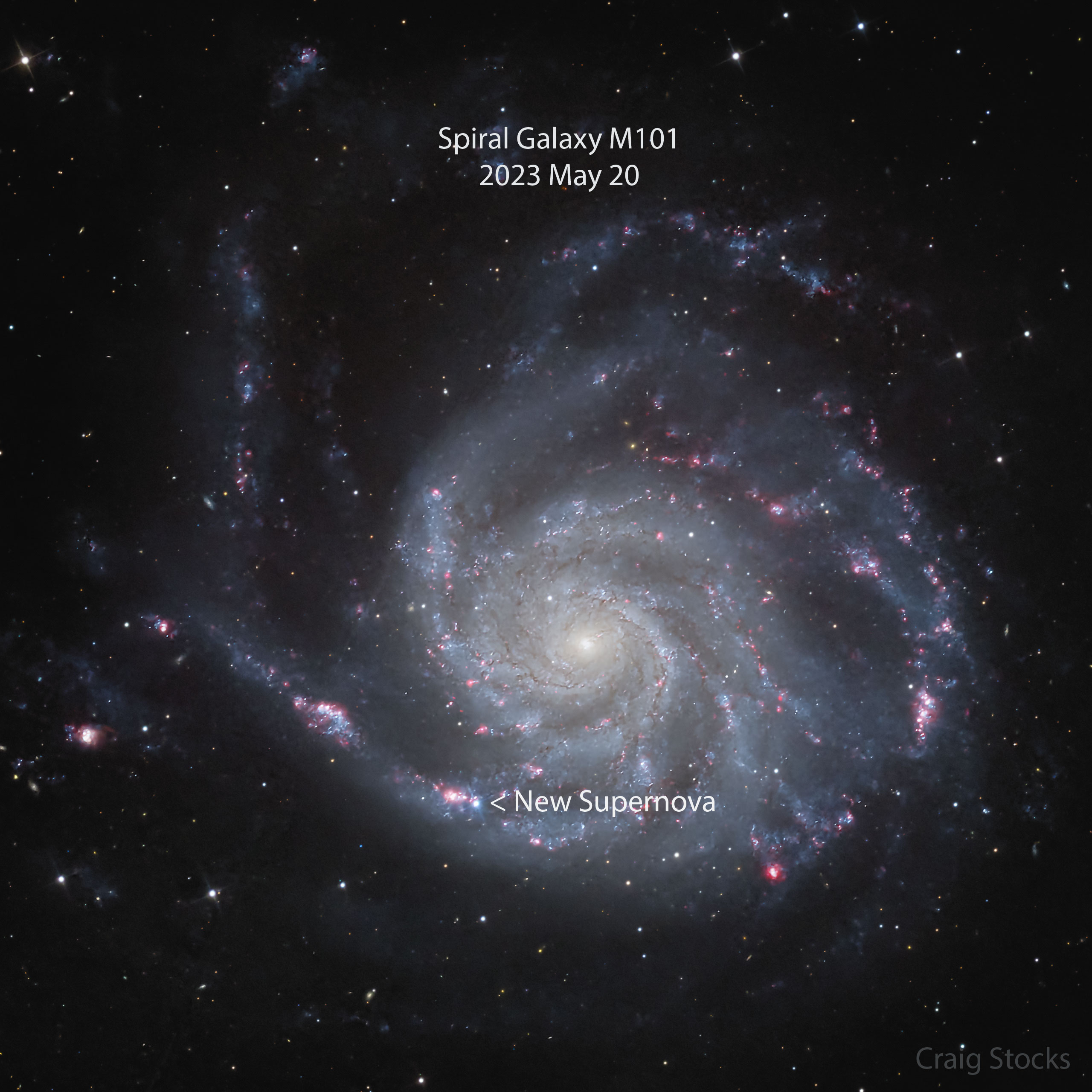
A nearby star has exploded and humanity's telescopes are turning to monitor it. The supernova, dubbed SN 2023ixf, was discovered by Japanese astronomer Koichi Itagaki three days ago and subsequently located on automated images from the Zwicky Transient Facility two days earlier. SN 2023ixf occurred in the photogenic Pinwheel Galaxy M101, which, being only about 21 million light years away, makes it the closest supernova seen in the past five years, the second closest in the past 10 years, and the second supernova found in M101 in the past 15 years. Rapid follow up observations already indicate that SN 2023ixf is a Type II supernova, an explosion that occurs after a massive star runs out of nuclear fuel and collapses. The featured image shows home spiral galaxy two days ago with the supernova highlighted, while the roll-over image shows the same galaxy a month before. SN 2023ixf will likely brighten and remain visible to telescopes for months. Studying such a close and young Type II supernova may yield new clues about massive stars and how they explode.
Una estrella cercana ha explotado y los telescopios de la humanidad se están orientando para monitorearla. La supernova, bautizada como SN 2023ixf, fue descubierta por el astrónomo japonés Koichi Itagaki hace tres días y posteriormente localizada en imágenes automatizadas del Zwicky Transient Facility dos días antes. SN 2023ixf ocurrió en la fotogénica Galaxia Pino M101, que, al estar a solo unos 21 millones de años luz de distancia, la convierte en la supernova más cercana observada en los últimos cinco años, la segunda más cercana en los últimos 10 años y la segunda supernova encontrada en M101 en los últimos 15 años. Observaciones de seguimiento rápidas ya indican que SN 2023ixf es una supernova del Tipo II, una explosión que ocurre después de que una estrella masiva se agote de combustible nuclear y colapse. La imagen destacada muestra la galaxia espiral en casa hace dos días con la supernova resaltada, mientras que la imagen al pasar el cursor muestra la misma galaxia un mes antes. SN 2023ixf probablemente se aclarará y permanecerá visible para los telescopios durante meses. Estudiar una supernova del Tipo II tan cercana y joven podría proporcionar nuevas pistas sobre las estrellas masivas y cómo explotan.