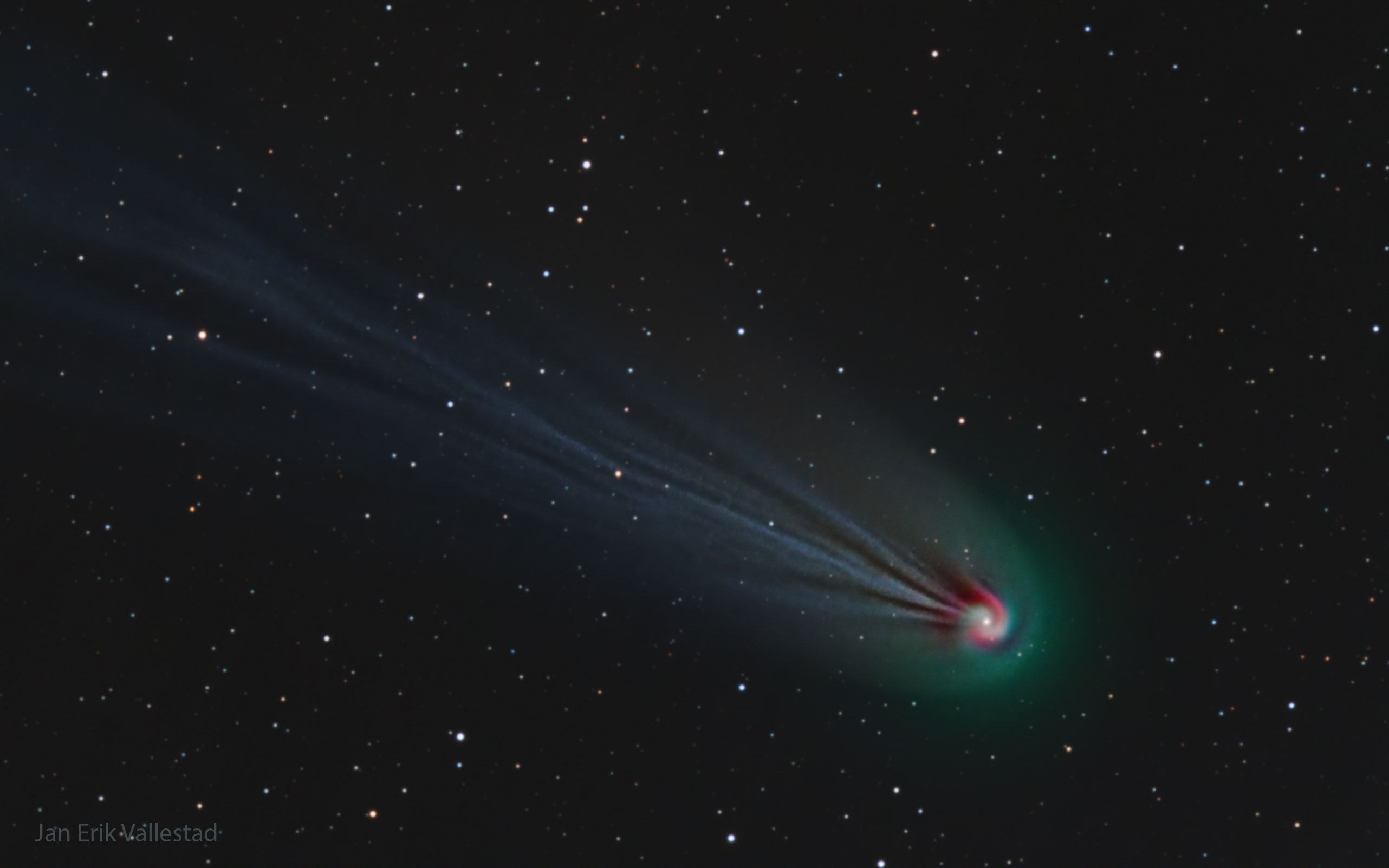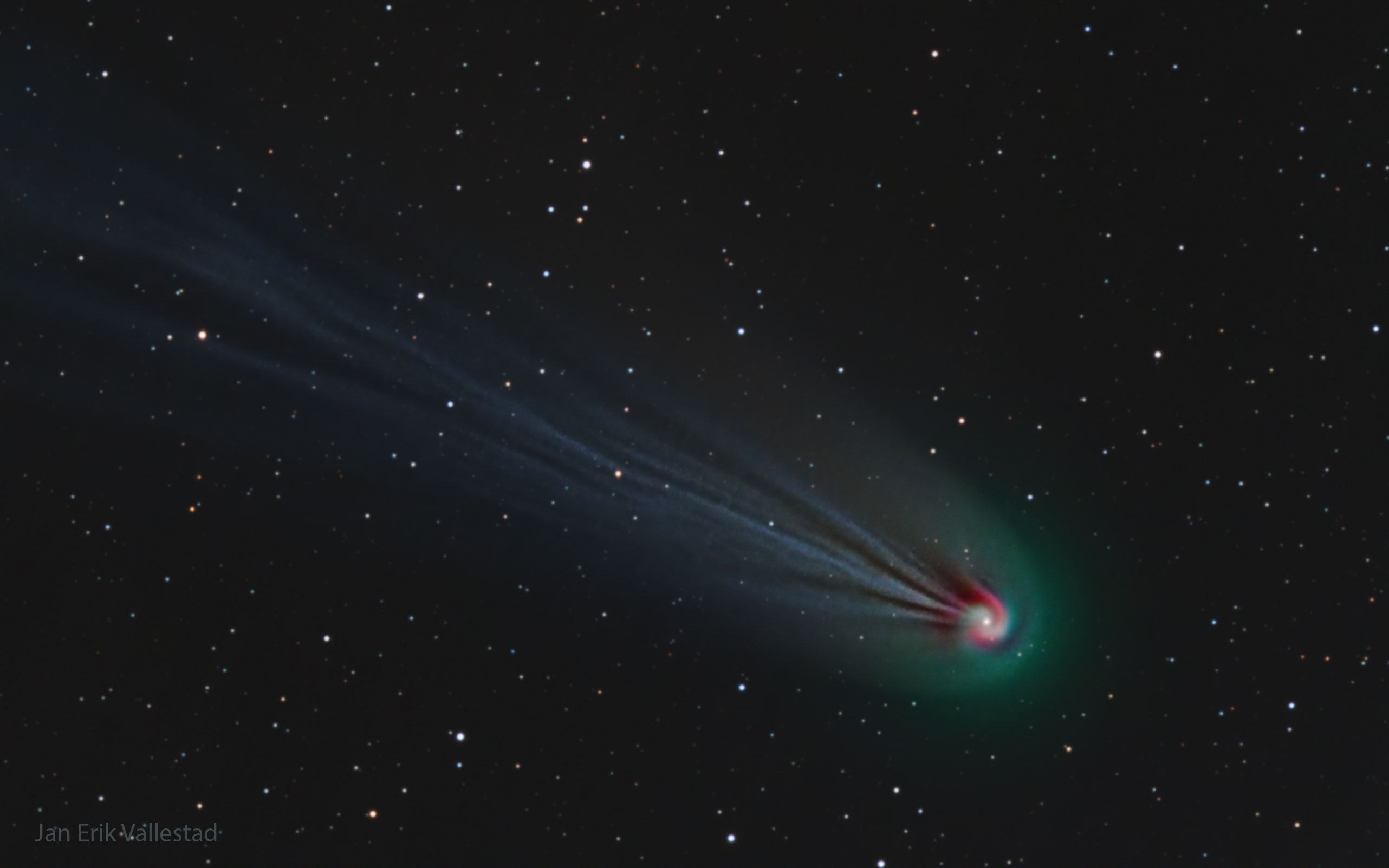
A bright comet will be visible during next month's total solar eclipse. This very unusual coincidence occurs because Comet 12P/Pons-Brooks's return to the inner Solar System places it by chance only 25 degrees away from the Sun during Earth's April 8 total solar eclipse. Currently the comet is just on the edge of visibility to the unaided eye, best visible with binoculars in the early evening sky toward the constellation of the Fish (Pisces). Comet Pons-Brooks, though, is putting on quite a show for deep camera images even now. The featured image is a composite of three very specific colors, showing the comet's ever-changing ion tail in light blue, its outer coma in green, and highlights some red-glowing gas around the coma in a spiral. The spiral is thought to be caused by gas being expelled by the slowly rotating nucleus of the giant iceberg comet. Although it is always difficult to predict the future brightness of comets, Comet Pons-Brook has been particularly prone to outbursts, making it even more difficult to predict how bright it will actually be as the Moon moves in front of the Sun on April 8. Total Eclipse Info: 2024 Total Solar Eclipse from NASA
Un cometa brillante será visible durante la próxima eclipse solar total. Este coincidencia muy inusual ocurre porque el regreso del cometa 12P/Pons-Brooks al Sistema Solar interior lo coloca, por casualidad, a solo 25 grados del Sol durante la eclipse solar total del 8 de abril en la Tierra. Actualmente, el cometa está justo en el límite de la visibilidad para el ojo no auxiliado, siendo mejor visible con binoculares en el cielo de la tarde temprana hacia la constelación de los Peces (Piscis). Sin embargo, el cometa Pons-Brooks está ofreciendo un espectáculo notable para imágenes con cámara de alta sensibilidad incluso ahora. La imagen destacada es una composición de tres colores muy específicos, mostrando la cola de iones del cometa en luz azul, su coma exterior en verde, y resaltando gas rojizo alrededor del coma en espiral. Se cree que la espiral es causada por gas expulsado por el núcleo del cometa, que gira lentamente. Aunque siempre es difícil predecir la brillo futura de los cometas, el cometa Pons-Brooks ha sido particularmente propenso a erupciones, lo que lo hace aún más difícil predecir cuán brillante será realmente cuando la Luna se mueva frente al Sol el 8 de abril.