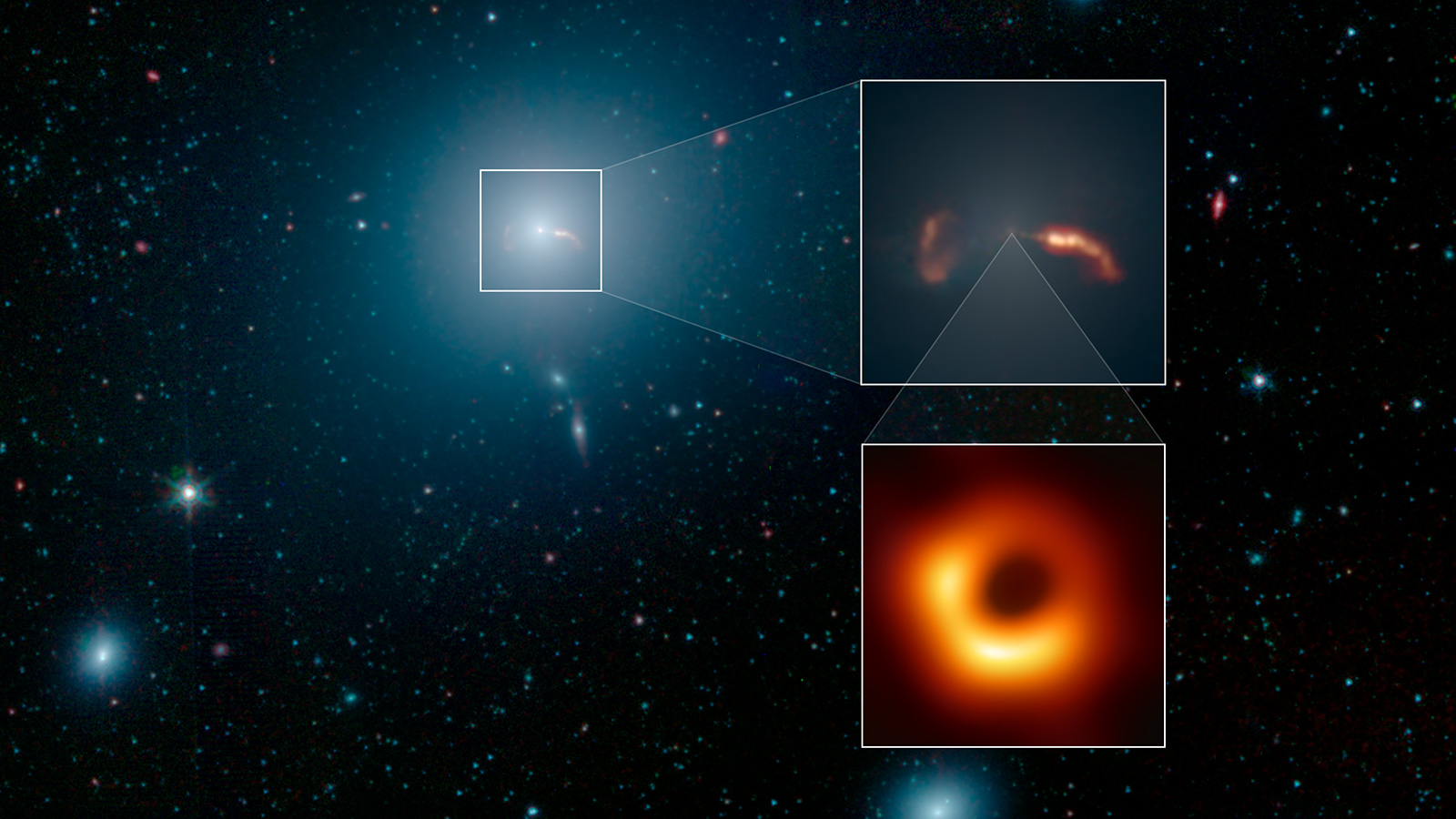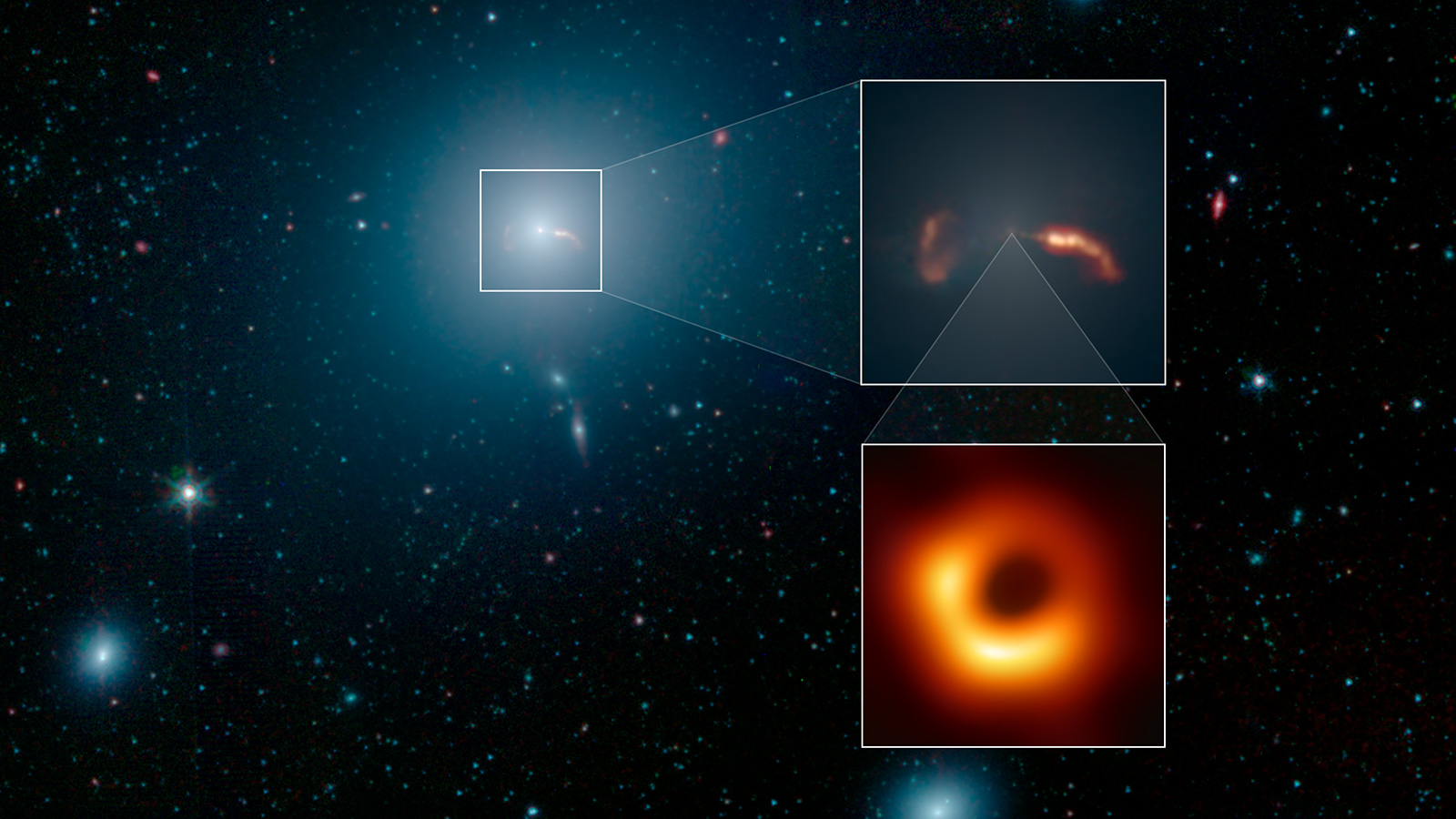
Bright elliptical galaxy Messier 87 (M87) is home to the supermassive black hole captured in 2017 by planet Earth's Event Horizon Telescope in the first ever image of a black hole. Giant of the Virgo galaxy cluster about 55 million light-years away, M87 is rendered in blue hues in this infrared image from the Spitzer Space telescope. Though M87 appears mostly featureless and cloud-like, the Spitzer image does record details of relativistic jets blasting from the galaxy's central region. Shown in the inset at top right, the jets themselves span thousands of light-years. The brighter jet seen on the right is approaching and close to our line of sight. Opposite, the shock created by the otherwise unseen receding jet lights up a fainter arc of material. Inset at bottom right, the historic black hole image is shown in context at the center of giant galaxy, between the relativistic jets. Completely unresolved in the Spitzer image, the supermassive black hole surrounded by infalling material is the source of enormous energy driving the relativistic jets from the center of active galaxy M87. The Event Horizon Telescope image of M87 has been enhanced to reveal a sharper view of the famous supermassive black hole. It's inescapable: Black Hole Week at NASA!
Crédito: NASA, Telescopio Espacial Spitzer La galaxia elíptica brillante Messier 87 (M87) es el hogar del agujero negro supermasivo capturado en 2017 por el Telescopio del Horizonte de Sucesos de la Tierra en la primera imagen jamás obtenida de un agujero negro. Gigante del cúmulo de galaxias de Virgo, a unos 55 millones de años luz de distancia, M87 se muestra en tonos azules en esta imagen en el infrarrojo obtenida por el telescopio espacial Spitzer. Aunque M87 parece en gran parte sin características y nuboso, la imagen de Spitzer sí registra detalles de los chorros relativistas que salen de la región central de la galaxia. Mostrados en el recuadro insertado en la parte superior derecha, los chorros mismos abarcan miles de años luz. El chorro más brillante que se ve a la derecha se acerca y está cerca de nuestra línea de visión. En el lado opuesto, el choque creado por el chorro que se aleja, de lo contrario invisible, ilumina un arco más tenue de material. En el recuadro insertado en la parte inferior derecha, se muestra la histórica imagen del agujero negro en contexto, en el centro de la gran galaxia, entre los chorros relativistas. Por completo no resuelto en la imagen de Spitzer, el agujero negro supermasivo rodeado por material que cae es la fuente de una enorme energía que impulsa los chorros relativistas desde el centro de la galaxia activa M87. La imagen del agujero negro de M87 obtenida por el Telescopio del Horizonte de Sucesos ha sido mejorada para revelar una visión más nítida del famoso agujero negro supermasivo.